
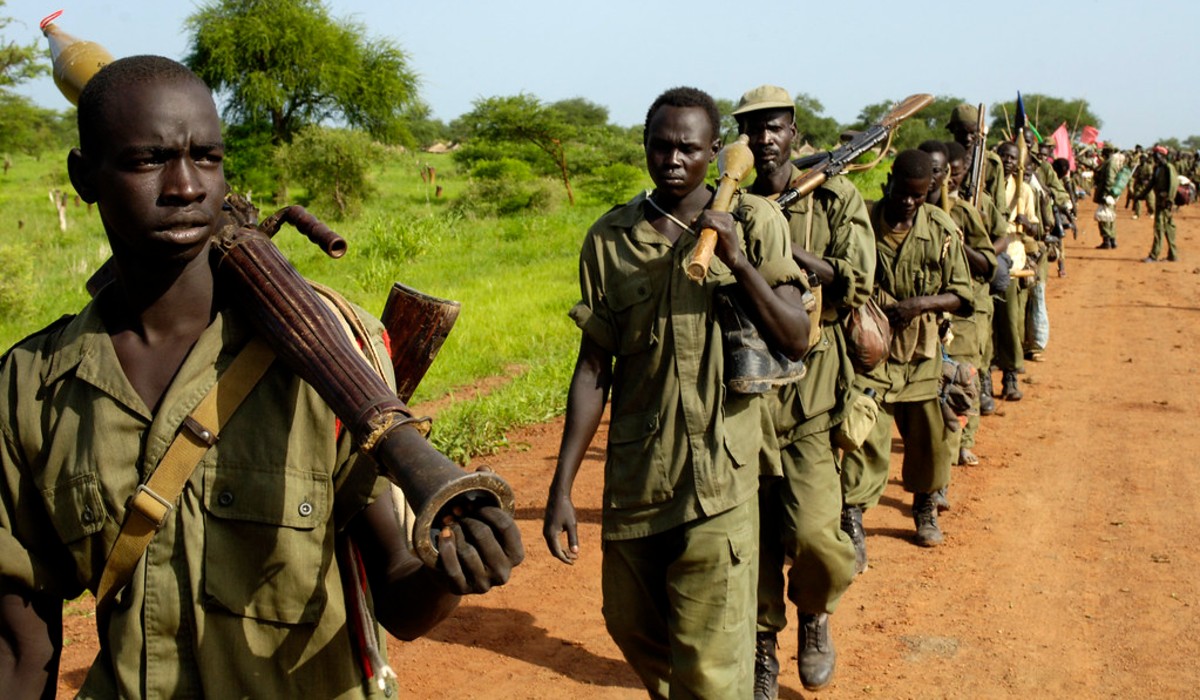
 Soliders of the Sudanese Armed Forces. Photo: UNMISS/Isaac Billy / Flickr / CC BY-NC-ND 2.0
Sudan has become a stage for imperialist interests to pursue their agendas, argues Steven McWilliam
In the previous two articles I covered the history and present of Sudan with a large focus on what was happening in Sudan and why certain actions likely went the way they did to lead to the current situation where the RSF (Rapid Support Forces) and the SAF (Sudanese Armed Forces) are committed to a bloody war which is causing mass death and displacement for millions of Sudanese civilians.
In this article I will look at the role of major global powers in Sudanese conflicts and the benefits they were able to gain but first I want to address why the multipolar discussion is important.
It’s clear that since World War II we have been living in a unipolar world where the US was absolutely the dominant power in terms of global trade and military might. In this period, they were able to cement the dollar as the global reserve currency through the Bretton Woods conference in 1944 where the US agreed to return to the gold standard in order to maintain a stable trading currency in the dollar. However pressure to handle inflation in the US and the prospect of a gold run meant that Nixon decided to repeal the gold standard in 1971 and convert the dollar back to a fiat currency.
This worked fine in a world where there is still a high level of trust in the US government’s ability to manage the money supply and protect the interests of global trade. However, with Donald Trump’s turn towards protectionism and the dismantling of many soft-power institutions, there is a growing concern that the dollar might not be the safest investment.
In order to hedge against any shocks to the dollar, investors and institutions have been investing in gold as a universal value store and this returns us to Sudan whose largest export is gold since South Sudan became independent in 2011.
Gold
The three-decade long dictatorship of Omar al-Bashir was under threat for most of its last decade. Part of the way he aimed to keep the fragile support from the army and militia was by allowing for a largely unregulated gold sector which became dominated by commanders and generals on both sides of the aisle. The SAF’s production comes from northern regions and leaves through Port Sudan for Egypt and the RSF controls production in the western regions of Darfur and Kordofan with much of the gold being smuggled into neighbouring countries such as Chad.
When al-Bashir was removed from power, Prime Minister Hamdok made attempts to expropriate and renationalise various parts of the gold sector through setting up the Empowerment Removal Committee to recover stolen assets and carry out macroeconomic reforms, such as exchange-rate unification, requiring state-owned enterprises, including companies linked to the military, to be subject to independent audits. However, the policy of Tamkeen (Arabic for empowerment) was too deeply entrenched for Hamdok to be successful in his aims. It’s also suggested this was part of the motivation for the 2021 coup against Hamdok’s civilian government.
After the outbreak of war, both the SAF and RSF looked to build their capacity for gold export in order to finance the war. For the SAF, this consisted mainly in exports to Egypt through Port Sudan authorities. Officially only around 1% of Sudan’s gold exports went to Egypt in 2024 but this number is likely far higher, with some estimates suggesting around 60% of SAF-controlled exports going through unofficial smuggling channels.
This desire to export to Egypt has a few causes. First, the SAF-aligned authorities in Port Sudan want to minimise the volume of gold being sent to the UAE, which it accuses of supporting the RSF. Furthermore, Egypt removed customs duties or tax on gold imports which when combined with a stronger market, made for a worthwhile risk in smuggling gold out of Sudan. However, despite the best efforts of the SAF, it seems that much of the gold exported to Egypt is then re-exported to the UAE.
Meanwhile, the RSF uses different routes to get gold to the UAE. For example, they have extensive connections with the Libyan Arab Armed Forces (LAAF) who help to facilitate smuggling of gold out of Sudan and into Libya before flying it to the UAE. Additionally, there is evidence of RSF smuggling though South Sudan. The South Sudanese government likely acquiesced to this as many of their oil pipelines go through Sudan and would likely be subject to sabotage if RSF leadership isn’t appeased.
The UAE is clearly a key beneficiary of Sudan’s gold sector but there are some other winners who benefit from the situation. One of those is the Russian private military company, Wagner group. Wagner Group has confirmed operations in Africa dating back to 2017 with operations in at least Sudan, Libya and Central African Republic.
What the Wagner Group does in Africa varies. It seems to be involved in training government and non-government forces alike, including at points both the SAF and RSF, as well as advising on disinformation campaigns to discredit protestors. It has also been involved more directly in conflicts in other African nations than it seemingly has in Sudan but it does provide security operatives that work in Sudan protecting gold mines and smuggling routes. The Wagner group, through its investment company ‘M-Invest’, is heavily involved in mines owned and operated by ‘Meroe Gold’. Both companies faced sanctions by the UK government for Wagner Group involvement.
The Wagner Group gives the Russian government a proxy through which it can pursue foreign policy and continue to extract resources from Africa without interference by Western sanctions. CNN reported seeing documents from a whistleblower at the Sudanese Central Bank which showed over 32 tonnes of gold was unaccounted for in 2021, which at the time was valued around $1.9 billion.
The IMF
The IMF is an imperialist attack dog that destroys countries’ productivity under the guise of economic relief. It doesn’t take long to find instances across Africa where their recommendations are followed by periods of instability and the removal of self-sufficiency.
For example, when they implemented their policies in Somalia, they dumped cheap imported grain into the markets, privatised the veterinary services and planted ‘high value added’ fruits for export . These changes resulted in the complete unravelling of the traditional pastoralist way of life that let Somalia be food self-sufficient, replacing it with a system where they are reliant on food aid instead.
In Sudan, we see a correlation between the implementation of IMF policy and the subsequent fall of both Nimeiry and al-Bashir. It has been argued that part of the reason this connection seems to exist is because the IMF requires public implementation so powerful leaders can more easily predict their expected future value under the new policy. If the outcome is poor, they are incentivised to perform a coup to protect their bottom line.
The IMF also looked to impose liberalisation on Sudan. This means deregulating industry, particularly in agriculture, to promote exports by removing trade barriers and obstacles to foreign investment while reducing the power of the government to regulate the economy. This opens economies up to privatisation and foreign ownership that can lead to situations reminiscent of the colonial period where food was exported from a country while the inhabitants starve.
The implementation of policy handed down by the IMF often benefits US interests disproportionately due to the undemocratic structure of the IMF where the largest donors have the most voting power. In the case of liberalisation, we see the UAE, allies of the US, benefit heavily as major importers of food with as much as 90% of stock being brought in from other countries. A lot of this livestock comes from Sudan and plays a key role in the continued financing of the war on both sides just like with gold.
Regional Stability and Control
Sudan also plays a part in the wider regional stability of the north of Africa and the Middle East. In 2020, Israel signed the Abraham Accords with the UAE and Bahrain. Shortly after this, Sudan signed a normalisation agreement. This is significant as it shows the US and Israel’s goals of wider regional normalisation as well as the US pivot towards using the Gulf states as regional watchdogs rather than rely entirely on the volatile state of Israel.
It’s likely that the ties between the UAE and Sudan’s diplomatic and military classes was the impetus behind Sudan’s agreement alongside the US removing Sudan from the state-sponsored terrorism list. Normalisation of this region will be particularly important due to the prevalence of the Red Sea and Suez Canal as a shipping route and we have seen that the Gulf states are willing to bankroll whatever is needed to achieve that goal. This is further evidenced by the RSF troops that were paid to fight the Houthis in Yemen.
In the build up to signing the normalisation agreement, the SAF was beginning to engage with Africom, the US outfit for operations in Africa, in 2017 when SAF commanders attended an Africom meeting. Officially becoming a combat outfit in 2007, Africom took over existing operations from the European command with a stated goal of combatting terrorism and piracy in the area. However, it is likely this force is there to protect US economic interests across Africa and provide forward operating bases for military incursions that benefit the US.
The attention of the US establishment in Sudan will also show more dynamics in the Middle East. With Trump making statements about being asked ‘to use the power and influence of the Presidency to bring an immediate halt to what is taking place in Sudan’ by the crown prince of Saudi Arabia, the US is put in a position to mediate between Saudi and the UAE.
The Saudis seem to be the likely candidate for rebuilding Gaza and so there will be a great amount of pressure piled onto any requests they make. At the same time, the UAE has built itself into an important strategic partner in the region. It has airports and military bases out of which it allows Africom to operate. The development of this situation will show where the White House’s priorities lie.
Another party interested in widespread regional stability is China which is invested in Sudan through the Belt and Road initiative. China has been a quiet collaborator with Sudan throughout the country’s post-colonial history. Through the policy of non-interference, they have been able to maintain trade relations throughout the Nimeiry and al-Bashir regimes where they benefitted from the discovery of oil and subsequently gold.
In the context of a shift towards multipolarity, the importance of the Belt and Road initiative cannot be understated. Much of the US ability to intervene militarily will come from naval strength in conjunction with allies in the region like Australia but if the Chinese are able to build up land-based trade routes, they will mitigate much of that risk. They also benefit from the investment by building up political and economic ties with the countries that join the BRI, placing them in a far stronger geopolitical position without the same stench of colonialism that investment from the West brings with it.
We are seeing unprecedented shifts in the global economic landscape and understanding the politics of resource exploitation in Africa will be key.
This is part of a series on Sudan; 1. Sudan’s History 2. Sudan’s Present 3. Multipolarity and Sudan 4. Sudan and Britain
Before you go
The ongoing genocide in Gaza, Starmer’s austerity and the danger of a resurgent far right demonstrate the urgent need for socialist organisation and ideas. Counterfire has been central to the Palestine revolt and we are committed to building mass, united movements of resistance. Become a member today and join the fightback.
