
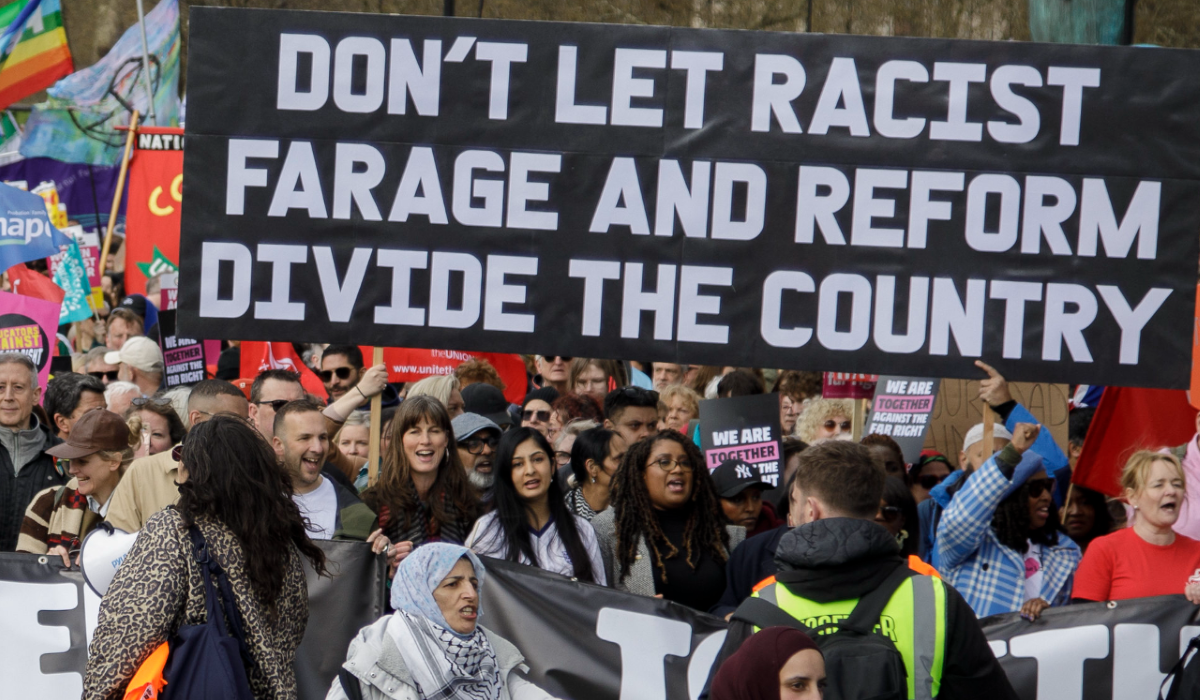
 Together Alliance’s inaugural national demonstration at Westminster, March 2026. Photo: Flickr/Steve Eason
Lindsey German on how mobilisation can help us beat the bigots and the generals
The nasty right-wing aspect of British politics has been on full display this week. There have been the vile race riots and pogroms which were orchestrated by fascists and the far right following a terrible attack on a man in Belfast by a refugee of Sudanese origin who had claimed asylum there. Then there has been the chorus of demands for more money on defence spending, following the resignation of John Healey as Defence Secretary.
At first sight, far-right street politics and establishment demands for more warfare at the expense of welfare might not seem connected, but they are. There is a close link between the ideas of nationalism, scapegoating of immigrants, flag waving and militarism, and those who seek to exploit the misery of so many working-class people by targeting ethnic minorities and blaming them for the failings of the system.
This took a particularly sinister turn in Belfast where houses were burnt out, ethnic minorities, including nurses, were targeted, roadblocks set up and buses set on fire. These pogroms were aimed at terrorising anyone who was black or Asian, and driving them out. To me it had echoes of 1969 when Catholics were burnt out of their homes. At the time I worked with a woman called Noreen who came in one day in tears because her nan’s house had gone up in flames. These were attacks by Loyalist mobs determined to maintain the discriminatory Orange state.
This time the riots were also in Loyalist areas – a fact little remarked on by the media. The close connection between the Loyalist paramilitaries and the British state and military is well documented. More generally the ideology of British nationalism and racism against Catholics is deeply entrenched. But if Belfast was the most horrific, there were also riots in Glasgow and Liverpool, and smaller right-wing demonstrations elsewhere.
The response of politicians was for the most part mealy-mouthed. Of course they condemn violence but can’t go too far in calling out the politics behind it because the major parties subscribe to one degree or another to the politics of scapegoating and discrimination. The increased repression against migrants and tightening of immigration laws, the calls by right-wing ethnic minority figures like Kemi Badenoch and Suella Braverman to scrap equality laws and provisions, the constant reiteration that the brutal attacks on migrants are the result of ‘legitimate concerns’, all feed a toxic atmosphere.
Add to this the drive to war and militarism at the top of society and we are in a dangerous place. The glorification of all things military, the constant reiteration that Russia is an imminent threat to Britain (even at the same time as claiming that Putin is losing in Ukraine), the docile media questioning of former generals who demand more money at the expense of other public services, has created the background to the resignation of Healey and armed forces minister Al Carns because Keir Starmer is supposedly not spending enough on defence.
This now worsens the already unstable situation at the top of the Labour government. Andy Burnham is favourite to win in Makerfield on Thursday. He has made nods towards a more left leaning political agenda – although he has already backtracked on some of this, for example compensation for the Waspi women. But this drive towards more defence spending will set the tone for a leadership contest over the summer. It may even see Healey or Carns (who seems to believe that 24 years in the Marines qualifies him to be prime minister) standing to provide a right-wing Labour alternative to Burnham. Another possibility of course is that Burnham will lose the by-election, in which case Reform and its ideas will be further strengthened, and Labour’s rightward course will continue.
You would not think from all the furore that Britain is one of the biggest arms spenders in the world, that its spending on nuclear weapons now surpasses that of Russia and is third largest worldwide after the US and China, and that – according to the remarks of a US general who commands Nato – Russia is not ‘looking for a conflict’ with Europe. The demands for more money on weapons comes from ex-military figures who are now consulting for or working for the arms industry.
None of them suggest paying these exorbitant sums from taxation on corporations or the rich. Far from it. The money has to come from pensioners, the sick and disabled, and working-class people generally, already struggling under a cost-of-living crisis. Meanwhile the military is given carte blanche to visit schools and universities, pushing the propaganda that while infrastructure crumbles, security comes from a drive to war. It is a disgrace that some unions are supporting more money for defence in the name of creating jobs – they are supporting cuts in their own members’ living standards.
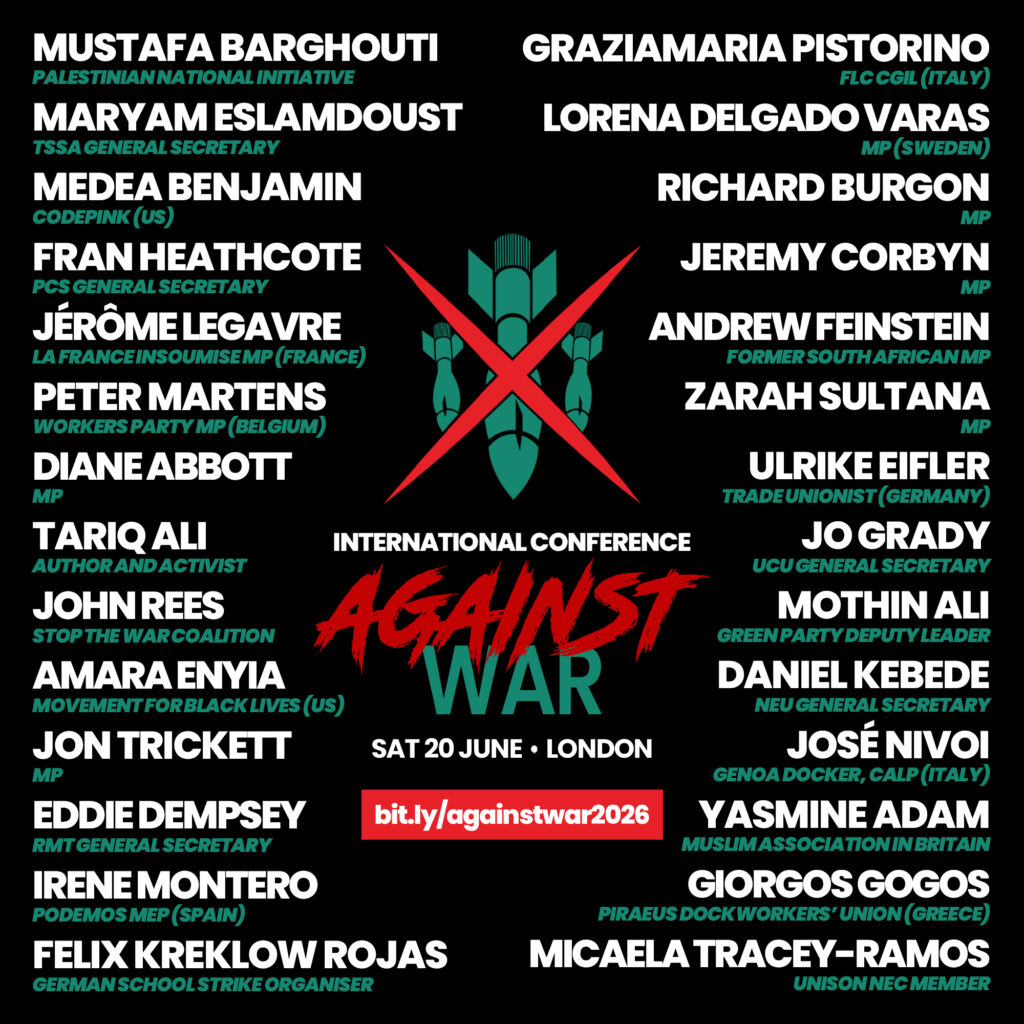
We have a major battle on our hands. The International Conference Against War has to be the start of a fightback across Europe – where governments are following similar policies – for wages not weapons, welfare not warfare. This means also fighting the racism which is inherent to these policies. And it means fighting state repression. The terrible sentences for the Filton 4, and the judge treating them as terrorists even though the jury did not find them guilty on those charges, are a chilling reminder of the state’s determination to stop protest at its policies. The decision on banning of Palestine Action is due on Monday. There must be a high likelihood in the present climate that the government wins its appeal.
But the fightback is there. At the weekend, a very large demo in Belfast and other sizeable protests across Britain showed the possibility of defeating the hard-right racist minority, and the revulsion of large numbers of people at what has been going on. The conference will bring together thousands for a new movement across Europe. And we have to link these to trade-union struggles to stop the ruling class from making us pay. We can do it, but now is the time to organise.
This week: I am working all week on building the conference, talking to speakers and helping organise. I think it will be a great day and look forward to seeing so many people coming together. In downtime I am rereading Sunset Song, the wonderful novel by Lewis Grassic Gibbon, and highly recommend. And I’m watching The Line on ITVX about the French resistance to German occupation, which came highly recommended to me.
Before you go
The ongoing genocide in Gaza, Starmer’s austerity and the danger of a resurgent far right demonstrate the urgent need for socialist organisation and ideas. Counterfire has been central to the Palestine revolt and we are committed to building mass, united movements of resistance. Become a member today and join the fightback.

Lindsey German
As national convenor of the Stop the War Coalition, Lindsey was a key organiser of the largest demonstration, and one of the largest mass movements, in British history.
Her books include ‘Material Girls: Women, Men and Work’, ‘Sex, Class and Socialism’, ‘A People’s History of London’ (with John Rees) and ‘How a Century of War Changed the Lives of Women’.