
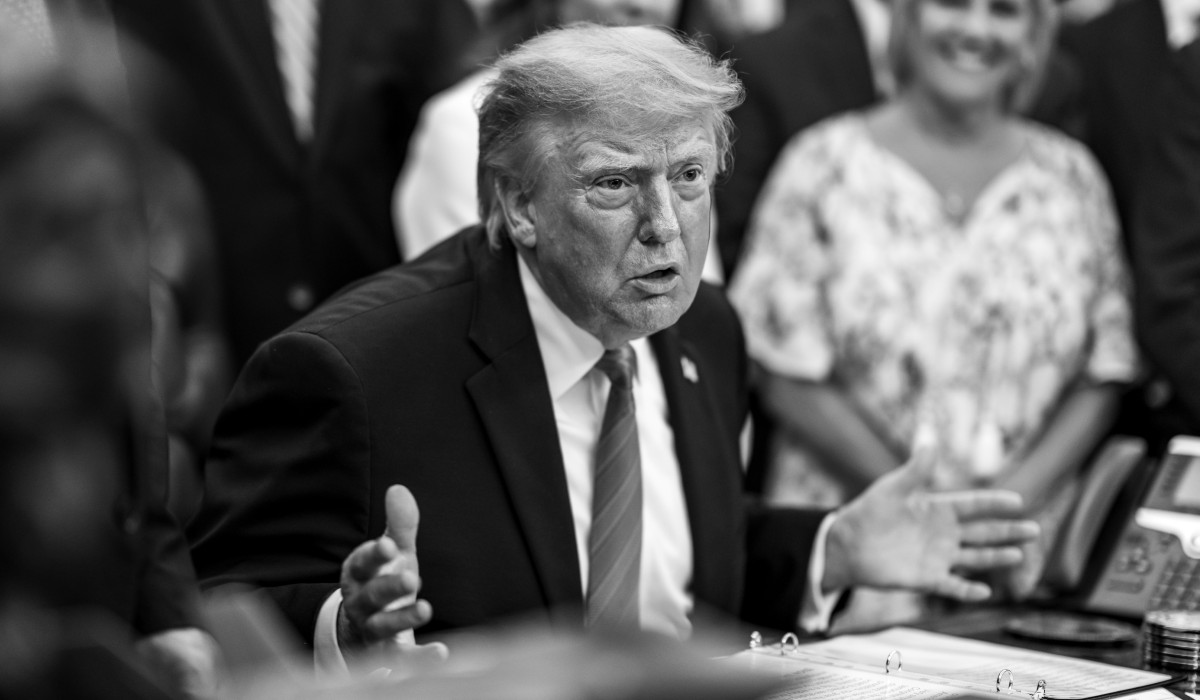
 Donald Trump. Photo: The White House / Public Domain
Chris Bambery analyses the agreement between Trump and Iran bringing an end to the war…for now
The important thing to understand about the memorandum of agreement reached between Iran and the United States is that this is not a peace deal, its an agreement which opens the way for further talks about a peace deal covering issues like Iran’s nuclear programme.
Both sides are not releasing details but my understanding is that four points have been agreed:
- There must be a complete end to all fighting, including Israel’s war in Lebanon.
- The immediate opening of the Straits of Hormuz.
- The US will pay Iran $24 billion of the $100 to $120 billion of Iranian assets frozen the the US.
- Washington will lift those sanctions stopping Iran selling its oil on the world market.
If that’s even half right it represents a considerable success for Tehran.
Why would Donald Trump back down from initial claims when this war started that he was going to bring regime change to Iran and so on?
The first thing is, as The Economist, notes:
“Iran has damaged a surprising amount of American kit.”
It adds:
“Losses would be much higher in a war with China.”
Iran hit US bases in the Gulf and, crucially, radar sites crucial to a US air war against it, aircraft and US economic assets such as an Amazon data centre.
Of course, the US and Israel inflicted terrible damage on Iran but they could not destroy its nuclear facilities or Iran’s arsenal of missiles and drones – all buried deep underground.
Secondly, despite Trump issuing threat after threat it was very difficult to see the US escalating matters. They could have resumed air strikes but they hadn’t in a month of bombing reduced Iran’s military capabilities. Boots on the ground were ruled out because the war was so unpopular domestically and threats to seize Kharg Island or Iran’s stocks of enriched uranium were just baloney. The US blockade of the Straits of Hormuz was fairly ineffective because US warships had to stay so far away so as to be safe from Iranian missile strikes.
In contrast, Iran could escalate by hitting US targets in Kuwait, Bahrain and Jordan or by blocking, in concert with the Houthis, the crucial Bab-el-Mandeb linking the Red Sea (and thus the Suez Canal) to the Indian Ocean. That would have driven the world economy off the precipice.
Third, Trump was under intense pressure from multinational capital finance – Saudi Arabia and the Gulf States and virtually every state in the world – fearful of the impact of the Straits of Hormuz on the global and their domestic economies.
Lastly, Trump faces mid-term elections in November and the closing of the Straits of Hormuz was hitting the US economy and thus impacting the polls. Before this war we were told America was self-reliant in oil. But it turned out it’s self-reliant in light crude oil but not heavy crude. Most of that came from the Gulf. It has also been hit by the lack of fertiliser which has angered US farmers and agricultural big business.
To put a long story short, Trump had nowhere else to go but to reach an agreement to end this war.
Of course, the fly in the ointment here is Israel.
The prime minister of Pakistan, who has been acting as a mediator, said after the deal had been announced that “both sides have declared the immediate and permanent termination of military operations on all fronts, including in Lebanon”.
But Israeli Defence Minister Israel Katz said the country will not withdraw from land seized in Lebanon as the interim deal is pending. Katz said Israel plans to stay “indefinitely” in lands it holds in Lebanon, as well as Syria and the Gaza Strip.
Katz also threatened that if Iran attacks Israel, Israel will strike Iran with “great force”. On Sunday, hours before the US and Iran agreed on the deal, Israel launched strikes on Beirut targeting Hezbollah.
Trump criticised this after both the US and Iran warned against attacking Beirut directly while the peace talks were ongoing.
There is an American-brokered ceasefire between Israel and the Lebanese government. But the latter has no leverage and the Lebanese army has done nothing to defend Lebanese sovereignty, that was done by Hezbollah.
But within Israel, where there is an election campaign underway, the opposition is attacking Benjamin Netanyahu for initially agreeing to Trump’s angry demand that he stops bombing Beirut, saying he has surrendered Israel’s military policy into American hands.
The problem is that for decades Netanyahu has built a career based on the crucial need to destroy Iran – not to change regime but literally destroy it, as has been done in Libya, Syria and Somalia – claiming it represents an existential threat to Israel. But to do that he needed US power.
Back in February, he and the head of Mossad, David Barnea, were able to convince Trump that sustained air strikes could bring down the Islamic Republic in days if not hours. This was over the objections of the American military, naval and air force leaderships backed by the intelligence community.
But that did not happen and now Trump has reached this memorandum of agreement with Iran by freezing Israel out of the talks.
Now Netanyahu faces the reality that his decades-long pledge to destroy Iran has not happened and America is highly unlikely to go there again. In other words he has failed in his life task. Not good for his re-election hopes.
The mass of Israelis support the war with Iran and Hezbollah but there is the beginning of a growing realisation that Trump may not stand idly by while Israel endangers the ceasefire by continuing its war in Lebanon. There are level-headed minds in Israel who grasp that Israel is dependent on the US financially and militarily and without that it becomes a very vulnerable state in a dangerous region.
All of this is not good news for Israel.
A lasting peace?
The memorandum of agreement lasts 60 days and in that time negotiations over a lasting peace deal are due to commence. I find it unlikely these are going to end in agreement.
The US is prioritising Iran’s nuclear programme and its stock of enriched uranium. But that is the last item on Iran’s list of things to be discussed. It does not trust Trump and the US because twice, in June last year and February of this, they bombed Iran while negotiations are underway.
Trump seems to think he can get a deal on the nuclear programme in days or weeks but the 2015 Joint Comprehensive Plan of Action (JCPOA) agreed between Iran, the US, the Europeans, China and Russia took months of complicated discussion. I don’t see that being any different this time.
Trump ripped up the JCPOA – I bet he wishes he hadn’t. Under it, international nuclear inspectors could inspect all Iran’s nuclear facilities. That ended when Trump reneged on the deal.
More importantly, Iran has a number of issues it wants resolved first so as to rebuild a degree of trust. These would include the ending of sanctions, reparations and the release of all of Iran’s frozen assets. The potential sticking points in all that are enormous.
But Iran knows a couple of things. Trump is not going to re-start the war and secondly Israel cannot defeat it on its own. For Trump this is a humiliation but he is not going to blame himself. Most likely he will blame Netanyahu for leading him up the garden path.
Before you go
The ongoing genocide in Gaza, Starmer’s austerity and the danger of a resurgent far right demonstrate the urgent need for socialist organisation and ideas. Counterfire has been central to the Palestine revolt and we are committed to building mass, united movements of resistance. Become a member today and join the fightback.

Chris Bambery
Chris Bambery is an author, political activist and commentator, and a supporter of Rise, the radical left wing coalition in Scotland. His books include A People's History of Scotland and The Second World War: A Marxist Analysis.