
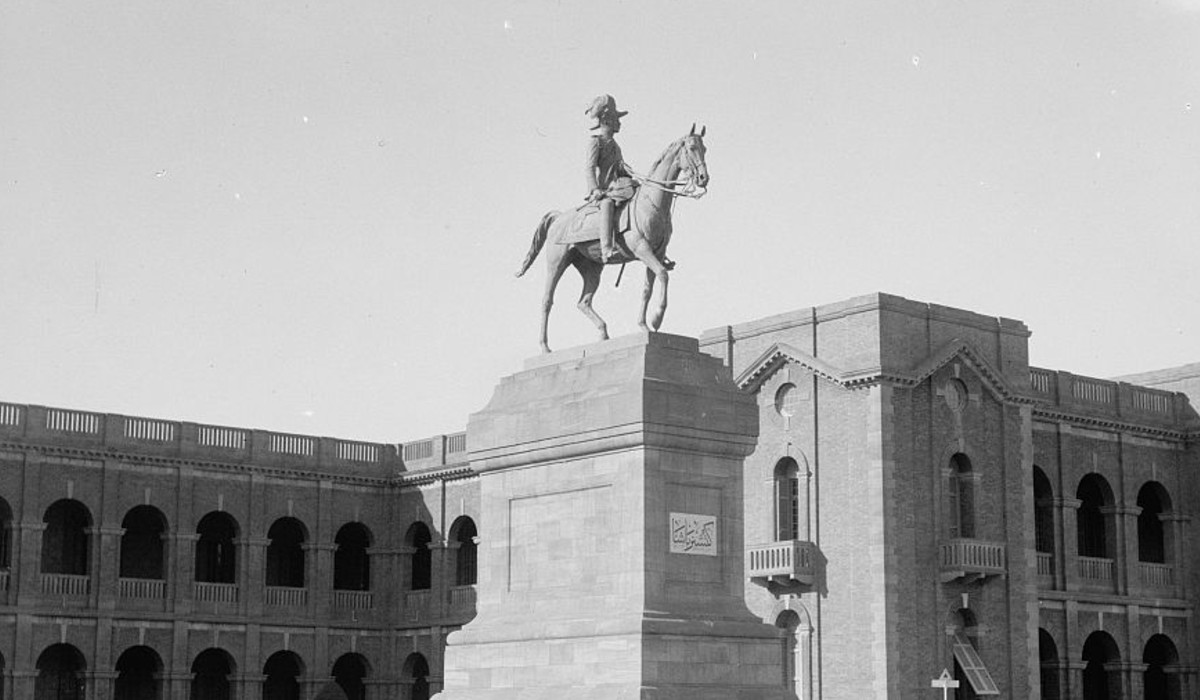
 Statue of Kitchner in Khartoum. Photo: Matson Photo Service, Library of Congress. No known Copyright restrictions
To understand the current war, we must understand the post-colonial history of Sudan, argues Steven McWilliam
Sudan has been in an acute crisis since fighting between the Sudanese Armed Forces (SAF) and the Rapid Support Forces (RSF) broke out in April 2023. Since then, the humanitarian crisis has only grown until the flash point of the fall of El Fasher in late October of 2025. The images and reports coming out of El Fasher are horrifying.
Understanding the crises that Sudan has suffered for decades requires a reckoning with the damages wrought by British colonialism. The nature of the post-colonial ruling class is rooted in the structure of colonial rule. In the first instance, while the bulk of the colonial population are considered no more than labour unit, a small group are in a position to accumulate capital as urban artisans or nomadic traders. This group are the embryo of a national bourgeoisie.
As time passes and the colony becomes profitable, the colonial population will shift from exclusively being a resource for exploitation towards becoming a market in and of themselves.
What the factory-owners and finance magnates of the mother country expects from their governments is not that it should decimate the colonial peoples, but that it should safeguard with the help of economic conventions their own “legitimate interests”.[1]
Sudan’s colonisation
The original value of colonising Sudan was the land and labour force. The British administrators opted to have cotton planted as another source to fuel the textile industry in Britain.
This shifting economic power is often matched by a rising fear in the settler population of an ‘atmosphere of violence’ which will often lead to further reactionary measures being implemented such as increased police presence and the arrest of nationalist leaders such as was seen with Jomo Kenyatta who was imprisoned in Kenya for seven years before becoming president or Nelson Mandela with a similar story. However, in Sudan, this didn’t seem to be the case.
The British government started preparing Sudan for self-governance before any serious rebellions were launched, unlike nearby Kenya. There are a few possible reasons for this difference. Firstly, the number of white settlers in Sudan was far lower than in Kenya and South Africa so the idea of transition was not as much of an existential threat as it was in those other places. Additionally, the Sudanese nationalist movement would have been inspired and emboldened by the Egyptian revolution of 1952 which ousted King Farouk as well as limited British influence in the new republic of Egypt. This new Egyptian government used its pressure to force Britain into allowing Sudanese independence. Lastly, the colony in Kenya was largely held for the agricultural value of the land itself, whereas control in Sudan was more focused on the strategic benefits such as access to the Nile river.
Returning to the embryonic nationalist bourgeoisie in Sudan, many of the Arab tribes of the northern region operated as nomadic traders which gave them the advantage in establishing themselves over the generally more stationary African-descended tribes that were prevalent in the south. This meant that Arab-identifying peoples were more directly economically linked with the settlers, which in turn meant that they were the ones trained by the British in governance ahead of the transition leading to the formation of the first government consisting almost exclusively of Arab-descended northerners.
Fanon notes a key difference between the bourgeoisie of the motherland and the colony which is that the motherland has a strong and established bourgeoisie that has deep capital, as well as entrenched systems of protection in a legal and economic sense, whereas the newly formed nationalist bourgeoisie does not have such a secure position. The nationalist bourgeoisie will therefore replicate the colonial power structures and tools in order to maintain and grow their own power at the expense of the rest of the population. They will often find themselves still trapped within the influence of the colonial government that was ousted, making the country still economically dependent and linked to the previous occupation. The fragility of the post-colonial ruling class also, in Sudan, made it vulnerable to pressures coming from other outside forces, besides the original imperial power.
Many newly formed governments will accept military aid and training from their ex-colonisers, as was the case with Sudan, whose military was initially supplied and trained by the British, which was the case until Sudan cut off ties in 1967 over British involvement in the Arab-Israeli Six-Day War. This relationship gives the prior colonisers a tremendous amount of control while risking very little, as they have a two-fold grip on both the military through advisors as well as the national bourgeoisie through trade agreements.
Coups and civil war
Returning to our newly formed, mostly northern government, southerners were immediately understandably unhappy with the situation and began the first civil war which was fought until the Addis Ababa Agreement was signed in 1972.
During this time, the government faced turmoil and coups. In 1958, just three years after its establishment, there was a bloodless self-coup performed by prime minister Ismail al-Azhari in association with Chief of Staff, Major General Ibrahim Abboud who took over the top position. This was likely in part due to continued economic pressures being faced by the Sudanese people as well as concerns that al-Azhari’s party would not be re-elected and therefore his personal businesses would be damaged.
Unfortunately for the people of Sudan, Abboud was not able or interested in returning to a civilian government nor was he able to solve the material conditions that lead to people’s concerns and was also ousted after only a few years in 1964. A series of governments failed to form or make meaningful change in the years following this which opened the door in 1969 for the first multi-decade dictator, Col. Gaafar Nimeiry, who led a coup against the civilian government to reintroduce military rule.
Nimeiry arguably got off to a good start as he secured the Addis Ababa Agreement in 1972 which led to the first civil war coming to an end and the country enjoying around a decade of peace. However this was not to last as, in 1983, Nimeiry attempted to introduce sharia law known as the September laws. This was likely to bolster ties with the Sudanese Muslim Brotherhood in order to have a more secure position in government after various failed coup attempts by opposition forces. Some have also attributed it to Nimeiry’s personal turn towards the Abu Qurun Sufi order.
Either way, this led to the resurrection of the civil war and the formation of the Sudan People’s Liberation Army who were the main opposition combatants at the beginning of the war, largely based in the southern regions. This, combined with a series of severe droughts in 1984/5 and the implementation of IMF policy in 1985, triggered mass demonstrations leading to Nimeiry being overthrown and fleeing to Egypt. A transitionary military council was formed that passed power to an ineffectual coalition government with Sadiq al Mahdi at its head; however these governments were unable to counter factionalism and corruption nor were they effective in creating policy that would end the war with the south, replace the sharia penal codes or reach an agreement with the IMF. It’s worth noting at this point that Sudan had discovered its first oil fields which brought renewed attention from global powers such as China who became one of the largest recipients of Sudanese oil.
Internal power struggles
The discontent with the coalition government was capitalised on by Omar al-Bashir and his military junta who took power in 1989. Over the next decade, they would be accused of favouring the capital and northern regions of Sudan at the expense of the western and southern regions which had a lower Arab population.
This discontent began to solidify in the early 2000s leading to the formation of two groups; the Sudan Liberation Movement/Army (SLM/A) and the Justice and Equality Movement (JEM). Part of the impetus behind the new groups was the release of a manuscript known as The Black Book which detailed the various ways that the north had an outsized political influence holding a little under 80% of positions despite making up under 5% of the population.
These groups were able to present a challenge to the government due to being supplied by other African countries, such as Eritrea, Libya and Chad. At first sight, it may seem strange that Libya under the rule of Gaddafi would funnel support towards militant groups who were opposing an Arab-Islamic government in Sudan. However, there were a few reasons for this. The first is that the fighting allowed Gaddafi to position himself as mediator in the region. The second was that by supporting and growing an external military force, that force could be used to quell and repress discontent in Libya without direct action being taken by the government. This marks the first example in Sudan of military forces being built up by external players so they could reap the rewards later.
Eritrea was happy to arm these groups at this point as well due to tense diplomatic relations with Sudan since its independence. Eritrea had accused Sudan of supporting jihadists attacking the Eritrean government, while Sudan returning the accusation that they were supporting the SLM/A.
By 2002, the government was concerned about rising forces in the Darfur region, while the second Sudanese civil war in the south was coming up to its second decade. Al-Bashir had witnessed and participated in coup d’états and wanted to avoid becoming the victim of such himself, so the question became, how to increase military power while avoiding the risk of it turning against its own regime. The answer was to allow the militia that has formed in the north to grow without impediment and even to assist its growth with weapons.
This was the introduction of the Janjaweed (eventually the RSF) into history. The Janjaweed is sometimes translated as ‘devils on horseback’, which if you were a peasant farmer in the late 80s and 90s was a very apt description as they were known for raiding villages on horseback. They had ideological roots in pan-Arabism and were seemingly trained by the Gaddafi government at their inception.
By allowing a semi-autonomous militia outside of the government’s armed forces, al-Bashir gained various benefits. Firstly, it presented a counterweight to the military with the hope being that any coup would require appeasing both the SAF and RSF high command who might have different and possibly conflicting priorities. Secondly, it provided additional military power which was needed given how stretched the government forces were dealing with the civil war in the south and the Eritrean supported attacks in the east.
War crimes
Finally, the militia provided a level of disconnect from the war crimes that were committed during the genocide in 2003-2005. While it seems fairly clear that most attacks during the acute genocidal period were carried out as joint operations with the regular army, having a force external to it allowed the government to deflect blame for the worst of the actions.
And the worst actions, they performed. During the acute phase of genocide in 2003-2005, an estimated 300,000 people died from violence, disease and famine. Sexual violence was prolific. Displacement was rampant. Food was scarce. It is also worth keeping in mind that much of the violence was targeted against the Fur, Zaghawa, and Masalit ethnic groups who are largely non-Arab.
By 2005, pressure from the international community led to the signing of the Comprehensive Peace Agreement, leading to a ceasefire in the south. Provisions included a guaranteed vote for independence after a six-year probationary period as well as revenue-sharing agreements, the introduction of job ratios for the north and south and the removal of Islamic law in the south.
This was a positive move for the South Sudanese who wanted autonomy, however it did little to stop the fighting in Darfur which continued with ebbs and flows. The government support for the Janjaweed allowed the latter to grow still more powerful.
In 2011, South Sudan voted overwhelmingly for independence and became the youngest nation in Africa. In 2013, the RSF was officially formed, following a restructuring and reactivation of Janjaweed militias in order to combat rebel groups in the Darfur region. It was immediately deployed in Darfur, where it would attack villages with the support of the SAF.
RSF troops were also heavily deployed in Yemen in order to combat the Houthis in 2016-2017. This was bankrolled by the UAE and Saudi Arabia. Reportedly, Hemedti, the head of the RSF, made billions off of this by taking payment in dollars and using black-market rates to convert it to Sudanese pounds to pay troops while pocketing the difference. This was a fruitful relationship for the RSF both monetarily but also in terms of training and experience with battle hardened veterans coming back to Sudan with increased funding.
This brings us up to 2018 where the protests began to break out in the north of the country, eventually leading to the removal of al-Bashir. This recent history will be discussed in next article.
[1] Franz Fanon, The Wretched of the Earth (1961, London: Penguin 1965)p..51.
This is part of a series on Sudan; 1. Sudan’s History 2. Sudan’s Present 3. Multipolarity and Sudan 4. Sudan and Britain
