
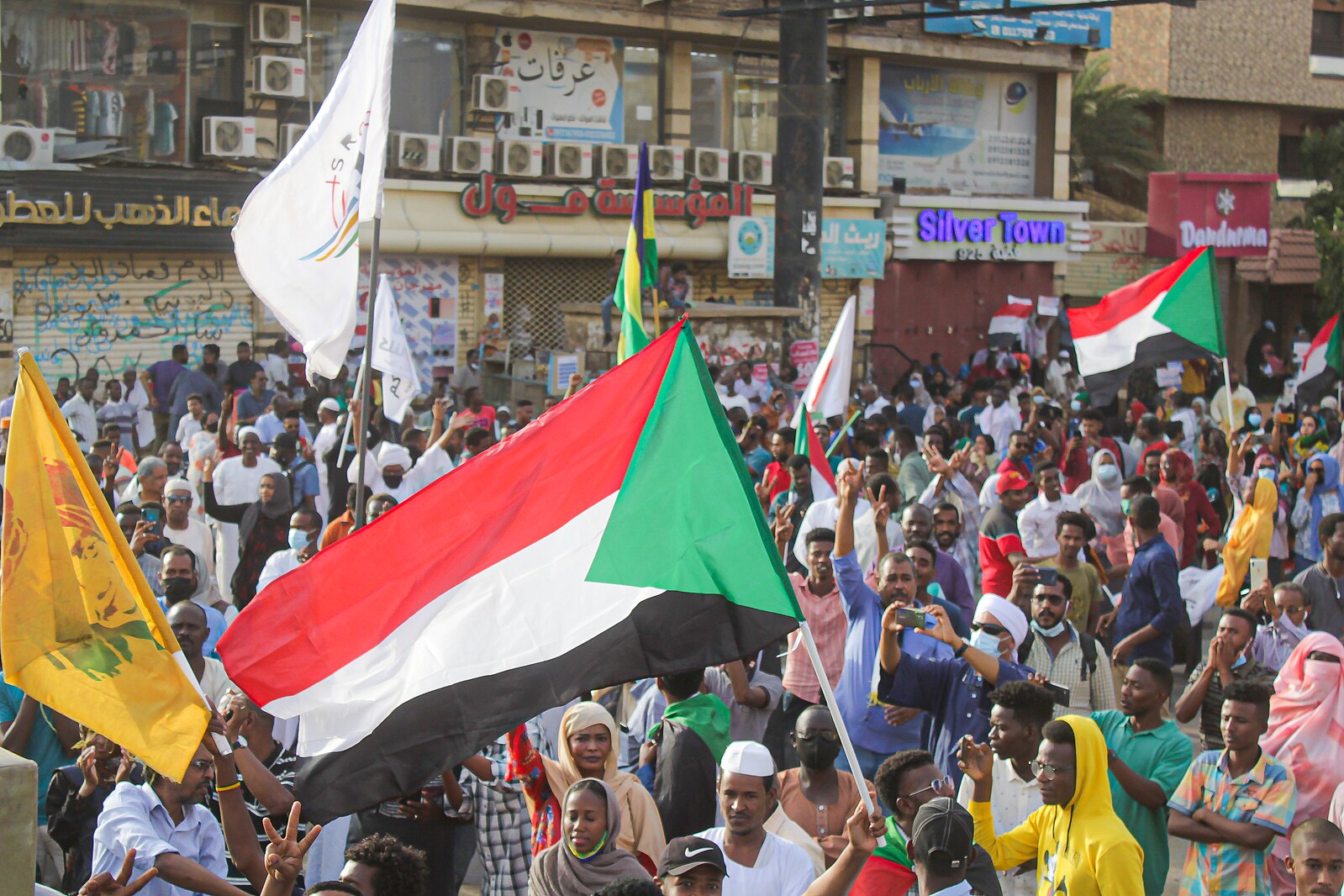
The ongoing humanitarian crisis in Sudan follows popular struggles against the military factions and their rivalries, explains Steven McWilliam
In 2018, Sudan was nearing three decades of dictatorship under Omar al-Bashir. South Sudan had gained independence seven years before. There was growing discontent around the country as living standards were not improving and the cost of living was increasing.
There were two major military forces in the country in the form of the Sudanese Armed Forces (SAF) and the Rapid Support Forces (RSF) which were both part of the state apparatus but were not integrated despite calls for this to happen. Some argued that letting the RSF grow was a tactical decision by al-Bashir to provide a counterweight to the army with the hope that it would make a coup d’etat against him less likely to succeed. Things were not looking good, and it would take very little to instigate a large movement against al-Bashir.
Mass protests topple al-Bashir
Therefore, when a series of mass protests broke out in December 2018, al-Bashir must have been worried. The protests started in Atbara, north of the capital, Khartoum, after bread prices tripled overnight, in part due to recommendations from the International Monetary Fund. These protests spread across the country and, in April 2019, al-Bashir was removed from office. His hope that a large enough militia would provide a counterweight to the army and prevent further coups was shown to be false.
An interesting tactic of the protestors was the sit-in. On April 6, 2019, which was the anniversary of the non-violent revolution that led to Nimeiry’s overthrow in 1985, thousands of people converged outside the military headquarters in Khartoum, staging a sit-in that would become the hub of the protest movement’s struggle for democracy.
On 3 June, 2019, negotiations over who should lead the election came to a halt leading to another sit-in. However the Transitional Military Council (TMC) declared the sit-in a national security risk and it was violently dispersed. Many people were shot and beaten as well as many of their tents being burned down. The TMC were quick to try to disable internet connections to the outside world to prevent the news of the massacre spreading, but as the Sudanese diaspora learned what had happened, they began posting blue images in solidarity with the dead protesters. After this, Prime Minister Hamdok was sworn in to lead the Transitional Sovereignty Council (TSC). Hamdok had the goal of holding full democratic elections in 2022.
Abraham accords and war in Tigray
Aside from the Covid pandemic, there were a few other important events in 2020. Firstly, in September, Israel signed the Abraham Accords with the UAE and Bahrain. This was a significant shift in regional politics with a goal of laying groundwork for wider regional normalisation with the genocidal state of Israel. Quickly following suit was Sudan’s TSC which signed a normalisation treaty in October. This was likely because the US agreed to remove Sudan from its state-sponsored terrorist list as well as to give relief from other economic and political sanctions.
The second was the breakout of war in Tigray. While neither the SAF nor the RSF were primary belligerents, the SAF was involved in fighting with Eritrean forces over the disputed border at Al-Fashaqa.
Moving into 2021, it was always likely there would be growing issues with the transition date of 2022 drawing closer. This is because, in November 2021, the civilian members of the sovereignty council would, according to the 39-month transition plan, select a new chair of the council. The two primary concerns for the warlords on the council was that the civilian leadership might want to pursue domestic or international charges for war crimes against both of them, particularly for any role in the 2019 Khartoum massacre but also possibly for any number of other crimes against humanity for which the two warlords, Abdel Fattah al-Burhan and General Hemedti of the RSF, were certainly partially responsible. The other major concern was that the transition might remove their ability to influence the country’s military budget. whose huge size would have benefitted them.
Sudanese Armed Forces take control
As a result, in October 2021, the Sudanese military took control of the government with al-Burhan at the head. While not directly involved in the coup, it was reported that large numbers of RSF troops were stationed in the streets of Khartoum on the day of the coup, likely as anti-protest insurance. Nonetheless, the people took to the streets en masse over the next year with sustained protests throughout the end of 2021 and into 2022. In November 2021, the military reinstated President Hamdok, however he resigned in January of 2022 after more protest deaths.
Sudan was then left with two leaders of different military organisations both at the head of a transitional military government. They were facing constant protests as well as the demand that the RSF should be incorporated into the traditional military apparatus.
In April 2023, the first of the fighting between the SAF and RSF kicked off with major battles being fought over Khartoum. Eventually the SAF was able to remove RSF troops from the city. The war developed with the SAF holding most of the north and east while the RSF strongholds were in the west.
Near the start of 2024, the RSF turned its attention to the city of El Fasher, the state capital of Darfur in the west. During the war, many ethnically African people who fled from RSF violence took shelter in the city believing it to be the safest place available. Over the course of eighteen months, the RSF laid siege to the city and eventually constructed a wall to trap people in the city. This meant that even if you were able to get out of the city, you might still be stuck and funnelled towards the RSF checkpoints where civilians reported terrible treatment.
Again there were reports of widespread sexual violence against women and girls. There were also many reports of kidnapping and ransoming of people trying to flee El Fasher. For those that could not flee, we can suspect what has happened based on the satellite images that showed streets of blood from space.
Unfortunately, the RSF is not finished because it is on the verge of taking El Obeid, some distance to the east of El-Fasher in the central province of Kordofan. In April 2025, Hemedti and the RSF declared an alternative government claiming to represent ‘a broad coalition that reflects the true face of Sudan’. This signals that Hemedti has no plans to slow down the war and based on his recent victory in El Fasher, that is perhaps not a surprise.
Analysts are suggesting that RSF troops are redeploying into Kordofan with the likely goals of trying to siege and capture the city of El Obeid. This presents a similar concern as the fall of El Fasher. Firstly, that the siege will kill thousands through conflict and famine, but also that the city is where many internally displaced people have fled and these people will be forced to uproot yet again to escape the violence.
To understand how to put pressure on states to end this war, we need to understand how the major powers have interacted with Sudan over the decades. I will discuss the role of these powers in Sudan in the next article.
This is part of a series on Sudan; 1. Sudan’s History 2. Sudan’s Present 3. Multipolarity and Sudan 4. Sudan and Britain
Before you go
The ongoing genocide in Gaza, Starmer’s austerity and the danger of a resurgent far right demonstrate the urgent need for socialist organisation and ideas. Counterfire has been central to the Palestine revolt and we are committed to building mass, united movements of resistance. Become a member today and join the fightback.
