
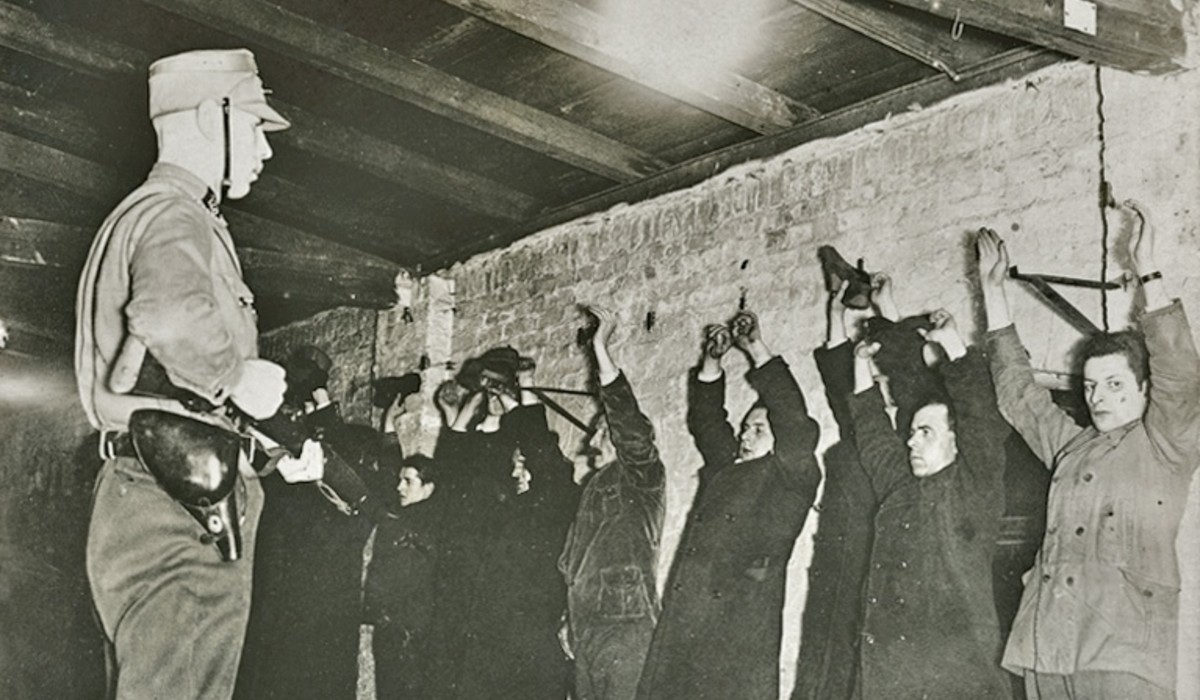
 Nazi brownshirt guarding communist prisoners, makeshift jail in central Berlin, 6 March 1933. Photo: Bundesarchiv, Bild 102-02920A / Georg Pahl / cropped from original / CC-BY-SA 3.0
Classic fascism involved violence on a scale we are not seeing now, and splitting voters from the far right may need different strategies from those the left are used to, argues Robert Dale
For quite a while I’ve been feeling uneasy about the fascism discussion. And it’s been getting worse rather than better. On the one side I see what history and political theory tell us about fascism. On the other I see the term used to label all kinds of people, groups and parties that don’t fit the bill. In some cases the label is just absurd (Starmer may be many unpleasant things but he’s not a Nazi). In some cases it is obviously appropriate (Ukip under Tenconi). But many of the cases we are dealing with currently seem to be more complicated (Meloni, Le Pen, FPÖ, AfD to start with). I’ll get to some of them later.
Do the terms matter? Sure they do. We base our actions on our understanding of the world we live in, in this case specifically our understanding of the forces we are up against. We must diagnose the condition before we choose the cure. No use treating head lice with antibiotics.
I’m not going to try to define fascism comprehensively here, but to put my finger on the thing that sets it apart, the reason why we have to treat it differently from parliamentary (bourgeois) parties. What makes fascist formations different is that they build their own organised fighting groups, which are ideologically coherent and independent of the state. (An extreme nationalist and exclusionary ideology is also part of the definition).
This allows them to use violence for their own ends in situations where the capitalist state would struggle to do so. Unlike the state’s security forces, the fascist army is ideologically coherent and recruited in the first place from the most desperate and angry, often those who have little or nothing to lose. Its first and most important target is the organisations of the working class, though Hitler later used the Nazi brownshirts to keep the capitalist elites in line.
The paradigm is the German Nazi Party’s seizure of power in 1933. It’s the clearest case, the most devastating, and the one people are generally alluding to when they bandy the term about. (There are various discussions about Mussolini’s fascism and Franco’s; I don’t see them as contradicting the argument laid out here).
In the following, I’m going to run through what happened in Germany between January and June 1933, when the Nazis took over the government and administration, and established tight control over all aspects of society. I will show how the process was predicated on wave after wave of absolutely vicious violence against the working-class organisations, carried out by autonomous Nazi forces, by the forces of the state, and within weeks of the seizure of power also by Nazi formations integrated into the state’s security apparatus. Then I will then take a look at what that can tell us about some of the current discussions.
So how did Hitler come to power?
By 1933, Germany had been in political stalemate for several years. The great depression had left the economy in tatters, the workers impoverished. Working-class organisations were still powerful (though bitterly divided): the trade unions, the socialists (SPD) and the communists (KPD). Between them, they had self-defence organisations numbering millions. The economic crisis also ruined the middle classes, who flocked to the Nazis. At the end of 1932, the Nazi Party had 850,000 members (not including SA and SS), numerous front organisations and 12.7 million votes in the national elections (33%).
The Nazis also had their own uniformed fighting organisations, which were crucial to their seizure of power. The Sturmabteilung (SA or brownshirts) was recruited principally from the lower middle class and the unemployed. As 1933 dawned, there were more than 400,000 brownshirts. After just a couple of months of Nazi rule, membership passed two million. The more elite Schutzstaffel (SS or blackshirts) had 50,000 members in January 1933.
First they came for the communists
Hitler was appointed chancellor on 30 January 1933. The Nazi Party had no majority in parliament so he required the support of the national conservatives, who also granted him power to rule by decree. That evening, the Nazis held massive torchlit marches in Berlin and across the country. The next day parliament (the Reichstag) was dissolved, with new elections called for 5 March. Now in control of the state, the Nazis expected a thumping victory. Their campaign was directed against the communists and socialists, under the motto ‘fight Marxism’. The brownshirts moved into action straight away, searching houses, detaining opponents, beating and sometimes killing communists, socialists and Jews.
During February, communist demonstrations were prohibited across large parts of the country, including the heartland, Prussia. Communist and socialist newspapers were banned for days on end. In mid-February the police occupied and searched the communist party headquarters in Berlin. The Nazis removed top civil servants and police chiefs and replaced them with their own men. On 23 February, Prussian Interior Minister Hermann Göring appointed 50,000 new police auxiliaries, recruited from the Nazi fighting organisations. In Berlin alone, between 3,000 and 5,000 brownshirts joined the police.
It was still possible to demonstrate at this point. The largest protest saw 200,000 in central Berlin on 7 February; the last communist demonstration was held on 24 February. But it was dangerous. In Eisleben, 600 Nazi brownshirts and blackshirts armed with pistols, spades and pickaxes attacked a communist meeting, with three deaths and 24 seriously injured. Altogether, the brief election campaign left at least seventy dead and hundreds injured.
Then they came for the socialists
The fascist fist really came down hard after the Reichstag fire on 27 February. A state of emergency was declared the next day and civil rights were suspended. A wave of arrests began the same morning, targeting communists and socialists. Lists had been prepared beforehand. In Prussia alone, 5,000 were arrested within days.
Now the brownshirts were let loose for a campaign of terror. The abducted ‘reds’ were placed in makeshift jails in schools, cellars and local SA buildings, where they were beaten, tortured and killed. By the end of March 1933, 7,500 had been detained, including the party’s leader Ernst Thälmann. In the course of 1933, at least 50,000 people were imprisoned in these makeshift concentration camps.
After the 5 March election, the Nazis took control of the regional and local governments. In each case, the local brownshirts marched to the town hall or government building and demanded that the Nazi flag be raised. The new appointees replaced the police chiefs and massively expanded the force.
Then they came for the trade unionists
The Nazis declared 1 May a public holiday and held rallies. While the incarceration of communists and socialists had also decapitated the trade unions, they were still legal at this point, and they called on their members to participate. The very next day, in a coordinated action, the brownshirts stormed trade-union offices across the country, detaining union officials and seizing property.
With that, working-class resistance had essentially been crushed. Many more steps followed of course. The industrialists and civil servants were brought into line. Official concentration camps were established and filled with communists, socialists and Jews. Finally, the brownshirts themselves – many of whom still believed they were on the road to a ‘national revolution against capitalism’ – were brought into line. In July 1934, about 100 of their leaders were murdered on the orders of Hitler and Göring. It was in those eighteen months, and especially the first six, that the Nazis established and consolidated their grip on pretty much every part of society.
And now?
So what does all that mean for the fight against fascism and the far right today? I think the most important observation is that the autonomous fighting force is an essential component of fascism. Without it, a fascist leader is no different from any other reactionary.
Any fascist organisation that is building an autonomous fighting force (or intimidatory mass marching formation) therefore presents a real present and future threat. They want to crush us and our organisations by direct physical attack. That is essentially why we argue that they must be stopped (if need be, physically) before they stop us. Their power lies in public displays of strength. So we stop them marching, we disrupt their organisation. Fascism is not just an idea, it is a formation, a band of men (and women). The strategy of denying them the street is well proven, and visibly successful (Cable Street, London in 1936, Anti-Nazi League in the late 70s, against the EDL around 2010, Dresden Nazifrei 2009–12).
Conversely, an organisation that has no intention of creating an autonomous fighting force is not a fascist one. Starmer may be a ‘wanker’, as people like to say these days, but he’s not a fascist. I’d suggest the same applies to Donald Trump. Up to here it all seems to make sense to me.
Puzzle pieces
After that it gets trickier. Across Europe we are seeing large votes for far right (fascist?) parties. Often workers’ votes. These parties are ugly. They want to restrict immigration, and speak about deportations. They rail against LGBT rights. They have members who speak positively about past fascist regimes. They have connections to street-fighting neo-fascist organisations (the numbers don’t seem to be huge there). But the picture is complex, there are aspects that suggest that these parties are not plain and simple fascist formations in the classic sense. There are reasons to wonder whether the traditional strategy of confrontation is applicable to parties of this format (RN in France, AfD, Reform UK).
I feel like I am looking at a bunch of puzzle pieces. Unsure how they fit together. Do some of them actually belong to a different picture? In the following I’m going to lay out some of the pieces. I’m not going to even try to create a coherent argument around them, as I can’t claim to understand how they fit together.
I’ll take quick look at Italy, a longer look at Germany, and a glance at Ukraine. I should note – if it’s not already obvious – that I’m not an expert. I know there’s plenty I don’t know. But what I do see, hear, experience and understand is enough to raise questions that seem to want answering.
Meloni
So let’s start with Italy under Meloni today. Even revolutionary organisations with a fine record of fighting fascism make a point of referring to ‘the fascist Meloni’. And yes, her political roots trace back to the neo-fascist MSI. But what has she achieved in three years in government? (Which started with a declaration that fascism is history.) Has she done anything Starmer wouldn’t do? In the EU, she is Ursula von der Leyen’s poodle. In the news from Italy these past three years I see no crushing of the labour movement. No fascist army on the streets. No systematic mass terrorisation of leftists. Her government has tinkered a little with LGBT rights, and with minor aspects of the abortion laws, but none of that could be called a fascist onslaught. Her gravest crime has been to cut benefits for the poorest, and she’s in good ‘democratic’ company there. As far as I can see, the pain currently inflicted on the Italian working class is of the same type and order of magnitude as that inflicted by Sunak and Starmer, by Scholtz, Baerbock and Merz in Germany, and by Macron in France.
In the case of the German AfD, some of my observations are first hand. I live in an area where the AfD currently takes a third of the vote, across the board. Sometimes people are afraid to come and visit, and then shocked by how ordinary it is here. We all have an idea what a Nazi thug looks like, and I think there is a tendency to assume that anyone who ever voted for a far-right party is exactly like that. (For more on the AfD’s voters, see ‘So is this 1933?’)
There is plenty of evidence against the AfD: connections with small militant neo-Nazi groups, members and representatives convicted of racist attacks, parliamentarians who say things like ‘we are the friendly face of the Nazi Party’. It’s a nasty piece of work. But can it be stopped through physical confrontation and ostracisation? I have my doubts. On the one hand, the party offers few opportunities. (German has a great word for this, ‘Angriffsfläche’, or ‘surface to attack’). No marches, few meetings. At election time, they have campaign stalls in the high streets. Sometimes they are overturned. I’m not sure whether that is politically helpful. There is currently a mobilisation to disrupt the founding conference of the AfD’s new youth wing. I can certainly see a case for targeting specific parts of the party, those closest to genuine fascist ideas. Probably also their stewards and bodyguards. The question is maybe how to target violent militants and their structures without demonising or patronising those who merely vote for the party. And I can see a very good case for focussing sharp and hard on the most militant groups (which are at least formally outside the party). That already happens.
There is a paradox here too. It would appear that participation in government has moderated the policies of certain far-right parties (Italy and Austria spring to mind first). I’m not suggesting that as a strategy, just noting a development. It’s not surprising, with the integration and defanging of radical parties being a core function of parliamentary democracy. In Germany to date, the AfD has been firmly and consistently excluded from participation in government at any level (apart from the lowest tier of local government). Even the conservative CDU and CSU have held that line. One effect of this has been to incentivise extremist currents within the party.
The Ukraine war has also produced unexpected oppositions. All the established parties supported Germany’s embroilment in the senseless slaughter (and the Left Party failed spectacularly to put up any opposition). The AfD aligned with those who opposed the war (which was not uncontroversial within the party, it’s an east/west split and probably a class divide too). When leftist outsider Sahra Wagenknecht called the first demonstration against the war, it was a great step forward. The established parties were outraged. That includes the Greens and the SPD, who are gung-ho for war and more war. I have rarely seen such a virulent media campaign against a demonstration (Gaza aside). The tenor was that there will be Nazis at the demonstration, so it should be boycotted. In fact, certain anti-fascist groups tried to sabotage the mobilisation by advertising fake transport. ‘Liberal’ journalists looked very hard, and found a couple of known fascists who were there incognito. I’d certainly bet that some of the those attending had voted AfD. Nonetheless, the demonstration was an important step pulling some kind of anti-war movement together.
A similar constellation is currently on the table over the reintroduction of military service. There is virtually no common ground with the Greens or the SPD here. They are all for war and more war. The Left Party may be. Like it or not, any campaign against military service should also be looking for support among AfD voters, many of whom (at least in the east) oppose the current war in Ukraine. An anti-militaristic campaign has better chances among AfD voters than Green voters. I’m not joking.
Here I’m talking about voters, not the AfD as a party. I’d probably agree that the party should be avoided on principle. On militarism, it’s conflicted anyway, and can be expected to end up with clear pro-war positions. But if we start looking for issues that can draw its voters away, these will likely be ones where our green and social-democratic friends are simply on the wrong side of the barricades. Or the trenches.
Ukraine
And so to Ukraine itself, what a mess. And an absolute shocker when it comes to fascist fighting organisations. The Azov and its allies have tens of thousands of men (and women) under arms. They hew to an ideology of largely unreconstructed Hitlerite fascism. They bear the insignia of the Waffen-SS as patches and tattoos. Their military units have been brought into the Ukrainian armed forces, which provides them with funding and resources. But they retain a high degree of political autonomy. They represent only a small proportion of the population, but have disproportionate influence. To my mind, they represent the single most alarming fascist problem of the day. And they have been feted, funded and armed (at least indirectly) by all the governments of Europe. By Sunak and Starmer, by Scholtz, Baerbock and Merz in Germany, and by Macron in France.
Questions, questions
I have more questions than answers. Three points to end with. Firstly, there seems to be a gap between what the far-right parties say and what they do. When they have joined or led governments, the outcomes look to me pretty much the same as the old parties. And whether inside or outside government, they don’t appear to be building fighting forces (of any meaningful strength). On that our argument was always ‘Ah, but they want to, secretly’ and ‘They are just putting on a show of being respectable’. Maybe they do, maybe they are. But they’ve had a lot of time now and little to show in the way of brownshirts. This argument may be easy to win in milieus with no contact with far-right voters, but it has worn very thin elsewhere.
Secondly, and more importantly, there is a big question about how the (broad) left relates to the far-right parties’ voters. The base of the classic fascist parties was the middle class and the most impoverished, downtrodden, disconnected – often unemployed – workers (in technical Marxist language ‘the lumpenproleriat’, meaning workers dressed in rags). That was an empirical observation back then, and is key to understanding how those parties functioned. It applied to their members, supporters and voters. Today, at least in some cases, we are looking at far-right parties whose electoral base is centred in the manual (or non-credentialled) working class. To boil the question down: Should we be ostracising and demonising those who vote for far-right parties? Or could we be looking out for battles to fight together.
One last observation. Having a scary far-right bogeyman can be an attractive crutch for the reformist parties. The Green/SPD government that fell at the end of 2024 gave us nothing but pain. The Left Party did little of note in opposition. When elections came round, their only argument of any substance was, ‘Be very scared of the AfD and vote for us’. It worked for the Left Party, which came back from the dead. This war of two camps suits the reformist parties. I think we should probably be looking to mix it up. Ordinary people have seen their lives and communities wrecked by the neoliberal parties. Some of those parties (SPD and German Greens) style themselves as champions against fascism and organise well-attended anti-racism rallies. Square that circle for me.
Robert Dale lives in the Berlin region, where he has been active in socialist politics since the 1980s.
Before you go
The ongoing genocide in Gaza, Starmer’s austerity and the danger of a resurgent far right demonstrate the urgent need for socialist organisation and ideas. Counterfire has been central to the Palestine revolt and we are committed to building mass, united movements of resistance. Become a member today and join the fightback.
