
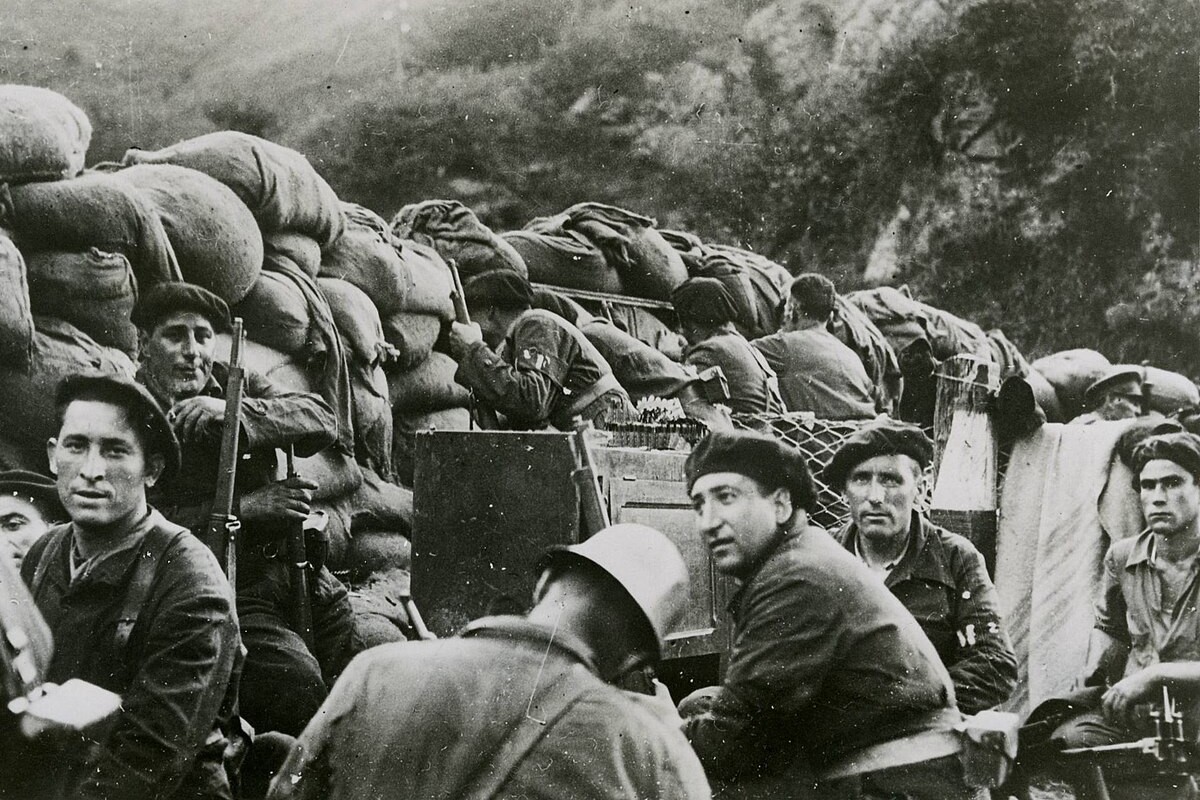
 Armed civilians from the Republican side during the Battle of Irún. Photo: Public Domain
As the 90th anniversary of the outbreak of the war approaches Chris Bambery assesses the role that Britain played during the conflict
On the one hand there were those who realised that it was a fight against fascism which if it was not stopped in Spain would go on to wage a European war. Some 2,500 Britons travelled to Spain to fight fascism in the International Brigades. Out of these volunteers, over 500 lost their lives. At home there was a considerable solidarity campaign for the Spanish Republic. Polling data from the British Institute of Public Opinion showed that sympathy for the Spanish Republic rose from 57% in March 1938 to 72% by January 1939. In contrast, support for Franco’s Nationalist rebels remained static at just 7% to 9%.[i]
On the other there was the role of the British government, first under Stanley Baldwin and then, in the later stages, Neville Chamberlain. This was nominally a national coalition government but in reality a Tory one. Formally it took a neutral position, despite the fact that the war began with a military rebellion against an elected government Britain recognised. In reality it played an important role in securing victory for General Francisco Franco and the Nationalists.
It was on a British plane, hired by MI6’s Major Hugh Pollard, that flew Franco from the Canary Islands, where he was stationed, to Morocco where he would initiate the rebellion of the army. Pollard had cut his teeth in Dublin Castle alongside the Black and Tans in the 1920s.
The rebel army in Morocco, led by Franco and containing the Nationalists best troops, had to be ferried across the Straits of Gibraltar. Some were ferried across in German planes but most had to cross by boat. The Spanish navy had remained loyal to the Republic but before it could do anything the Royal Navy warned it not to intervene.
The defeat of the military uprising in Barcelona, Madrid, Valencia and Bilbao meant Franco did not control the industrial areas and their vital exports, vital for gaining the foreign currency he needed to buy weapons. He found a saviour in the CEO of British owned Rio Tinto Zinc, whose operations were in the Nationalist Zone, Auckland Campbell Geddes, a former government minister in Lloyd George’s wartime administration. He ensured production was not only maintained but increased and supplied Franco with goods and British pounds.
Campbell Geddes feared a Republican victory because:
‘… there is a possibility of Spain passing through a communistic phase’ during which the firm might be faced with the ‘nationalization of [its] property’.[ii]
Campbell Geddes drew a line when he discovered Franco was exporting Rio Tinto’s zinc to Germany. He demanded the British government act but they were reluctant. Franco threatened to nationalise the company. The matter was only resolved when Britain recognised Franco’s government in late 1938 (before Barcelona fell and the Republicans still held a third of Spain).[iii]
What governed the stance of Britain’s elite?
There were three determining factors. Firstly, strategically Spain was of considerable importance to Britain. If the nationalists were victorious it raised the possibility of Spain joining with Nazi Germany and Fascist Italy and that would have implications because if they could gain access to its Atlantic ports, this would endanger Britain’s Atlantic sea routes, and if they threatened Gibraltar, this was key to securing Britain’s imperial routes through the Mediterranean.
In addition to this were British economic interests. Spain was an important commercial client of Great Britain absorbing 25 percent of its exports, providing 10 percent of its imports and British capital accounted for 40 percent of foreign investments in the country, mostly concentrated on iron mining and pyrites.[iv]
Britain determined early on in the Civil War that it must maintain friendly relations with whoever was in charge in Spain or at the very least secure her neutrality. But British policymakers went much further than that. What fundamentally drove British policy was the second factor, deeply-rooted anti-communism. Whatever Stalin’s rejection of world revolution and his espousal of a Popular Front linking the left, liberals and all who opposed fascism, British policymakers believed these were simply subterfuges and nothing had changed in Moscow.
The third factor was that by the summer of 1936 the policy of the Baldwin government was one of doing anything to avoid a confrontation with Hitler and Mussolini. To appease the Fuhrer that meant acquiescing in his land grabs in central and eastern Europe in the hope that that would lead to war with the Soviet Union rather than with Britain and France.
In Spain that translated into turning a blind eye towards the substantial German and Italian military presence and pretending both powers were neutral. Of course, anti-communism and appeasement were connected. Many in Whitehall and Westminster saw the fascist states as ‘bulwarks against Bolshevism’, as The Times put it.[v]
The first test of the Baldwin government came over the request of the legitimate government of Spain to be able to buy arms to resist the military revolt.
In France there governed a popular front government led by the Socialist Léon Blum. On 19 and 22 July it received telegrams from the Republican government asking for arms. Blum began sending them across the border but on 25 July he flew to London for talks on the Anglo-French response to Hitler’s occupation of the Rhineland.
Prime Minister Baldwin had already said: ‘That on no account, French or other, must he bring us in to fight on the side of the Russians.’ [vi]
In the vestibule of The Savoy Blum told Baldwin and Eden that he was ready to arm Spain. Eden then told him: ‘It’s your business; I ask only one thing of you, I beg of you, be careful.’ [vii]
‘Non-intervention’ policy
Aware that the British did not approve, and facing a ferocious reaction from the right wing at home, on 25 July Blum announced no arms would cross the frontier to Spain. On 1 August he announced that his government now favoured a Non-Intervention Agreement by the powers to enforce an embargo on arms to Spain (it was widely believed this had been suggested to him by Baldwin and Eden).
The subsequent Non-Intervention Agreement was a pact signed by 27 European nations – including Britain, France, the Soviet Union, Germany, and Italy – pledging to not to provide arms and war materials to either side in Spain. A committee comprising Britain, France, Italy, Germany and the Soviet Union was to enforce this and first met in London on 9 September 1936, chaired by William Morrison, Britain’s Financial Secretary to the Treasury. [viii]
From the start it was a farce with Germany and Italy providing shipload after shipload of weaponry to Franco, including tens of thousands of Italian “volunteers.” Italian submarines began sinking ships bound for Republican ports with the British navy doing nothing.
In Moscow Josef Stalin released that with Madrid under siege Soviet prestige determined he must, reluctantly intervene by sending weapons and advisers (in far fewer numbers than the Germans and Italians) and instructing the world Communist Parties to mobilise the International Brigades.
The Director of the Southern Europe department of the Foreign Office, Owen St. Clair O’Malley, described non-intervention as ‘an extremely useful piece of humbug.’ [ix]
Meanwhile, in the corridors of power, the great majority of voices deplored the possibility of a Republican victory in Spain.
On 20 July 1936 the Cabinet Secretary, Maurice Hankey, wrote a memorandum for the Cabinet claiming:
“In the present state of Europe, with France and Spain menaced by Bolshevism, it is not inconceivable that before long it might pay to throw in our lot with Germany and Italy and the greater or detachment from European entanglements the better.”[x]
Henry Buckley was the Daily Telegraph’s reporter in Madrid in the mid-1930s who came to know several British diplomats quite well. He would write that they were ‘very complaisantly disposed towards the Spanish right … as a guarantee against Bolshevism’,[xi]
The British Consul in Vigo, on the north west coast, warned the Foreign Office that the ‘victory of communist [sic] government means finish of Spain.’[xii]
From Barcelona the British Consul, Norman King, told London on 6 August that:
‘If the Government are successful in suppressing the military rebellion, Spain will be plunged into the chaos of some form of bolshevism and acts of savage brutality can be expected.’[xiii]
The poet, Stephen Spender, passed through Barcelona en route to serve in an ambulance unit. Where he dined with King. The conversation at table led him to write a letter to the News Chronicle in which he stated:
‘In a very short time, without enquiring about my political feeling’s, he [King] told me in a spirit of camaderie and with great assurance that he wished [Luis] Companys, the constitutional president of the Catalan Republic (with whom he had a political relationship of international importance, second only to that of an ambassador) had been shot dead after the rising of 1934.’[xiv]
Diplomatic duplicity
The British ambassador in Madrid, Sit Henry Chilton, had fled the Spanish capital to take up residence for the duration in St Jean de Luz, just across the border from Euskadi/The Basque Company in France, where he remained until 1939. When the fascists took it he maintained close relations with the Nationalist authorities there.
Chilton told London that Spain faced a choice between ‘rebel versus rabble’ and warned that ‘the communists, anarchists, etc.’ would ‘play absolute hell’ in the wake of a Republican victory.[xv] The American ambassador, Claude Bowers, reported that Chilton was “violently against the loyalists from the first day, and he habitually calls them ‘reds.’”[xvi]
Despite his opposition to Nazi Germany, which he saw as an existential threat to British power, in early August 1936 Winston Churchill claimed that a Republican victory was certain to produce ‘a communist Spain spreading its snaky tentacles through Portugal and France.’[xvii]
In the course of the war Churchill would, however, change his position to favour the Republic because he saw that as better for British interests.
In mid-October 1936 the Cabinet decided to recognise the insurgents as belligerents, which would give them the status of lawful combatants, when they captured Madrid, which seemed set to fall imminently. But the Republicans held the Spanish capital from Franco’s offensive.
In the meantime, Germany and Italy announced on 18 November that they recognised the Nationalist regime as the government of Spain. But this move was certainly not in line with established practice. As a consequence, Eden was forced to rethink the existing policy. He decided to delay granting belligerent status because it would leave the Government open to the charge that Britain was following in the wake of Hitler and Mussolini.
Cabinet split
Six months into the Civil War a split developed in the British Cabinet over Spain. By the start of 1937, Eden argued that Spain had become an international battleground and that ‘the character of the future Government of Spain has now become less important to the peace of Europe than that the dictators should not be victorious in that country’.[xviii]
In contrast, Lord Halifax described Spain as a ‘tactical situation’ where it was important not to ‘lose sight of the main disideratum of not allowing our relations with Italy and Germany to deteriorate’[xix].
Eden disagreed arguing regarding Germany and Italy needed be conducted that British control of the Mediterranean was a red line which could not be crossed.
Eden was not arguing out of sympathy for the Republic but on the basis of what he believed Britain’s best interests were. Baldwin, Chamberlain and Halifax supported appeasing the dictators and were, accordingly, prepared to sacrifice the Spanish Republic.
By early 1938 Eden was an isolated figure and he resigned.
Meanwhile, the Bank of England suspended relations with the Bank of Spain in Republican Madrid. Credit requests were continually denied and British trade in Spain was concentrated overwhelmingly in the Nationalist-controlled zones.
In November 1937 Neville Chamberlain, now prime minister, appointed Sir Robert Hodgson as Britain’s “Commercial representative” to the Nationalist government in Burgos. For Hodgson the Republicans were:
‘Communist-controlled hordes, inspired by the Comintern and supported by the human scum, largely alien, from which the Republican forces are recruited.’[xx]
In April 1938 Chamberlain signed the Anglo-Italian Pact under which Britain implicitly agreed to recognise Italy’s conquest of Abyssinia (Ethiopia); Italy promised to withdraw its troops from Spain but only once the conflict ended; both nations agreed to respect the status quo in the Mediterranean, with Italy pledging not to threaten British territories in Egypt or the Suez Canal.
Chamberlain ignored protests from the Republican government.
One of the final nails in the Republic’s coffin came with the Munich Agreement as Chamberlain flew back to London to promise ‘peace in our time.’ The strategy of the Republican government under Juan Negrín was that the outbreak of a European war would save the besieged Republic. Now that seemed to be off agenda.
The war would end with a coup in the Republican zone against the Negrín government. The rebels, encouraged by Britain, believed they could negotiate an honourable peace with Franco. That was not on his agenda. The end would see tens of thousands of Republicans jailed, tortured and executed.
British policy aided Franco’s eventual victory. A Tory MP who opposed appeasing the fascist dictators, Harold Nicolson, got things right when he argued:
‘The second German war began in July 1936 when the Germans started with their intervention in Spain… the propertied classes in this country with their insane pro-Franco business have placed us in a very dangerous position.’[xxi]
Leaving aside Franco’s export of crucial minerals and supplies to the Third Reich, the direct assistance he gave to their submarine warfare campaign and the 40,000 fascist “volunteers” sent to fight in Russia, the Spanish Civil War impacted on Hitler.
The refusal of Britain and France to assist the Republic, together with Munich, convinced Hitler neither state would ever go to war. In Moscow Stalin drew the same conclusion and began working towards the eventual August 1939 Hitler-Stalin pact. Matters did not end there. The victorious Allies refused to move to topple Franco in 1945 and very soon he became a key US ally in the Cold War. He would rule Spain under his iron heel until his death in a hospital bed in November 1975.
Before you go
The ongoing genocide in Gaza, Starmer’s austerity and the danger of a resurgent far right demonstrate the urgent need for socialist organisation and ideas. Counterfire has been central to the Palestine revolt and we are committed to building mass, united movements of resistance. Become a member today and join the fightback.
[i] Tom Buchanan, Britain and the Spanish Civil War, Cambridge, Cambridge University Press, 1997), P23
[ii] Douglas Little, Red Scare, 1936: Anti-Bolshevism and the Origins of British Non-Intervention in the Spanish Civil War, Journal of Contemporary History, Vol. 23, No. 2, Bolshevism and the Socialist Left (Apr., 1988), P299
[iii] Douglas Little, Red Scare, 1936: Anti-Bolshevism and the Origins of British Non-Intervention in the Spanish Civil War, Journal of Contemporary History, Vol. 23, No. 2, Bolshevism and the Socialist Left (Apr., 1988), P301
[iv] Antony Beevor, The Battle for Spain, (London, Weidenfeld & Nicolson, 2006), P378
[v] Douglas Little, Red Scare, 1936: Anti-Bolshevism and the Origins of British Non-Intervention in the Spanish Civil War, Journal of Contemporary History, Vol. 23, No. 2, Bolshevism and the Socialist Left (Apr., 1988), P300
[vi] Chris Bambery and George Kerevan, Catalonia Reborn: How Catalonia Rook On the Corrupt Spanish State and the Legacy of Francoism, (Edinburgh, Luath Press, 2018), P82-83
[vii] Douglas Little, Red Scare, 1936: Anti-Bolshevism and the Origins of British Non-Intervention in the Spanish Civil War, Journal of Contemporary History, Vol. 23, No. 2, Bolshevism and the Socialist Left (Apr., 1988), P299
[viii] Douglas Little, Red Scare, 1936: Anti-Bolshevism and the Origins of British Non-Intervention in the Spanish Civil War, Journal of Contemporary History, Vol. 23, No. 2, Bolshevism and the Socialist Left (Apr., 1988), P294
[ix] The Earl of Avon, The Eden Memoirs. Facing the Dictators, (London, Cassell & Company Ltd, 1962), P433
[x] Paul Preston, Perfidious Albion: Britain and the Spanish Civil War, (London, Clapton Press, 2024), P48
[xi] Paul Preston, Perfidious Albion: Britain and the Spanish Civil War, (London, Clapton Press, 2024), P20
[xii] David French, Deterrence, Coercion, and Appeasement: British Grand Strategy, 1919-1940, (Oxford, Oxford University Press, 2022), P348
[xiii] Henry Buckley, The Life and Death of the Spanish Republic, (London, I.B. Tauris, 2013), P174-176
[xiv] Paul Preston, Perfidious Albion: Britain and the Spanish Civil War, (London, Clapton Press, 2024), P53
[xv] Paul Preston, Perfidious Albion: Britain and the Spanish Civil War, (London, Clapton Press, 2024), P27
[xvi] Paul Preston, Perfidious Albion: Britain and the Spanish Civil War, (London, Clapton Press, 2024), P17
[xvii] The Earl of Avon, The Eden Memoirs. Facing the Dictators, (London, Cassell & Company Ltd, 1962), P405
[xviii] Paul Preston, Perfidious Albion: Britain and the Spanish Civil War, (London, Clapton Press, 2024), P12
[xix] A. Shubert and G. Esenwein, Spain at War: The Spanish Civil War in Context 1931-1939, (Harlow, Longman, 1995), P194
[xx] Sandra Halperin, War and Social Change in Modern Europe: The Great Transformation Revisited, (Cambridge, Cambridge University Press, 2004), P222
[xxi] Chris Bambery, The Second World War: A Marxist History (London, Pluto Press, 2014), P64

Chris Bambery
Chris Bambery is an author, political activist and commentator, and a supporter of Rise, the radical left wing coalition in Scotland. His books include A People's History of Scotland and The Second World War: A Marxist Analysis.