
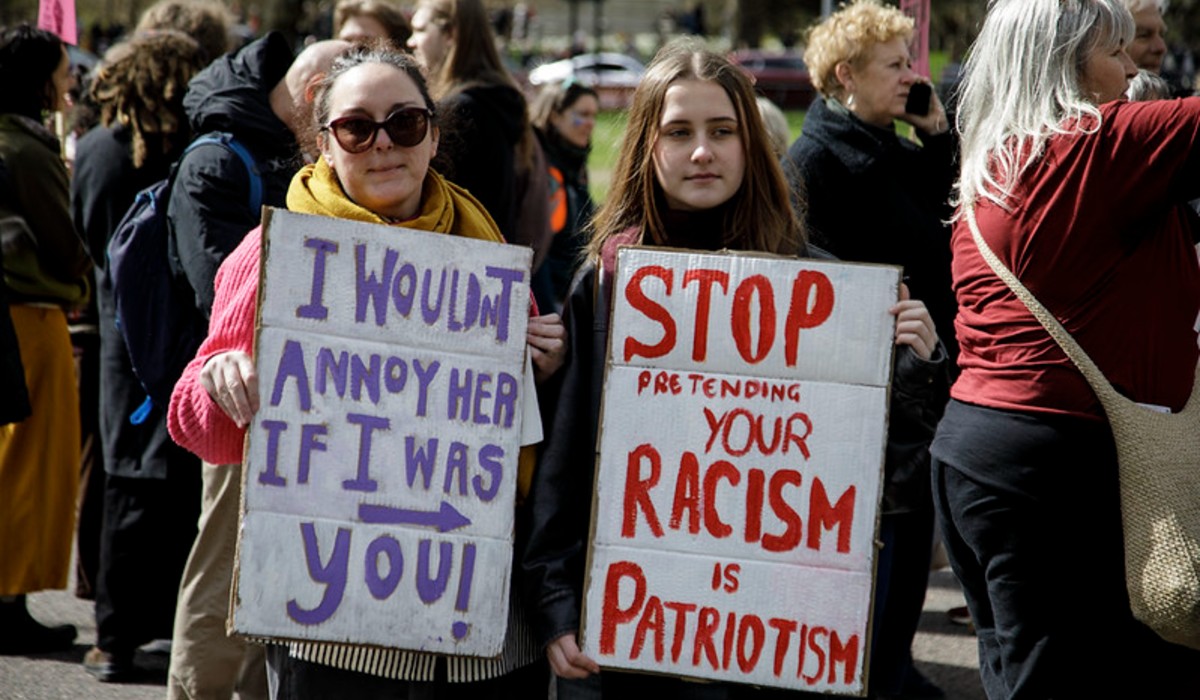
 Together Against the far-right protest, central London 28th March 2026. Photo: Steve Eason / CC BY-NC 4.0
Sam Colclough examines where the Far Right is today, and how we might go about beating it
The far right in Britain has become larger and more emboldened at various levels in recent years. This concerning development has happened more notably in an electoral context and in the streets.
This is to say that the far right is in a historically strong position in the UK right now, and the electoral success of other far right parties in Europe in recent years, such as Fratelli D’Italia in Italy, Fidesz in Hungary, and Law & Justice in Poland, indicates a) the existence of favourable political-economic conditions for the far right, and b) the left-liberal view Reform will somehow be “exposed” in office and therefore necessarily destroy its own prospects without the left needing to confront it is deeply flawed.
Reform in a rut
Nevertheless, it’s also true Reform finds itself in a bit of a pickle. Three recent by-elections have gone against them and they’ve lost to three different parties in the process: Plaid Cymru in Caerphilly, the Greens in Gorton and Denton, and Labour in Makerfield. These results support the claim the anti-Reform vote is stronger than the pro-Reform vote and highlight the possibility of short-term success against them through tactical voting.
And Reform hasn’t been helped by revelations about Nigel Farage receiving £5 million from a British crypto-billionaire based in Thailand. While most people likely don’t really care about the debate over whether this money was a “gift” or a “political donation”, this episode has undoubtedly harmed the Farage brand by exposing him as in hock to the super rich and fundamentally sleazy – hardly a surprise to his critics.
This shows the danger of an over reliance on individual personalities as substitutes for political movements. In many ways, Reform is the ultimate example of this, with MP Rupert Lowe responding to his expulsion from Reform over allegations of bullying by setting up a new even-further-to-the-right party in Restore Britain, which has started taking votes off Reform to its right.
The Far Right street movements
The other part of this equation is the far right street movements. Over the past few years, we’ve seen a newly determined army of cadres trained up to intensify and organise the far right struggle on the streets. This was clearly on display in Southampton where the protests in response to Henry Nowak’s murder – when he died in police custody – essentially constituted a national mobilisation of various canny operators.
Of course, political activity never takes place on a blank canvas. Instead, it builds on pre-existing political currents. It’s no coincidence the recent Belfast riots took place in loyalist communities where racist, right-wing ideas have always been deeply pervasive. However, the wave of far right street activity of recent years far exceeds anything Britain has seen for a number of decades.
The high point to date for the far right on the streets was arguably the Unite the Kingdom demonstration in London in 2025, where the far right far outnumbered the left-wing counter-protest. This was disastrous for the left, whose numbers were sufficiently low for the counter-protest to be kettled. This represented a profound reversal from the previous summer, in which the far right pogroms following the Southport killings were brought to an abrupt end by local anti-fascist and anti-racist street activity in towns and cities up and down the country.
But another reversal was effected last month, as the joint demonstration organised by the Palestine Movement and Stand up to Racism was around five times the size of the latest Unite the Kingdom demonstration held on the same day. This was a humiliation for the far right and for its street leader Tommy Robinson, who was clearly anticipating building on the success of the demonstration organised the previous year. It was also highly embarrassing for the Metropolitan Police who chose to give all the top spots in central London to the far right despite the fact the Palestine movement had requested them far earlier.
As with Reform, the street movements are perhaps not entirely helped by links to big business. The latest Unite the Kingdom demonstration was funded by a US crypto billionaire. Links to US capital appear to have combined with emerging organisational links between the British and the US far right to result in the wholesale adoption of far right stances from the US in the UK, including the recent conversion of Tommy Robinson to Christianity. Indeed, the far right street movement in Britain seems to be embracing religious iconography at a rate that may be putting off potential supporters.
Building the alternative
So, the far right is in the strongest position it’s been in for decades in this country. At the same time, its fundamental flaws are becoming increasingly visible. While attempts to paint the far right as an inherently working class political force are patently wrong – this relies on a conception of the working class as almost exclusively white, male, and made up of tradesmen – approaching two decades of falling living standards has encouraged people to look for alternatives. Some of those people have been attracted by the far right.
Peeling these people away from the far right and towards the struggle for socialism means building campaigns around the things that really matter to people: better wages and working conditions; reliable housing, healthcare, and education; affordable access to essentials like fuel and water; and the end of the threat of conscription and war.
Central to this ought to be the Together Alliance which organised a demo of over 500,000 people in London on 28th March this year. This demo brought together – among others – trade unions, a wide range of community groups, and a number of socialist and progressive parties. It was a wonderful celebration of diversity, sent a strong message to the far right, and gave opponents of racism and other oppressive ideologies confidence they’re not alone. Since the success of 28th March, the Together Alliance has been relatively quiet. With the far right simultaneously ascendant and vulnerable, now is the time for anti-racists and anti-fascists to deepen and widen the struggle against the far right to push it back to the margins. The past few years have seen a number of promising initiatives quickly fall away: Enough is Enough, We Demand Change, Your Party. If we’re to continue to beat back the far right, the Together Alliance can’t repeat these mistakes.
Before you go
The ongoing genocide in Gaza, Starmer’s austerity and the danger of a resurgent far right demonstrate the urgent need for socialist organisation and ideas. Counterfire has been central to the Palestine revolt and we are committed to building mass, united movements of resistance. Become a member today and join the fightback.
