
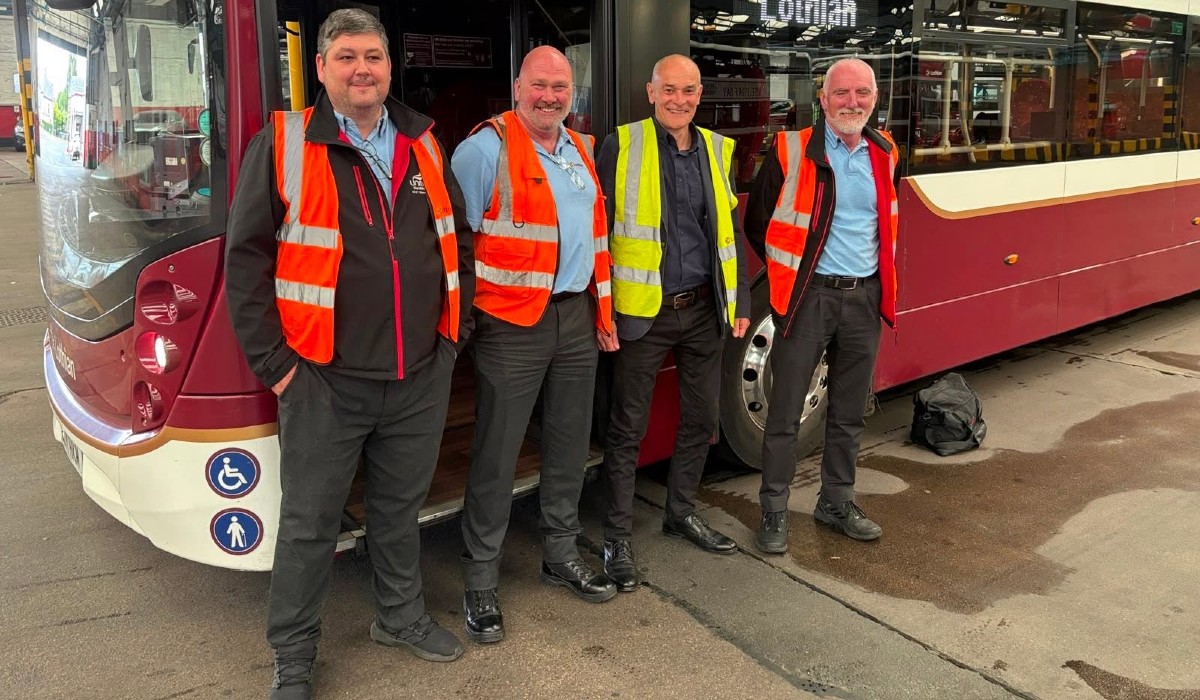
 Simon Dubbins at Lothian Buses. Photo: Simon Dubbins Facebook
As the ballot opens on Unite’s General Secretary election, Counterfire interviews Simon Dubbins, who is challenging incumbent Sharon Graham. Whoever wins thousands of workers will be affected so it is crucial that Unite members give some consideration before returning their ballot paper
The election for General Secretary of one of Britain’s largest unions, Unite, opens this week. The contest is between the incumbent, Sharon Graham, and Simon Dubbins, who works for the union. Counterfire is supporting Dubbins in light of the rightward moving drift of Graham’s politics, defending more oil and gas drilling, welcoming increased arms expenditure, and failing to support the Palestine movement.
We talked to him about why he decided to stand against Graham.
‘I am standing to be elected as Unite General Secretary because I, like thousands of other members, activists, reps and officers, believe Unite has been going in the wrong direction under the current General Secretary and it’s time to press the reset and get the union back on track. Our union has clearly moved to the right under the current leadership, and, under the mantra of “back to the workplace”, retreated from our long-established commitment to being a bastion of left-wing progressive politics and committed internationalists. The union has lost its way industrially and politically and has also lost its unity and cohesion as internal strife has rocked the organisation.’
Much of the left backing for Graham comes from her supposed commitment to workplace struggles. This should quite rightly be seen as the basis for stronger organising and for developing the union across different sectors. But, while there have been some local successes, there have been few national battles with employers. Dubbins argues:
‘It is true there was a strike wave that coincided with Sharon Graham becoming General Secretary, but it was not because she became General Secretary of Unite that a strike wave started. The cost-of-living crisis that followed the Covid19 crisis forced hundreds of thousands of workers to take action in struggles to protect their jobs, pay and living standards in the face of soaring inflation and an employers’ offensive to cut costs and restore profits. It’s important to recognise that the action of Unite members was part of a much wider struggle taking place at the time, which is why hundreds of thousands of union members in other areas were also taking action – on the railways, in the education sector, and in swathes of the health sector that Unite does not represent.
‘As a union we must always support members in struggle, and I have absolutely pledged to continue that if I am elected. However, we cannot ignore the fact that under the current General Secretary we have also had some industrial disasters. The loss of over 2000 jobs at Port Talbot steelworks was not a success. The closure of the Stellantis plant (formerly Vauxhall and GM) in Luton was not a success; it was a disaster and the reps felt abandoned by the leadership of Unite who failed to turn up to a critical meeting with the government minister to discuss plans to save the site. By contrast there have been fantastic campaigns to save the GE Rugby site, ADL buses in Falkirk, and numerous other campaigns that receive no recognition.’
Dubbins argues that there is a need for a strategy to defend jobs and wages, given current and likely future attacks.
‘In the current industrial climate Unite has many workplaces that are literally hanging by a thread and in real danger while the cost-of-living crisis – that never really ended – is set to intensify further as the Middle East conflict sends oil prices and inflation surging again. We need a new industrial strategy focused on protecting jobs and sites and protecting and raising pay. If I am elected, I have pledged to introduce a new industrial strategy within the first 100 days’
A new industrial strategy
One of the big complaints about Graham’s period as General Secretary has been her retreat from politics. This can mean different things – she has distanced herself from the Labour government and claimed that she wants to concentrate on industrial struggle. But it can also mean a marginalisation and sometimes outright attack on political campaigning and solidarity movements. Here Graham’s record is very poor – something barely acknowledged by those on the left who support her. Under her the union has disaffiliated from the Stop the War Coalition and taken a hostile stance to the Palestine movement.
Dubbins is a longstanding campaigner on these issues. However, more controversially from Counterfire’s point of view, he also believes there should be a stronger and more focused input into Labour, given Unite’s affiliation to the party and the fact that they are in government.
‘There is a feeling that the current Unite leadership has disengaged from politics and dumbed down the union’s voice, power and influence. Whatever anyone thinks of the current Labour government, and I fully share the anger over cuts to winter fuel payments, cuts to disability payments, the lack of a bold and clear political vision, and the support for the Israeli genocide, the reality is that Unite remains the largest single affiliate. All our members need our political voice to be heard and our power and influence to be felt. The fact that Unite’s group of MPs has not had a single meeting since the current General Secretary took office, and that Unite’s political department has been decimated and is a shadow of its former self, speaks volumes about the general disengagement from politics.’
He is right to stress that affiliated unions should seek to exert influence on Labour government policies. But he appears to put much more faith in this process than Counterfire members would do. The relationship between the union bureaucracies and the Labour party has been one of putting pressure financially and politically on Labour in order to achieve the outcomes it wants, but this tends to be done behind closed doors and involves all sorts of compromise deals. The generally uncritical way in which many trade union leaders are receiving Andy Burnham suggests that the compromises he makes will not be challenged too strongly.
Taking the fight to Reform
He also wants to take on the threat of Reform. It is widely believed that a good number of Unite members have voted or intend to vote for Reform, and while the union has supported initiatives like the big Together Alliance march it is not in the forefront of campaigning. Simon Dubbins wants to change that.
‘There is also a huge frustration in the union about the failure of the Unite leadership to speak out loud and clearly and oppose the rise of Reform and the far-right. It’s certainly true that swathes of Unite members are drifting towards supporting Reform, but from the conversations I’ve been having I believe around 80-90% of our reps and activists fully oppose Reform and recognise the existential danger it poses to the wider trade union and labour movement. What they are telling me is that they have not had the information, support and leadership to help them deal with the issue in the workplace. I believe the current Unite leadership has been silent on the issue out of fear of upsetting some members. I have made it absolutely clear in various interviews that I am ending the silence and taking the fight to Reform.
‘The trade union movement must not bow to Reform or in any way, shape, or form, appear to legitimise or make support for Reform appear acceptable. Reform and the far-right represent the polar opposite of everything the trade union movement stands for. History shows us that often the very first thing such movements seek to do on reaching power is to attack and destroy trade unions and organised labour. In my view our union has been silent on spelling out the dangers of Reform and arming and equipping our reps with the leadership they need to challenge the rise of support for Reform in the workplace. The current Unite General Secretary has allowed Unite officials to meet with Reform and also remained silent when the Reform Mayor of Lincoln joined a Unite demonstration in Lindsey – that’s a dereliction of duty. There can be no compromise with the far-right and as the Makerfield by-election and the recent problems Farage has encountered, where there is a determination and willingness to take the battle to Reform, they can and will be defeated.
‘If I am elected fighting the far-right will be one of Unite’s political priorities. I have pledged to put a new political strategy in place within the first 100 days of taking office, and that the strategy will be based on only supporting politicians who support us – they need to earn our support and trust, not assume it, rebuilding our political voice, power and influence, and prioritising the fight against the far-right. The issue of affiliation to the Labour Party will be decided at the 2027 Rules Conference where members will have their say and make their decision. The priority right now is not the question of disaffiliation, it’s to re-engage with politics and quickly rebuild our voice and power.’
Wages or warfare?
Sharon Graham has welcomed huge increases in defence spending from the government in the name of creating jobs for Unite members. In doing so she is lining up with the growing calls for more militarism, and is accepting that there will be cuts in other areas of the public sector, including those where Unite organises. Studies have demonstrated that whatever jobs are created within the arms industry, more are likely to be lost from cuts elsewhere. Dubbins has a mixed view on this:
‘Unite has thousands of members in the defence sector and they have every right to expect our union to protect their jobs, pay and conditions, just as Unite does for any other group of workers in the union. I am proud that branches in the defense sector, such as those in Babcock, Rolls Royce and GE, have nominated me and are supporting me to become General Secretary.
‘The issue of extra military spending is a difficult and complex one. Of course, some Unite members benefit when military expenditure increases and their jobs are secured, but at the same time other Unite members suffer if spending is cut in other areas. This is exactly what happened when the international aid budget was slashed to fund increased military expenditure – Unite members in many organisations in the not-for-profit sector – such as Oxfam or Save the Children – lost their jobs and people dependent on the aid they delivered suffered.
‘We also need to be acutely aware that increasing military expenditure may not even benefit Unite members in existing defence sector companies. For example, the recent decision to buy F-35 aircraft for the UK’s two aircraft carriers brings little or no benefit whatsoever as billions are spent buying US equipment that in turn makes the UK more dependent on a US run by Donald Trump!’
He argues that Unite can both support campaigns for peace and against war while defending workers’ conditions in that sector.
‘The issue of defence workers’ jobs and interests has been weaponised to justify retreating from the union’s traditional support for international solidarity and opposing militarism – on issues such as support for the Palestinian cause. Instead we should respect the long-established policy of Unite to firmly defend the interests of our members working in the defence sector, whilst at the same time remaining true to our union’s long-established wider political position on the left – of promoting peace and opposing militarism.’
International solidarity
Dubbins believes that this is not happening because Graham ‘has simply sought to eliminate any space in the union for support for wider international issues such as opposing wars and supporting peoples facing the most horrific and criminal repression. In relation to Palestine, instructions were given by the current leadership that no senior official could speak at national demonstrations, that our support for Boycott, Divestment and Sanctions campaigns had to stop. When recently a new order for Typhoon jets secured the jobs of Unite members who build them it is entirely understandable that Unite welcomed the saving of many members’ jobs, however there was not a single comment of concern from the union that the jets were going to be delivered to Turkey – a country with an appalling human rights record.’
He argues:
‘The union’s traditional position of being a major supporter of the international peace movement has been undermined and damaged by the position of the current leadership. This is why I am pledging to restore Unite’s international solidarity work. We should never forget that Unite members in the past bravely refused to repair the jet engines of dictator August Pinochet following the coup in Chile, and that members from the aerospace and shipbuilding committees in the Scottish and London and Eastern regions both submitted motions calling for Unite to strengthen solidarity work with Palestine, even though we have members in the defence sector in those regions.’
Dubbins draws on the history of solidarity within the union to reinforce the point about internationalism in an era of global capital and which he feels is being lost.
‘Our union should be rightly proud of the great history of international solidarity that it has always had. A former General Secretary of the TGWU, Jack Jones, volunteered to fight fascism in the Spanish civil war. We should look to both respect that legacy and see it as an inspiration for today’s struggle against the same forces – who in the age of Trump and Elon Musk are even more internationally organised than in the past.’
He also points out that it is impossible to ignore international connections for workers:
‘The stark reality for Unite members is I believe some 60%-70% work in multinational companies. Many of the decisions affecting our members’ jobs, pay and conditions are taken outside the UK so it is essential for Unite to be active internationally for basic industrial reasons, and it’s essential that we have good strong relationships with sister unions in order to present a united front to multinational companies and global capital more generally.’
A Just Transition
Despite Graham’s claims to eschew politics, she has recently made a number of political interventions, including opposing energy minister Ed Miliband becoming chancellor, and demanding more drilling for oil and gas, despite very widespread environmental concerns. Dubbins argues that,
‘A just transition is not only achievable it’s an absolute necessity and must be a priority for Unite. Climate change is a reality. We have to tackle climate change as a matter of urgency, but it also has to be done in a manner that protects jobs and living standards and there is a real and justifiable anger that until now the transition has been happening without replacement jobs being created. All too often it feels like hollow words for Unite members, so any future plans have to start with the measures in place to create new jobs for people to move to.’
The coming election will help decide the direction in which the union will go. A change of General Secretary can only be a part of that, and as has been pointed out on the left, this is a contest between two figures who have long been part of the Unite bureaucracy, and are not grassroots candidates. However, Dubbins clearly takes a much stronger approach towards political trade unionism and towards international solidarity. While there will clearly be differences between our approach over some issues and his, Graham’s political trajectory should be a warning to the left.
Crucially though, the unions are in a weak state and we need much more thoroughgoing organisation at rank-and-file level to remedy that. That means linking the political with the industrial and economic strategy, not downplaying politics or pretending it can be separated from workplace struggle.
Before you go
The ongoing genocide in Gaza, Starmer’s austerity and the danger of a resurgent far right demonstrate the urgent need for socialist organisation and ideas. Counterfire has been central to the Palestine revolt and we are committed to building mass, united movements of resistance. Become a member today and join the fightback.
