
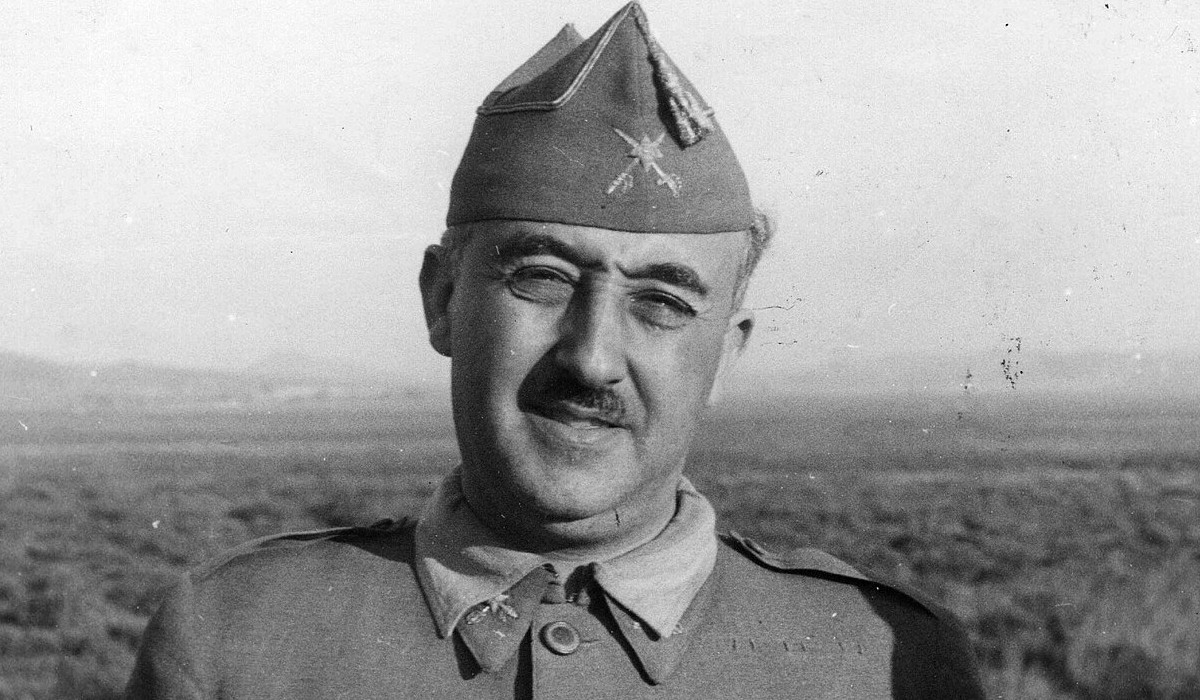
 Francisco Franco. Photo: ad Alerta digital / CC BY-SA 4.0
The terror carried out by Franco and his supporters during the Spanish Civil War and beyond can be characterised only as fascist, finds Chris Bambery
After his victory in the Spanish Civil War in April 1939, General Francisco Franco ruled the country via a ruthless dictatorship until his death in November 1975.
The question I want to ask is whether that dictatorship was fascist or not. For a long time I would have answered no but as my reading about the Spanish Civil War intensified I would now answer yes. Let me explain why.
I have argued, in line with Trotsky, that fascism creates a mass movement independent of the state, based in the middle class. In moments of acute crisis where the forces of the state no longer seem able to contain working class unrest, the ruling class turns to fascism. As Trotsky said:
“The big bourgeoisie likes fascism as little as a man with aching molars likes to have his teeth pulled.”
Elsewhere, I have written:
“i) fascism is the product of capitalism in crisis, ii) it differs from other forms of pro-capitalist government in that it has at its core a petty bourgeoisie mass movement, iii) it aims to destroy working class organisation by dividing it against itself.”
The Spanish Civil War began with a military revolt, and the military was crucial to Franco’s victory. The military is a key part of the state, so the Nationalist forces did not represent a force independent of the state.
But Trotsky also wrote:
“Fascism is not merely a system of reprisals, of brutal force, and of police terror. Fascism is a peculiar governmental system based on the uprooting of all elements of proletarian democracy with bourgeois society… To this end the physical annihilation of the most revolutionary sections of the workers does not suffice. It is also necessary to smash independent and voluntary organisations, to demolish all the defensive bulwarks of the proletariat, and to uproot whatever has been achieved during three quarters of a century by Social Democracy and the trade unions.”
This describes exactly what Franco achieved in Spain.
The Spanish Civil War saw the right launch a genocidal campaign of extermination, which they called a crusade, against all those who they saw as enemies of the patria, the nation: leftists of all shades, liberals, Catalan and Basque nationalists, freemasons and trade unionists.
The army of General Francisco Franco played a key role in this, but behind the lines the killings were in the main carried out by members of Spain’s fascist party, the Falange.
Emilio Mola, another general, planned the military uprising and commanded the fascist forces in the north of Spain, but would suffer because of the failure of the planned uprisings in the great cities of Madrid, Barcelona, Valencia and Bilbao. The large areas of northern Spain supported the uprising and joined in without very much resistance. That did not stop Mola ordering his men to implement terror, killing anyone suspected of having voted for the government or for being vegetarians, naturists or champions of Esperanto. Teachers were another target. From the beginning, Mola saw the civil war as a crusade against the ‘Jewish-Masonic-Bolshevik’ conspiracy, telling Italian fascist officers fighting alongside him that he would welcome the wholesale destruction of the industrial working class. Like many veterans of the long and bitter colonial war in Morocco, Mola, like Franco, viewed the working class in the same colonial way he viewed Moroccans.
In the south, Gonzalo Queipo de Llano took control of the uprising in Seville, elbowing his way to the top. He would become famous for his rants on the radio promising death to a long list of those supposedly conspiring to destroy Spain. His list would include US President Roosevelt, supposedly controlled by Jews. His forces, aided by squads of Falangists, carried out mass killings in the towns and villages of the south, where landless labourers backed the Republic. Aristocrats joined in with glee. Queipo himself loved killing, and raped and sexually assaulted female prisoners. He also despised those who rose above him, Franco above all, ensuring he would be sidelined as the dictator gathered power into his hands.
Paul Preston in his book, The Spanish Holocaust: Inquisition and Extermination in Twentieth-Century Spain, puts the number executed by the Nationalists at between 150,000 and 200,000: many still lying in unmarked mass graves, many brutally tortured prior to being shot. The wives of those killed had their children forcibly removed to be given to Nationalist families in which to be brought up.
The right simply claimed Paul was a red, a rojo. Others said he was breaking the ‘Pact of Silence’, agreed between the former Francoists who oversaw the transition to parliamentary democracy and the Socialist and Communist opposition. Along with an amnesty for all of Franco’s torturers and executioners, they agreed to put the events of 1936-1939 and the subsequent dictatorship behind them.
It was also claimed that Paul ignored victims of terror in the zone controlled by the Republicans, those who remained loyal to the elected government of Spain, which the generals wanted to overthrow. Preston did not in fact do so, but did point out that the numbers of those executed in the loyalist zone was far smaller, 50,000, and that the Republican government deplored the killings and, as it asserted its authority after the effective collapse of the state subsequent to the military rising, acted to halt them. In contrast, Franco and the Nationalist authorities encouraged the killings, handing over much of the rearguard to the tender mercies of Spain’s fascist party, the Falange. Their final victory would be followed by a further wave of executions, which continued, albeit on a much smaller scale, until the bitter end.
Franco’s dictatorship used a wide array of savage tactics to dehumanise, persecute, terrorise, and silence the enemy, including forced exile, labour camps, torture, and rape. Their goal was to eradicate all of Spain’s supposed enemies, actors in the ‘Judeo-Masonic-Bolshevik’ conspiracy: leftists, republicans, liberals and Catalan and Basque nationalists. The Catalans were denounced by the Falange as being Jews.
General Mola declared the strategy early in the war, on 19 July 1936, when he said in a speech: ‘It is necessary to spread terror. We have to create the impression of mastery eliminating without scruples of hesitation all those who do not think as we do.’[i]
Franco, in a speech following his 19 May 1939 victory parade through captured Madrid, justified the continued need for repression by pointing to the continuing and necessary struggle against the Jews, stating:
‘The Victory would be wasted if we did not stay on the alert and maintain the concerns of the heroic days, if we left eternal dissidents, the embittered, the egoists, the defenders of liberal economics free to act … Let us have no illusions: we cannot extinguish in one day the Jewish spirit that facilitated the alliance of big capital with Marxism, that knows all about deals with the anti-Spanish revolution. That spirit still flutters in many hearts.’[ii]
The three central figures in the dictatorship which emerged spread the myth that Spain faced a ‘Jewish-Freemason-Bolshevik’ conspiracy. Franco, the man who ruled Spain from his victory in March 1939 until his death in November 1975; his brother-in-law and Interior then Foreign Minister until his dismissal in September 1942, Ramón Serrano Suñer, and the man who would become Franco’s chosen successor, Admiral Luis Carrero Blanco (best remembered now for his assassination by the Basque terror group ETA in December 1973).
After the Second World War, both Franco and Carrero Blanco had to try to tone down their public statements attacking Jews and Freemasons, as the dictatorship tried to draw a curtain over its enthusiastic support for Hitler and, as the Cold War gathered strength, became an ally of the United States. But it was a façade. Neihter could stop making such hideous statements and both wrote articles (and Franco even scripted a film) under pseudonyms attacking Jews and Freemasons. Old fascists couldn’t change their stripes.
Serrano Suñer was very close to the Falange and was Franco’s foreign minister from 1940-1942 visiting Germany where he met Hitler, Himmler and Ribbentrop. He also met Mussolini. Serrano Suñer was fervently pro-Axis. While Spain did not join Germany and Italy at war it provided ports, re-fuelling, weather reports and much more for German U Boats, which also utilised a German tracking base in the Canary Islands. When Germany invaded Russia, Serrano Suñer was the driving force in organising 45,000 Falangist volunteers into the Blue Division which fought in the St. Petersburg theatre.
It’s often said Franco was no fascist. That may be, but he and the others in this book shared the genocidal impulse of Hitler and the Nazis. The Falange would be incorporated into the National Movement under him, along with monarchists of different hues, but they were central to the terror, and central to the regime, until it became clear Germany was going to be defeated. Nonetheless, the Falange remained the force Franco would turn to whenever he felt threatened, right up to the end.
Until the Popular Front, and alliance of liberals and the left, won the February 1936 general election, the Falange was a fairly marginal force. The dominant force on the right was the CEDA “Confederación Española de Derechas Autónomas” (Spanish Confederation of Autonomous Rights) which adopted some of the trappings of the Nazis, but was a parliamentary party – albeit a nasty one.
In the months between the general elections – the next was in July 1936, it began haemorrhaging support to its right, mainly to the Falange. Virtually the whole of its youth wing went over to the Blueshirts. The Falange began a campaign of terror, targeting leftists and attacking a supposedly Jewish owned department store.
Thus, the Falange became a mass party in the final few months prior to the Civil War, but one which was relatively under-developed.
The Falange had lost its key leader, José Antonio Primo de Rivera, who had been in jail when the army uprising began, and who was executed in Alicante jail. Other important figures were in the Republican zone. So the party was essentially leaderless.
After the Civil War began the Falange grew significantly once more as it was given a free hand to kill en masse.
This made it easy for Franco to carry out a manoeuvre whereby the Falange was incorporated into the Movimiento Nacional (National Movement) along with the Carlists and CEDA. In many accounts this signalled the end of the Falange, but this was not the case.
The Falangists were Franco’s most loyal supporters. He himself did not trust the Carlists, knowing they felt betrayed because he did not recognise their claimant to the Spanish crown or the former CEDA politicians because he saw them as verging on being liberals. So, in moments of crisis, right up to the very end, it was the Falangists who he rallied in his support.
When Franco’s forces advanced into Catalonia, capturing Lleida in April 1938, the Falange were let loose:
“… repression in the Lleida region was indiscriminate and resolute, and was carried out by the military authorities in co-operation with the Falangists and local right-wingers. Dozens of non-combatants were executed merely on the grounds that they were perceived as sympathetic towards the Republican cause. Certain extremely violent acts were perpetrated against women from the Pallares region.”
Conxita Mir puts the number executed in the Lleida region after trial by Military Courts at 558 with another 148 Republicans executed without trial, while 169 political prisoners were simply murdered.[iii]
This was repeated when the rest of Catalonia fell at the beginning of 1939. The use of the Catalan language, called by the Francoists “the language of dogs,” was banned in public. Catalan pre-names names were banned, as were all Catalan newspapers and publications. All Catalan cultural institutions – theatres, dance groups, choral societies and literary societies – were banned. That remained the case until Franco’s death.
The Catalan novelist, Manuel Váquez Montalban (who would be arrested and tortured by Franco’s secret police) wrote about Barcelona under occupation:
“Cripples, beggars, stub end tobacco sellers, charlatans, street singers, organ grinders, rag-and-bone men, uniformed Falangists marching to their epic songs… flags in the wind… Fascist commandoes, who shaved their heads to their scalp and forced repressive fear, estraperlo (black market), white bread and blonde tobacco sellers and ‘Idea’ cigarettes. Military priests who led punitive processions and urged the mob on to chants like: ‘What shall we do with the Protestants? Throw them into the sea.’”[iv]
The success of the far right in spreading the pernicious myth of a ‘Jewish-Masonic-Bolshevik’ conspiracy drew on old Catholic traditions, stretching back to the expulsion of Muslims and Jews in 1492, when the last Muslim kingdom of Grenada was conquered. But its propogandists quickly picked up and spread the current version issuing from Berlin.
The entire Spanish right, from open fascists to the officer corps, the Catholic hierarchy and most of the priesthood, and the monarchists, were infected by Nazi ideas and by Nazi methods. When World War II began, Franco would declare Spain neutral, but after Hitler’s occupation of Scandinavia, the Low Countries and France, changed that to ‘non-belligerence’, supporting Germany and Italy in every way short of joining in the fighting.
The truth was that after the civil war, Spain was in no position to join the war and Hitler could not afford to supply it with the material that would have required, or accede to Franco’s price, swathes of North Africa. But Franco did send the fascist Blue Division to fight in Russia.
What Paul Preston also shows is that subsequent efforts to pretend Spain helped save Jews from across Europe were a barefaced lie. The regime handed over the census it took of its own Jewish population to the SS commander, Heinrich Himmler. It imposed fines and taxes on them, and made it clear they were not part of Franco’s new order. When Franco occupied Tangiers, until then a French possession, the Falange ran amok, attacking its Jewish population and forcing them to flee. The regime also tried to stop Jewish refugees (including Spanish-speaking Sephardic Jews, the descendants of those expelled from the Kingdom of Spain in 1492, many of whom had Spanish passports) entering Spain and, when they relented to a degree, allowed those with papers only the right to cross the country to a port from which they could depart. Those without papers were interned.
All the time the press and radio were issuing antisemitic statements given to them by the German embassy or lifted from ‘The Protocols of Zion’. Post-war Holocaust denial was the rule of the day.
In July 1936, the Nationalist generals hoped for a quick victory. That did not happen. Instead they faced four years of civil war. They won that not just by conventional means by unleashing mass terror in which the Falange was central. The Nationalist camp and the state they constructed was infected by that; it was genocidal, far more so than Mussolini’s Italy and only less so than Nazi Germany because it did not have the military and economic power Hitler could deploy.
Franco’s state quacked like a Nazi duck and waddled like one. The genocide it carried out qualifies it as a fascist movement. It’s worth recalling, before someone quotes Trotsky at me, that in Fascism: What it Is and How to Fight it, that he describes the dictatorship of General Pilduski in Poland as fascist. It very much resembled Franco’s dictatorship but killed far fewer of its opponents.
The scale of what was unleashed in Spain by the July 1936 military uprising proves to me that it was fascist.
Before you go
The ongoing genocide in Gaza, Starmer’s austerity and the danger of a resurgent far right demonstrate the urgent need for socialist organisation and ideas. Counterfire has been central to the Palestine revolt and we are committed to building mass, united movements of resistance. Become a member today and join the fightback.
[i] Paul Preston, Architects of Terror: Paranoia, Conspiracy and Anti-Semitism in Franco’s Spain (London, Harper Collins 2023), P212
[ii] Paul Preston, Architects of Terror: Paranoia, Conspiracy and Anti-Semitism in Franco’s Spain (London, Harper Collins 2023), P27-28
[iii] Conxita Mir, The Francoist Repression in the Catalan Countries, Catalan Historical Review, 1: 133-147 (2008), P143
[iv] Manuel Váquez Montalban, Barcelonas, (London, Verso, 1992), P143

Chris Bambery
Chris Bambery is an author, political activist and commentator, and a supporter of Rise, the radical left wing coalition in Scotland. His books include A People's History of Scotland and The Second World War: A Marxist Analysis.