
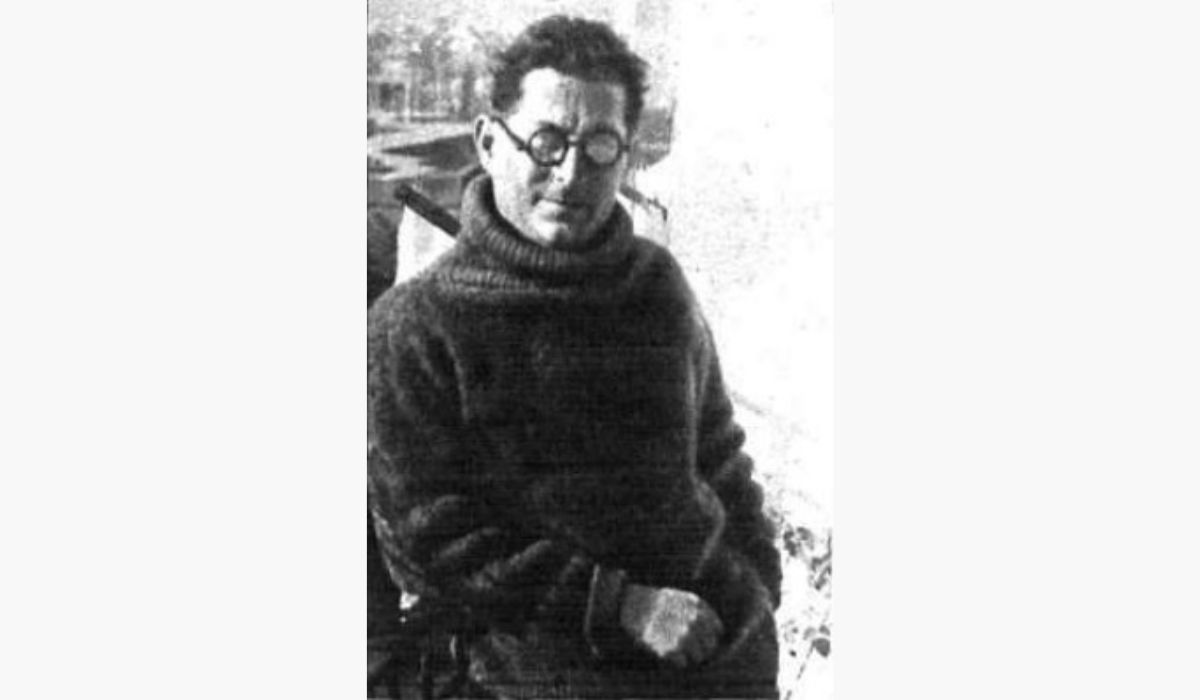
 Andreu Nin, most likely early 1930s. Source: Wikicommons / Public Domain
Ninety years ago the most serious figure in the revolutionary movement in both Catalonia and the Spanish state was Andreu Nin, writes Chris Bambery
Andreu Nin, one of the most important figures in the Spanish Revolutionary Marxist movement, was born in the Catalan town of El Vendrell, south west of Barcelona, in 1892. His father was a shoemaker and his mother a peasant’s daughter.
He became politically active as a teenager participating in the 1909 Semana Trágica (Tragic Week), a great uprising in Catalonia provoked by conscripts being forced to go to Morocco to fight in Spain’s dirty, colonial war. It was brutally suppressed by the Spanish state. Barcelona became known as the Rosa del Foc (the Rose of Fire).
While still at school Nin became a Catalan Republican – the end of the 19th century had seen a cultural flowering of Catalan nationalism. Having trained as a teacher he went on to teach in Barcelona, just after the First World War had broken out. Spain stayed neutral but the competing powers rushed to place orders from Catalan industries. While Spain was still overwhelmingly agrarian, Catalonia had experienced an industrial revolution in the early 19th century.
Barcelona was an industrial powerhouse, home to one of the most militant working classes in Europe. The working class of Barcelona was organised in the main in the anarcho-syndicalist Confederaión Nacional de Trabajo (National Confederation of Labour, CNT) but it was also home to a flourishing Catalan cultural scene. Nin himself gave lectures on the latest theories of progressive education.
1917 saw a general strike in Barcelona, which led to a week of street fighting with the army, leaving 71 dead, hundreds wounded and thousands arrested.
The October Revolution in Russia later that year struck a powerful chord in Catalonia, and among the CNT membership in particular.
Throwing himself into working-class struggle Nin first joined the Catalan Federation of the Spanish Socialist Party (PSOE) and then, in 1918 he joined the CNT. At the CNT’s Second Congress in 1919, he told delegates:
“I am a fanatic for action, for revolution; I believe in actions more than in distant ideologies and abstract questions. I am an admirer of the Russian Revolution because it is a reality, because above ideologies, it represents a principle of action, a principle of coexistence of all purely revolutionary forces that aspire to establish communism immediately.”1
That congress decided to provisionally affiliate to the new Third or Communist International (Comintern).
1919 was a year of mass strikes in Barcelona, but as the war-time economic boom faded away a recession followed. Bosses went on the offensive organising armed gangs to assassinate CNT leaders. In 1920, Nin survived such an attack by flinging himself to the floor. The comrade with whom he had been speaking was shot dead.
During the spring of 1921 with the murder and arrest of several key CNT leaders, Nin was appointed general secretary of the CNT. Its national plenum decided to send a delegation of four to the Comintern’s Third Congress and the founding conference of the Red International of Labour Unions (RILU). It included Nin and a fellow teacher who would become a firm friend and comrade, Joaquín Maurín.
The CNT would decide to withdraw its support for the Soviet Union and the Comintern. Maurín on his return to Catalonia would join the fledging Spanish Communist Party (PCE) editing his own paper, La Batalla.
Nin, however, could not return having been arrested in Berlin on-route home on trumped charges of having taken part in the assassination of the Spanish prime minister. He was deported to Moscow where he would live for the next eight years, working as assistant secretary of the RILU and joining the Soviet Communist Party, being elected delegate to the Moscow Soviet. He also married a co-worker at the RILU and they had two daughters.
As Andy Durgan writes:
“After an odyssey which took him from Catalanism to social democracy and syndicalism, his final home became Leninist Bolshevism, and from 1923, with a group of colleagues within the CNT, he laid the basis for a movement which could combine Communism with support for Catalan ‘national liberation struggle’ against the central state.”2
Within the RILU Nin fought for workers’ unity against fascism and unemployment, with the immediate post-war revolutionary wave having ebbed away.
In 1925 he became a supporter of Leon Trotsky and the opposition in the fight to reverse the degeneration of the revolution. He would deliver the last speech inside Russia in support of Trotsky in 1928 at the RILU congress. He was soon after expelled from the RILU and the Communist Party.
He was, however, allowed to leave for Barcelona with his wife and daughters. There he eked out a fragile living translating Russian authors into Catalan and began organising a group of Trotskyist supporters in Spain.
By now, Stalin was claiming the world had entered a revolutionary Third Period, which required the communist parties to be on the permanent offensive, and identifying the social democrats as “social fascists.”
In opposition to this, Nin championed the united front declaring:
“The guarantee for the future lies in the United Front, but it lies also in the organic independence of the vanguard of the working class. In no way … can we fuse within an amorphous conglomerate which would break up at its first contact with reality. However are sad and distressing, we are disposed to maintain the principled position we have learnt from our chief, even if we have to risk taking a different path from him on the road to victory.”
In 1934, Nin and his followers played a key role in forming a Workers Alliance against the coming of the hard right to government and in October it declared a general strike. In reality this strike only took off in Asturias, where it was brutally supressed by the army under Gernal Franco. It lost, but only after three weeks of fighting. The strike took hold to a lesser extent in Catalonia.
There, Maurín’s group called a general strike which was met with a good response. However, the Catalan regional government refused to issue arms and having declared a “Catalan state of the Spanish Federal Republic,” allowed itself to be arrested. The army took control.
To cut a long story short, in 1935 Nin and Maurín merged their two groups into the POUM (Partido Obrero de Unificación Marxista – Workers’ Party of Marxist Unification). By 1936, on the eve of the Civil War, it would have some 6000 members. In Catalonia it was especially strong in Lleida and Girona, less so in Barcelona, and strong elsewhere in Valencia, Madrid and Galicia.
For the new organisation, the Spanish state was a “prison house of nations” and the national question was of crucial importance.
Nin’s Els moviments d’emancipació nacional (The National Emancipation Movements), was published in Barcelona in 1935.
Drawing on his experience in Russia, Nin presented the USSR, as it was established in 1922, as the perfect solution for the rights of the nations inside it, writing:
“The USSR is the protoplasm of the future Union of Socialist Republics of Europe first, and of the Union of Universal Socialist Republics later. Its doors are open to all the workers’ republics that are established.”3
Unfortunately, Nin never managed to publish the second part of the book, where he intended to deal with the Catalan question. In the first, published part he attacked the pseudo-internationalist position, which denies nationalities and looks to the creation of large states where large nations would absorb small nations leading thereby to national oppression.
Following in the footsteps of Lenin, Nin argued that acceptance of the right to separation did not necessarily mean agitating in favour of separation. The matter should be decided according to the concrete interests of socialist revolution. Recognition of the right to separation reduces the right of disintegration and strengthens working class unity.
Within an oppressed nation, revolutionaries have to combat their own national bourgeoisie and strengthen unity with the proletariat of the dominant nationality, while the latter have to combat their dominating national bourgeoisie in defence of the oppressed nations.
The ultimate aim for Nin was the creation of the Union of Iberian Socialist Republics, modelled on the early, revolutionary Soviet Union. It goes without saying none of the above applied under Stalin’s dictatorship under which Russian centralisation was imposed on the subject nations.
The rest of this story is more familiar, especially if you have watched Ken Loach’s film Land and Freedom. In July 1936, the Spanish army launched a coup d’etat to overthrow the Popular Front government elected earlier that year. They had planned a quick victory, but the rising was defeated by worker uprisings in Barcelona, Madrid, Valencia and Bilbao. In Barcelona and Catalonia this immediately translated into revolution. The CNT, and to a much lesser extend the POUM, collectivised workplaces and created neighbourhood committees and popular militias.
Nin would state that the “stupid… Spanish military” had provoked “a proletarian revolution more deep-going than the Russian one itself.”4
The POUM looked to the CNT to create a revolutionary republic. In September 1936, in an attempt to win over the CNT he wrote:
“What is the dictatorship of the proletariat? It is authority exercised solely and exclusively by the working class, the abolition of all political rights and all freedom for the representatives of the enemy classes. If this is the dictatorship of the proletariat, comrades, the dictatorship of the proletariat exists today in Catalonia…”5
The CNT leadership rejected seizing power and instead joined first the Catalan regional government and then the Spanish government. On its own, the POUM was too small to take decisive action.
Meanwhile, the only aid coming to the Republic was supplied grudgingly by Stalin. This inflated the prestige of the small Spanish Communist Party that followed the line from Moscow that it must aid the creation of a conventional army to fight a conventional war, and do nothing to rock the Republican boat.
The middle class Republicans and the Communists wanted an end to the revolution in Catalonia. The latter began a witch hunt against Nin and the POUM, labelling them “Trotskyites,” this was at the height of Stalin’s purges in Russia and the Moscow show trials.
The Republican government in Madrid was centralist, as was the Communist Party. Juan Negrín, who would become prime minister stated:
“I am not making a war against Franco… so that its offspring is a provincial and stupid separatism in Barcelona.”6
Matters came to a head in May 1937 when Communist security units tried to seize the CNT central telephone exchange in Barcelona. The CNT rank and file reacted by erecting barricades and taking control of swathes of the city. The POUM fully supported this but the CNT leadership did not. They insisted the barricades come down and eventually won this argument.
Almost immediately, Communist led army units took control of Barcelona. The POUM was outlawed and Nin seized by Soviet agents. They hoped he would star in a show trial confessing to be an agent of fascism. Despite being tortured, Nin would not confess.
Eventually the NKVD, the forerunner of the KGB, claimed he had been taken by fascist troops when they raided the secret prison outside Madrid where he was held. It was fake news. A Russian NKVD agent had shot him, and he was buried in an unmarked grave.
Andreu Nin remains the most important figure among Spanish and Catalan Marxists and his writings remain relevant today.
1 Andy Durgan, The POUM: Republic, Revolution, and Counterrevolution, (London, Resistance Books, 2025), P21
2 Andy Durgan, The Spanish Civil War, (London, Palgrave Macmillan, 2007), P93
3 Quoted in Albert Balcells, Catalanism and national emancipation movements in the rest of Europe between 1885 and 1939, Catalan Historical Review 6(6):85-104, June 2013, P100
4 Michael Eaude, A People’s History of Catalonia, (London, Pluto Press, 2022), P162
5 Andy Durgan, The POUM: Republic, Revolution, and Counterrevolution, (London, Resistance Books, 2025), P70
6 Chris Bambery and George Kerevan, Catalonia Reborn: How Catalonia Took on the Corrupt Spanish State and the Legacy of Franco, (Edinburgh, Luath Press, 2018), P77
Before you go
The ongoing genocide in Gaza, Starmer’s austerity and the danger of a resurgent far right demonstrate the urgent need for socialist organisation and ideas. Counterfire has been central to the Palestine revolt and we are committed to building mass, united movements of resistance. Become a member today and join the fightback.
