
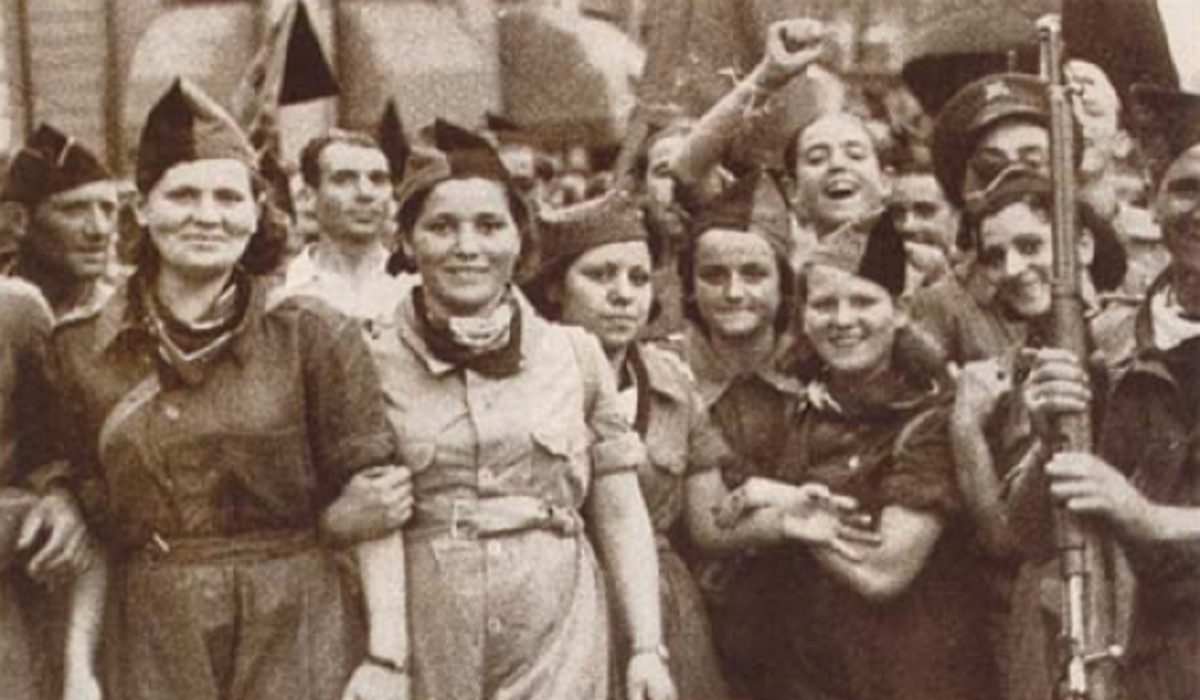
 Women of CNT-FAI in Barcelona, July 1936. Photo: Public Domain
Ahead of the 90th anniversary of the outbreak of the Spanish Civil War, Chris Bambery outlines books crucial to understanding the bloody conflict
There are two books which I am going to omit from this list. Both are must-reads but they are so obvious I am not going to include them: George Orwell’s Homage to Catalonia and Ernest Hemingway’s For Whom the Bell Tolls.
Let’s instead start with two short but excellent histories of the Spanish Civil War. First Helen Graham’s The Spanish Civil War: A Very Short Introduction (Oxford University Press) and Andy Durgan’s The Spanish Civil War (Palgrave). They are both good starting points but they also represent two sides of an important debate.
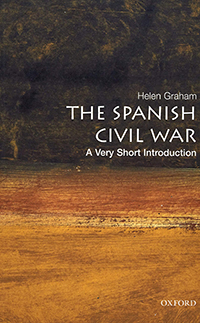
For Graham the line of the Juan Negrín Republican government, which governed from 1937 to the end, was correct. That was to build up a conventional army to fight a conventional war. To do that the revolution which had occurred in Catalonia, where the July 1936 uprising had been defeated by the working class, had to be suppressed because it threatened the necessary cross-class unity against fascism. Negrín wanted a centralised Spanish state and was determined to undermine Catalan autonomy, which he did.
In this he was supported by the Spanish Communist Party (PCE), following the line from Moscow. There Stalin had reluctantly supported the Spanish Republic because its defeat, he came to realise, would strengthen fascism and thus weaken Russia. But what he really wanted was an alliance with Britain and France against Nazi Germany, and did not want events in Spain to scare off those two states.
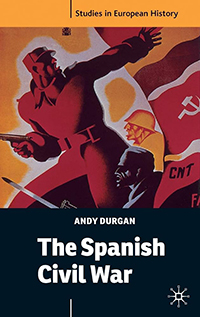
Andy Durgan, in contrast, argues the only way fascism could have been defeated was through revolutionary war, as exemplified by Cromwell, The Jacobins, Lincoln and Trotsky. Rather than waging set piece offensives, which the Republicans always lost because Franco had more men, planes, tanks and artillery, better to take the defensive while waging guerilla war and pledging the land to the peasantry and landless labourers. The Spanish colony of Morocco was also crucial to the fascists.
Rather than a conventional army organised along class lines like the British one, better to organise a revolutionary army carrying the revolution on the point of their bayonets. After all, the two Republican successes early in the war – the capture of much of Aragon and the defence of Madrid – had been achieved along those lines.
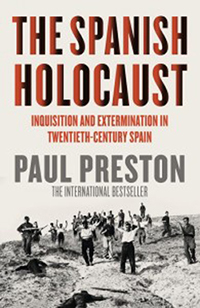
Paul Preston’s The Spanish Holocaust: Inquisition and Extermination in Twentieth-Century Spain (Harper Press, 2013) caused huge controversy in Spain when it first appeared because it drove a coach and horses through the Pact of Forgetting (Pacto del Olvido), agreed after Franco’s death in 1975 by the parties of the right and left to draw a veil over what happened in the Civil War and under Franco. The very title is provocative.
Some 200,000 people were killed by death squads, vigilantes, village rivals or firing squads – a quarter in the Republican zone. After victory Franco took his revenge further killing 20,000 and condemning hundreds of thousands to prison, exile, ostracism or poverty as Franco made a calculated investment in terror. By the end of the war more than 370,000 prisoners were being held.
As Preston makes clear, these killings on the fascist side were official policy in the Republican zone not just opposed them but reigned them in.
Preston explains the fascist fervour for these killings because they saw the war as a crusade. Franco saw it as a battle against a “Jewish-masonic-Bolshevik” conspiracy against Spain using leftists of all shades, separatists, Jews, freemasons, Marxists, Muslims, “free” women, trade unionists, socialists, socially concerned priests and social liberals, all guilty of crimes against the fatherland, god and the natural social order.
Also driving the killings was the brutalisation of Spain’s colonial army in Africa, where Franco had made his name fighting Muslims regarded as sub-human. That was easily applied to Spain’s working class landless labourers, regarded as “Berbers and savages.”. “It is necessary to spread terror, eliminating without scruples or hesitation all those who do not think as we do,” said General Emilio Mola. “All those who oppose the victory of the movement to save Spain will be shot.”
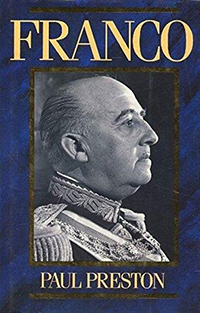
All of Preston’s books are worth reading, although he shares Helen Graham’s line on how the war should have been fought. If you want to understand the monster Franco was, his biography, Franco (Fontana, 2013) is the place to start.
At this point you might wonder why there are so many English language books in my choice? The reason is simple. Under Franco, Spaniards could not write a truthful history and after his death the Pact of Forgetfulness kicked in. British historians, in particular, filled he vacuum reflecting the fact that the Civil War had a great impact here, one not subsumed by the experience of wartime occupation.
The role of the International Brigades in the war is often romanticised. Little wonder they fought a heroic war but they were raised by the Communist Parties of the world in response to instruction of Stalin. He did not want the Russians to directly intervene so this got him off a hook.
The International Brigades were drawn from the cream of the working class but they were also a tool of Stalin’s attempts to control the Republican zone.
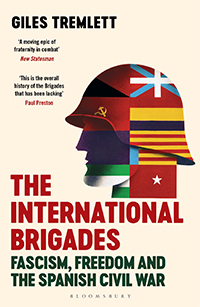
Giles Tremlett’s The International Brigades: Fascism, Freedom and the Spanish Civil War (Bloomsbury, 2020) gives an honest and fascinating account.
Ian Gibson’s The Assassination of Federico García Lorca tell us about fascist murder of the great Spanish poet and playwright at the hands of fascist killers, it’s also located within the much, much wider fascist repression of the war.
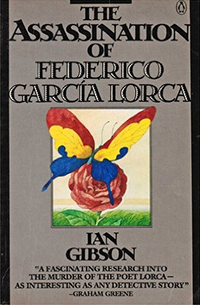
In 1934 Lorca had declared: “I will always be on the side of those who have nothing.” His travelling theatre group La Barraca, took culture to the villages, not just in Andalucia but all over Spain. He had upset the local elite by suggesting that the Catholic conquest of Moorish Granada in 1492 had been a disaster. He was also openly gay. Their revenge was not long in coming.
When the military uprising started, Lorca was in his home town of Grenada which was quickly over run by the fascists. He took shelter with a friend who was a member of the Falange, the fascist party, but was betrayed.
Gibson tracked down the fascists who took him out into the hills and shot him dead in the most homophobic way possible.
Lorca’s unmarked grave has never been found.
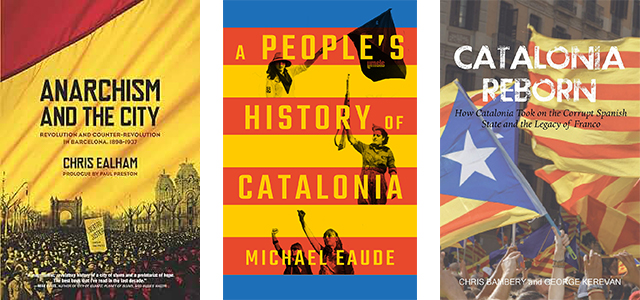
If you want to understand Catalonia I suggest three books: Chris Ealham’s Anarchism and the City: Revolution and Counter-Revolution in Barcelona, 1898-1937 (AK Press, 2010), Michael Eude’s A People’s History of Catalonia (Pluto Press, 2022) and (forgive me) Chris Bambery and George Kerevan’s Catalonia Reborn: How Catalonia Took on the Corrupt Spanish State and the Legacy of Franco (Luath Press, 2020).
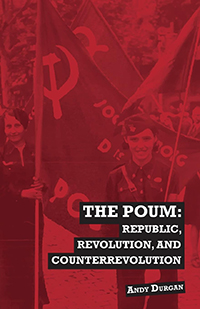
For a Marxist understanding of the Civil War and Revolution another of Andy Durgan’s books, The POUM: Republic, Revolution and Counter-Revolution, (Resistance Books, 2025) looks at the role of Andreu Nin and the Partido Socialista Obrero Español (Workers Party of Marxist Unification). Nin remains a fascinating figure and the POUM had a base in parts of Catalonia. In May 1937, when the Catalan revolution was suppressed by the Republican authorities, it was outlawed and Nin kidnapped and murdered by the Russian secret police.
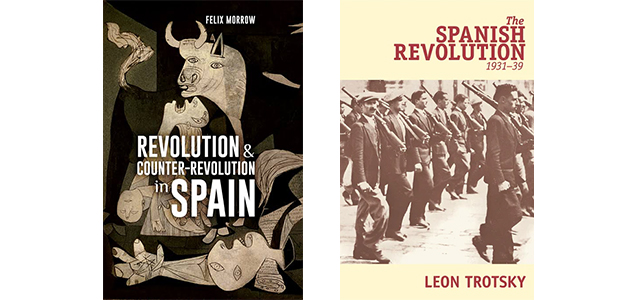
Felix Morrow’s Revolution and Counter-revolution in Spain (Pathfinder Press, 1974) was first published in 1938 by the publishing house of the American Trotskyist Socialist Workers Party. Despite its age it’s as fresh as paint and a vital read. If you like it the next jumping off point should be Leon Trotsky’s The Spanish Revolution, 1931-39 (Pathfinder Press, 1973) contains his various articles on events in Spain. A tad hard on the POUM in my estimation but a great read.
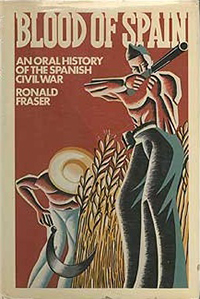
Finally, my favourite book of all is Ronald Fraser’s Blood of Spain: An Oral History of the Spanish Civil War (1979, then Verso, 1993) which first appeared in 1979 and contains interviews with hundreds of participants from all sides in the Civil War. It brings events to life in a way which moves beyond conventional history and it caught up with people in the final years of their life and thus gave them a voice. I’ve re-read a score of times.
There are many more books I could have chosen, and I have not even got on to novels, but I need to end somewhere.
Before you go
The ongoing genocide in Gaza, Starmer’s austerity and the danger of a resurgent far right demonstrate the urgent need for socialist organisation and ideas. Counterfire has been central to the Palestine revolt and we are committed to building mass, united movements of resistance. Become a member today and join the fightback.

Chris Bambery
Chris Bambery is an author, political activist and commentator, and a supporter of Rise, the radical left wing coalition in Scotland. His books include A People's History of Scotland and The Second World War: A Marxist Analysis.