
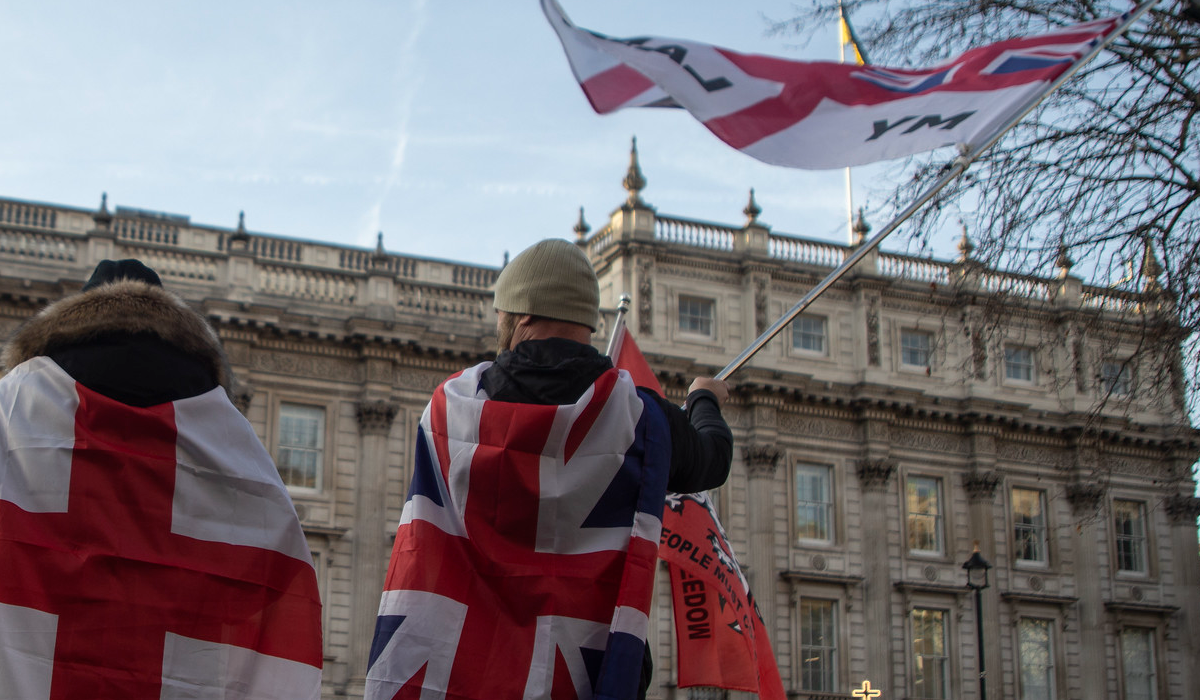
 Tommy Robinson’s Christian-right rally at Whitehall, December 2025. Photo: Flickr/Steve Eason
Lindsey German on the diminutive demagogue and Labour hopeful Andy Burnham
Sweaty, coke-fuelled, would-be Fuhrer Tommy Robinson presided over one of the biggest fascist failures since the Beer Hall putsch on Saturday. A sparse rally of at most 50,000 looked like a poorly-attended church fete spread across the ludicrously large area of central London granted to it by the Metropolitan Police.
Some of Tommy’s gang were dragging 4-foot-high wooden crucifixes, piles of which were paid for by the organisers, behind them. A clankingly high proportion seemed to be dressed as crusader knights with chain mail armour, at serious risk of rust as a late afternoon shower set in.
Meanwhile 250,000 people marched on the demo to commemorate the 78th anniversary of the Palestinian Nakba, and to oppose the far right. It was a very effective and large united movement. So a good day for the Palestine movement and a bad day for the far right is the verdict from Saturday’s marches.
This despite the best efforts of the Metropolitan Police, the right-wing media and the government to favour the far-right march, to denounce the Palestine movement, to accuse it of fostering antisemitic hatred, and to minimise its impact. Both Keir Starmer and police commissioner Mark Rowley talked about banning the marches, record levels of policing were sanctioned at a cost of £4.5 million, and armoured cars roamed central London in scenes reminiscent of Belfast in the 1970s.
The relative failure of the Tommy Robinson operation (although it is still much too large for anyone’s liking) contrasts with its high point last September when a much larger march terrorised central London, and thousands broke away from the main march to try to attack a much smaller counter-protest in Whitehall. How do we account for the difference?
One reason is the mass Together march two months ago which brought half a million people onto the streets of London to say no to racism. That sent a message of opposition to the politics of hate espoused by the far right. Saturday was important to ensure that the right was not able to reverse the impact of that march by showing that anti-racists and pro-Palestine campaigners were in the majority.
There will be a range of other reasons: there are internal divisions within the far right; the electoral polarisation to right and left may not help Robinson, and indeed he stressed the need for his followers to move into electoral politics; last September’s march followed a summer of pickets of refugee hotels and ‘raise the colours’ flag waving. It’s also interesting how reports of his rally said it was very much US-dominated and themed, including with chants of ‘USA, USA’. This is no doubt because the funding and support for these highly expensive rallies comes from US right-wingers and evangelists. However, the Christian fundamentalist message does not translate in the same way in Britain, and Trump’s unpopularity is high.
But we know this is not the end of the story. Reform came top in share of the vote for the local elections, winning large numbers of seats in once solid Labour areas. The danger in Britain is that Reform, sections of the Tories (several of whose right-wing leading lights such as Braverman and Jenrick have already defected to Reform), and the fascist-led street movement manage to coalesce to establish a major electoral and street presence.
We know as well that Labour will continue to disappoint. Your Party has not got out of the starting blocks, and while the Greens have done very well in the local elections, the jury is still out on what they are likely to achieve. So the building of mass movements and demonstrations like we saw on Saturday is vital. It will require all the forces at our disposal. It is a great shame that the TUC did not call for people to join our march or do anything to encourage it. It is also regrettable that the Together Alliance, which built such a big movement in March, did not publicise or openly support the demonstration, even though a number of its component parts did.
Stopping the fascists and far-right requires deeds as well as words. It’s a great credit that we had so many out defiantly on Saturday, but we need much more to confront what is an international highly dangerous movement. The next big step for that is the International Anti-war Conference on 20 June in London. It will be talking militarism, Palestine, European rearmament, Islamophobia and how to stop the fascists.
Can Burnham wood come to Downing Street?
Keir Starmer is toast. He is a completely lame duck prime minister. Either Andy Burnham wins the Makerfield by-election in which case there will be a rapid leadership election, or by the autumn Wes Streeting, Angela Rayner and maybe others will put up against him. The election results were a shocking indictment of Labour under Starmer and even his most loyal MPs can see little hope of him continuing.
It says something about Labour’s talent pool that out of 400 MPs they can find no more favourable candidate than one who has to be parachuted in through a by-election. And come to that, Labour is the only major party never to have had a woman leader (apart from Harriet Harman’s interim sojourn after Ed Miliband resigned). But this tells you everything about neoliberal Labour, hollowed out of any views that do not conform with the leadership, and desperate to destroy any remnant of Corbynism.
The questions now are firstly will Andy Burnham win the Makerfield seat? He should do, and most likely will do, given his personal standing in the northwest. But Reform did win every ward in the constituency only two weeks ago and Farage will want to run him a close race. So it is by no means guaranteed, since there are no absolutely safe Labour seats these days. I also remember the Leyton by-election under Harold Wilson’s first Labour government in 1964. Patrick Gordon Walker, who was planned as foreign secretary, lost his Smethwick seat to a thoroughly racist Tory campaign. Parachuted into Leyton, the voters refused to elect him, resentful at being treated like this.
That’s less likely to happen here but is a possibility. However, assuming Burnham does win, the second question is how will it change things for Labour? Burnham is talking nationalising water, energy and housing (I guess that means more council houses). These are the very basics. But unless they are accompanied with drastic cuts in prices and restoration of living standards then it will mean little. That hasn’t happened with nationalised rail prices. For this Labour government to think of a second term it needs emergency measures over housing, jobs, and the NHS.
Let’s face it, Burnham is unlikely to do this, especially since the ‘bond markets’ are already jumpy that he might do anything remotely to challenge profits. So my guess is there will be a temporary boost with Burnham but it will soon dissipate unless he is prepared to stand up to the markets and the bosses. There’s nothing in his record to suggest he will. So all the issues of building the socialist left and fighting the fascists and far right still remain.
This week: I’m speaking at a fringe meeting at PCS conference in Brighton on Wednesday lunchtime. Please join us if you are a delegate. I’m also doing a Counterfire online meeting on women for Devon and Cornwall group on Tuesday. I have been watching Believe Me on ITVX which is the dramatisation of the John Worboys rapist taxi driver case. Yet again, women not believed, their cases dismissed, and the whole attitude of the Metropolitan police to these rape crimes quite shocking. Worth a watch.
Before you go
The ongoing genocide in Gaza, Starmer’s austerity and the danger of a resurgent far right demonstrate the urgent need for socialist organisation and ideas. Counterfire has been central to the Palestine revolt and we are committed to building mass, united movements of resistance. Become a member today and join the fightback.

Lindsey German
As national convenor of the Stop the War Coalition, Lindsey was a key organiser of the largest demonstration, and one of the largest mass movements, in British history.
Her books include ‘Material Girls: Women, Men and Work’, ‘Sex, Class and Socialism’, ‘A People’s History of London’ (with John Rees) and ‘How a Century of War Changed the Lives of Women’.