
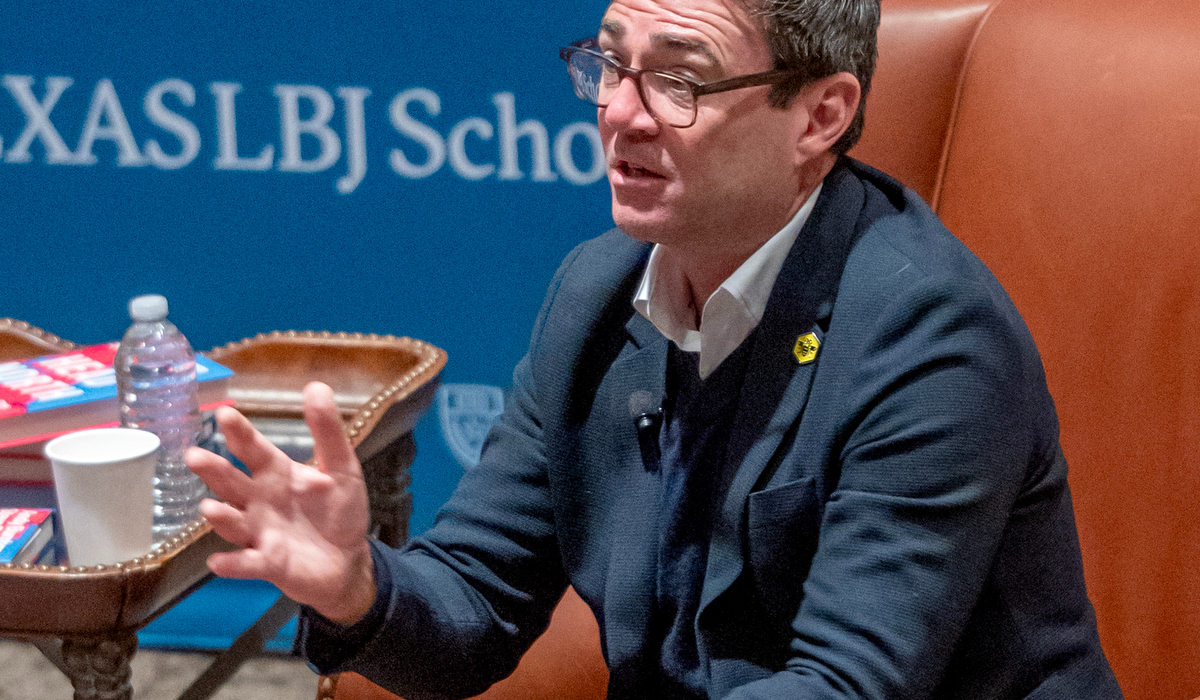
 Andy Burnham at the University of Austin in 2025. Photo: Flickr/Jay Goodwin
Lindsey German on Labour at the crossroads and reshaping political trade unionism
We should not allow Keir Starmer to leave the political stage feted as a decent man who made Labour electable and fought off the Corbynite dragon. And we shouldn’t judge his legacy by the fawning obnoxious display in the House of Commons last Wednesday as those who hated or despised him, or just thought he was useless, roundly praised everything he had done. Nor should we for a minute accept his view that he left the country in a better place than when he took over.
He has presided over worsening living standards and a cost-of-living crisis, has facilitated the rise of Reform, pandered to racist and nationalist ideas, and done nothing to halt the crumbling infrastructure and crisis of morale in the public sector. His statement that Israel had the right to cut off water and electricity to the people of Gaza not only lost him many votes, but will haunt him forever. Labour canvassers now admit how damaging this was, though Palestine is rarely cited in the media as a reason for his downfall. His determination to support war in Ukraine and the Middle East, and his prioritising of arms spending over health and education, make Britain more dangerous not safer.
What does all this mean for his successor, Andy Burnham? He will gain just by not being Starmer. But the signs that he will effect real change are not so promising. Already we are hearing that he will allow drilling for oil and gas in the North Sea – a policy urged by the right wing, including Reform and Trump. He is scrapping ID cards, and no doubt will make other attractive promises as he enters Downing Street. He has criticised neoliberalism – not something that would have passed Starmer’s lips – but it’s not clear he knows what to do about it.
Burnham faces several major problems. One is the economic crisis which is expected on an international scale with the closure of the Strait of Hormuz, and which will impact a British economy already weak compared to its rivals. Unemployment among young people is already high, and the lack of jobs for skilled workers like nurses is notable. His pronouncements so far suggest Labour’s right still have a lot of influence, from the oil and gas decision to the likely appointment of Shabana Mahmood as chancellor. He will be under pressure from the right and Labour’s grandees like Neil Kinnock not to rock the boat.
Big business is already very wary of him, putting demands to restrain any serious attack on employers, landlords and the rest. There is little sign, however, that he seriously wants to challenge the fundamentals, as his record in Manchester and previously in government shows. He also shows little sign of breaking from the government-by-focus-group consensus which is by any standards both a poor and unprincipled way of operating. Unprincipled because it accepts public opinion rather than trying to change it; poor because it has no understanding of how and why ideas change. It is one factor in the deadening of politics which has marked the neoliberal period.
One area where he is unlikely to make change is foreign policy. Sure, he has said Labour didn’t get it right over Palestine, but he tends to focus on not calling for a ceasefire early enough, rather than because the government supports and arms Israel and denies the genocide. Starmer always claimed Britain was not involved in Trump’s illegal war in Iran, but US planes fly from British bases and there is no condemnation of his war crimes in bombing schools, hospitals and railways. Burnham won’t break with the Nato war machine or challenge the obscene levels of money channelled to arms spending.
Where Burnham certainly will make some change is within Labour itself. Labour activists have been unable to defend Starmer on the doorstep and have been thoroughly demoralised by his internal witch-hunting. So there is already a sense of the left trying to get its act together, and anecdotal evidence of people who have resigned giving it another chance. Calls to restore the whip to Diane Abbott may be successful. So Burnham will help to improve morale and stabilise the party internally – for now.
This isn’t great news for the Greens, who have made hay under Starmer, scoring remarkable victories in the local elections, and increasing their membership under Zack Polanski. They may find it harder going now, as may the various socialist and left independents. Burnham will also be helped by the turmoil within Reform. Farage is clearly in some sort of crisis, despite success in the locals, the party’s by-election results recently have been poor, and the Clacton by-election looks much more like farce than political opportunity.
But all of this is conditional on Burnham making enough of a difference to win back Labour support. And that is still an open question. The key here remains campaigning – whether through trade unions or movements – to ensure that what the government does benefits working-class people. Or else we will see Reform – and worse – on the rise.
Why politics in the unions matter
I’ve just filled in my ballot paper for the Unite general secretary elections. I’m voting for Simon Dubbins who is challenging the incumbent, Sharon Graham. Graham proclaims herself ‘the workers’ candidate’ but that isn’t the case. She has promoted a ‘back to the workplace’ agenda, with some successes but also failings, for example in steel and cars. But to see this as the only issue, I’m afraid, only misunderstands the class struggle, seeing it from an economistic and sectionally narrow point of view.
From any serious Marxist viewpoint, it is about the entirety of class struggle and the balance of forces between employers and workers. Here Graham supports environmentally damaging oil and gas drilling, welcomes more arms spending in the name of saving jobs, and has lobbied hard to stop Ed Miliband becoming chancellor because he favours net zero. She has not supported the Palestine movement and under her leadership the union has disaffiliated from the Stop the War Coalition.
Socialists shouldn’t be fooled by her standing on picket lines while carrying out these politics. Nor should they accept her ‘anti-politics’ approach, some speculating that she will disaffiliate the union from Labour. That’s highly unlikely, and she is as involved in backroom politics and lobbying as much as most trade union leaders. She has moved to the right since her last election. I don’t agree with Simon Dubbins on everything, and I certainly don’t believe that any union leader can make a fundamental difference without mass struggle from below. But he is committed to more democracy in the union, taking the fight to Reform, and supporting international solidarity. And that would be a big step forward.
This week: I will be at a conference in Germany at the weekend, discussing trade union opposition to war. Also going to a meeting on how to fight back against attacks in the universities. And keeping up with the latest Spycops developments as former Met commissioner Paul Condon gives evidence.
Before you go
The ongoing genocide in Gaza, Starmer’s austerity and the danger of a resurgent far right demonstrate the urgent need for socialist organisation and ideas. Counterfire has been central to the Palestine revolt and we are committed to building mass, united movements of resistance. Become a member today and join the fightback.

Lindsey German
As national convenor of the Stop the War Coalition, Lindsey was a key organiser of the largest demonstration, and one of the largest mass movements, in British history.
Her books include ‘Material Girls: Women, Men and Work’, ‘Sex, Class and Socialism’, ‘A People’s History of London’ (with John Rees) and ‘How a Century of War Changed the Lives of Women’.