
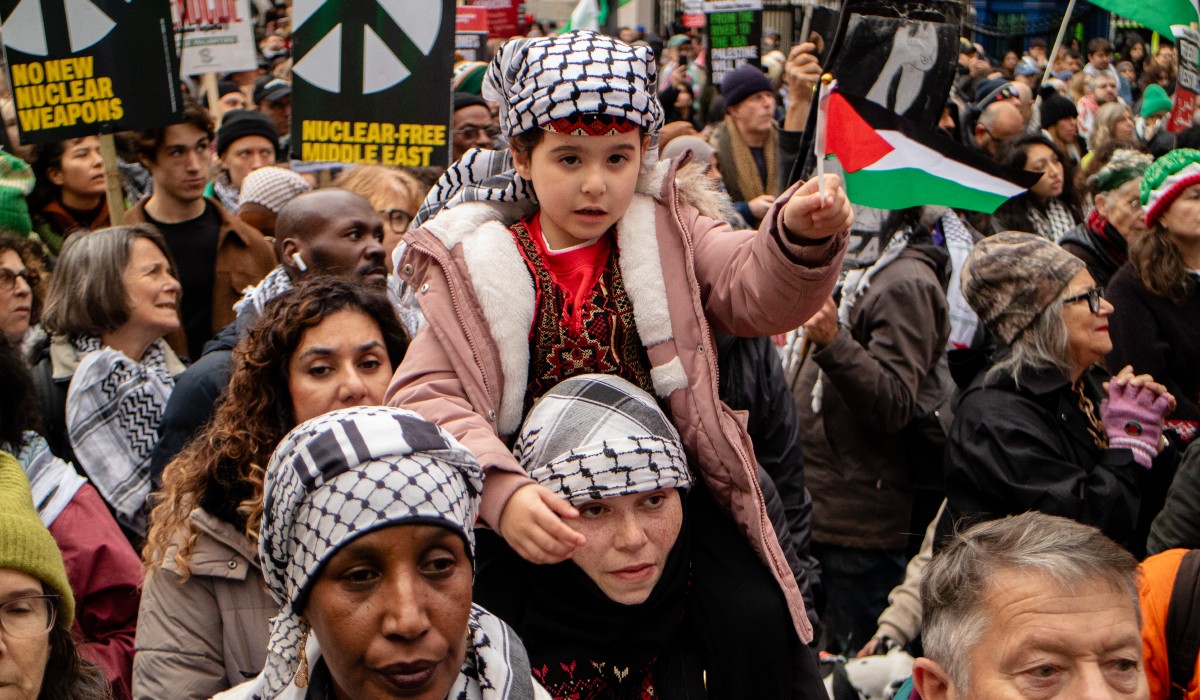
 Palestine national demonstration. Photo: Steve Eason / CC BY-NC 2.0
Lucy Nichols assesses a year of struggles against all the injustices and horrors of a difficult year
In 2025, we have seen more war, a far-right resurgence around the world (including Trump’s return to the White House), renewed austerity and a crackdown on the right to protest in the UK. The Labour government has this year shamefully attacked disabled people, benefits claimants, striking workers, pro-Palestine protestors and more.
However, the year has also had its successes. People have, at almost every turn, come together to fight against Starmer’s rightwards shift. This year, we marched for Palestine regularly, as well as with DPAC against the disability cuts, against Trump’s visit and against Rachel Reeves’ austerity budget. In the last few months, there seems to have been a rise in the number of people going on strike, and while these have largely been rather small and fragmented, they signify potential for wider workers’ struggle.
The war machine rages on
Militarism is ramping up across the world. Conflicts backed by powerful players rage in Sudan and Congo. Trump threatens Venezuela, and the EU and Nato seem to want us to believe that a new, Europe-wide war is imminent as more Nato countries back conscription.
As Zahid Rahman argued earlier this month, ‘for working people, this means conscription, austerity, repression, and the growing expectation that they should sacrifice their lives for conflicts over which they exercise no control.’
The war in Ukraine was the world’s deadliest conflict in 2025: 78,000 people (from Russia and Ukraine) were killed this year alone (according to the Armed Conflict Location & Event Data Project). The overall death toll is huge and will only grow unless there is an end to the war. However, with Ukraine limping on and the EU and Nato insisting on keeping it going, it is unclear whether there is an end in sight, despite almost a year of Trump attempting to bring about a peace deal.
This has not gone on without opposition. The international anti-war movement is strong, and despite all the propaganda, the ‘welfare not warfare’ argument is very popular in the UK and abroad. In June, anti-war activists convened in Paris at the huge ‘Contre Le Guerre’ conference, attended by delegations from nineteen different countries, including Russia and Ukraine. There has been a huge level of pushback across Europe, with general strikes and walk-outs in Italy, Greece, and Spain.
This October marked two years since the start of Israel’s genocide in Gaza. Trump’s farcical two-month ceasefire ended abruptly in March after Israel re-started its bombing campaign in Gaza. Another attempt has since been made to put an end to the conflict, though Al Jazeera reports that Israel has violated the latest ceasefire 738 times since it went into effect on 10 October.
Israel has also steadily been attacking Palestinians in the West Bank. As well as the twelve-day-long assault on Iran in June, Israel has frequently bombed Lebanon this year and has carried out an average of six attacks per day this December.
This would not be allowed to happen without support of the US and its allies. Despite recognising a Palestinian state and sanctioning some Israeli ministers, Starmer’s government has remained largely uncritical of Israel in 2025, instead choosing to crack down on those standing up against Israeli genocide and warmongering.
Defending the right to protest
The state crackdown on the Palestine movement became obvious at the very start of 2025, with police banning us from marching to the BBC on 18 January. The Metropolitan Police then arrested Chris Nineham after a small delegation from our rally attempted to make its way toward the BBC. Cases have been brought against Chris, Ben Jamal, Alex Kenny and Sophie Bolt in an outrageous attack on the right to protest. Kneecap and Bob Vylan have also been brought before the law for demonstrating solidarity with Palestine, to huge uproar. The massive national demonstrations for Palestine have, however, continued, despite smears calling us antisemitic or violent, and other attempts from the state to slow us down.
This was also the year in which the government proscribed Palestine Action as terrorist. Thousands have since been arrested for protesting the proscription, including hundreds in one day after a sit-in in Parliament Square.
Most recently, the state has acted despicably in its treatment of the ‘Prisoners for Palestine’ on hunger strike. The hunger strikers, all of whom are in prison accused of taking part in Palestine Action activities, demand immediate bail, and the right to a fair trial: some of them have been locked up for over a year while awaiting their trials.
Austerity, asylum seekers and the far right
Any hopes in the first Labour government in fourteen years were put firmly to bed this year. Rachel Reeves has continued a path of austerity. The Spring Statement announced huge cuts to welfare, with disabled and ill people to be the worst hit. The Department for Work and Pensions estimated that these cuts would push 250,000 people into poverty, a figure which then rose to 400,000 according to Disability Rights UK. After a huge level of opposition, including a large ‘Welfare not Warfare’ march organised by DPAC in March, the government rode back somewhat, though planned cuts will still hit future Pip claimants. The government’s latest budget in November also brought little relief: though the government has finally canned the two-child benefit cap and is increasing minimum wage, little is being spent on public services or to end the crisis in the NHS, and little is being done to ease the cost-of-living crisis.
Instead of providing public services with the investment that is so badly needed, and putting an end to austerity, the government is turning the blame elsewhere.
Labour has been just behind Reform in its attacks on migrants, refugees and asylum seekers. Instead of countering Reform’s racism, Labour seems to be doubling down and has spent the year introducing draconian policies and spouting racist clichés. In May this year, Keir Starmer echoed Enoch Powell in his ‘island of strangers’ speech. Shabana Mahmood introduced new laws that make it far more difficult for people to claim asylum in the UK, and, as Kevin Ovenden argued in November, these remind one of 1930s Germany.
Instead of winning supporters away from Reform, Labour’s depraved attacks on migrants have served to bolster the far right and racists. Nigel Farage, despite being condemned for his racism as a schoolboy, has had a very successful year. Reform did incredibly well out of the May elections and now control twelve local councils. Despite losing out to Plaid Cymru in Caerphilly in October, the party looks reasonably strong as we move towards the 2026 local elections.
It is not just Reform that has grown in 2025. After a huge and terrifying summer showing in 2024, the far right also took to the streets regularly in the summer and autumn of this year. In July, riots broke out in Epping after an asylum seeker from an Epping hotel assaulted a local girl. This sparked a number of similar demonstrations across the country and an outburst of racist, Islamophobic rhetoric from across the right (and the Labour party). Unfortunately, Tommy Robinson attracted hundreds of thousands to central London in September, backed by Elon Musk and outnumbering the left counter-protest.
The left has had more success in pushing back the far right elsewhere. Bristol, Glasgow, and Falkirk saw the far right surrounded, and Ukip were scared off completely from their plan to march through Whitechapel.
In December, the Together Alliance launched their national demonstration against the far right, and hopefully hundreds of thousands will take to the streets on 28 March 2026 to prove that the far right and fascists are not welcome, and that racism and Islamophobia will not go unopposed.
Working people strike back
Though far from the level of industrial action during the 2023 strike wave, several disputes have sprung up in 2025 as workers fight to improve their pay and conditions. Bin workers in Birmingham have been on a well-reported strike, and had a well-attended mega picket in May.
Unison members at the Greater Manchester Early Intervention Service won their dispute over pay, and UVW (United Voices of the World) members at Epsom and St Helier’s Hospital Trust won fair pay under their NHS contract after threatening strike.
The BMA has walked out three times this year, and met with significant public support despite serious attempts by Wes Streeting to undermine resident doctors, calling them ‘moaning minnies’ for demanding fair pay and employment opportunities. Members of the NEU, UCU, Unison and Unite across England and Scotland have also been on strike for better working conditions, proving a serious level of fightback.
The Employment Rights Bill, passed after a long campaign by the TUC, marks the most serious step forward in workers’ rights in years, despite having been watered down. The new Renter’s Rights Act, which bans no-fault evictions, is another development that will make life slightly easier for the around 20% of UK households living in rented accommodation.
Elections, and the Party (finally) starts
In July of this year, Your Party was finally launched, sparking hope in thousands that a new left electoral project could offer an alternative to the Labour status quo and Reform’s rise. It was not long after this that the infighting begun, very publicly. After a very rocky start, the party’s founding conference did prove, however, that rank-and-file members have the will to make Your Party a success. Thousands have already self-organised into branches, of various natures, and the party membership has begun to take part, meaningfully, in various local and national campaigns, for instance by supporting the Save Newham Libraries campaign and supporting striking bus drivers in East London.
Outside of Your Party, the left has had a few electoral successes. Preston Independents got four councillors elected to Lancashire County Council in May, and there have been ‘Palestine plus’ independent victories elsewhere.
The Green Party made a decisive turn leftwards in September with the election of Zack Polanski. Support for the Green Party shows that progressive politics are growing in popularity: if only Your Party could capitalise on this in a more meaningful way with an explicitly anti-imperialist platform.
Internationally, we saw Catherine Connelly win the Irish Presidential Election despite a rise in far-right ideology there. Mamdani’s monumental win in New York will, we can hope, improve living conditions in New York, and strengthen the American left against Trump.
La Lutta Continua
We finish 2025 having fought incredibly hard on a number of fronts. There have been a number of key victories and despite all the difficulty, the left is in a reasonably strong place.
Our task is to keep pushing forwards, to build and fight for a genuinely democratic, socialist, anti-Islamophobic Your Party but to recognise that politics is more than elections.
We must build the next Palestine march on 31 January. We will continue to march at least until there is a meaningful ceasefire, and argue that in marching for Palestine, we are also fighting to protect our right to protest. With this in mind, we will defend those with charges brought against them and support Chris Nineham and Ben Jamal on their first court date in February.
We will go on fighting the far right and mobilise as many people as possible on 28 March in central London, as part of a broad, united front against fascism. In June, we will welcome comrades from the international anti-war movement at the second international conference ‘Contre le Guerre’, this time in London.
Counterfire has been actively involved in a number of struggles and has made key interventions in the movement, through our regular Revolution events but also by taking part in organising, joining picket lines and mobilising for major demonstrations. We will continue to do so in 2026 and encourage others to join us in this.
Before you go
The ongoing genocide in Gaza, Starmer’s austerity and the danger of a resurgent far right demonstrate the urgent need for socialist organisation and ideas. Counterfire has been central to the Palestine revolt and we are committed to building mass, united movements of resistance. Become a member today and join the fightback.
