
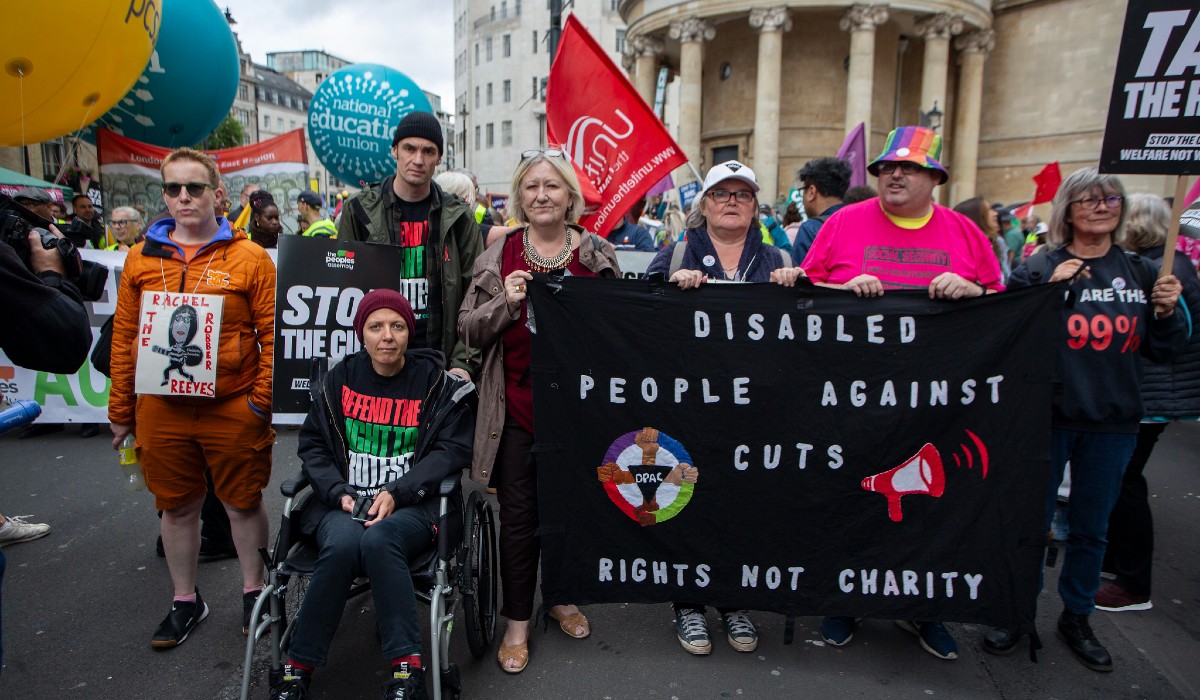
 People’s Assembly anti-austerity march, London 7th June 2025 / Photo: Steve Eason / CC BY-NC 2.0
Today’s U-turn on Pip shows the weakness of Starmer in the face of massive public anger. The campaign against the welfare cuts must continue, but we can win, argues Kevin Ovenden
The Starmer government managed to pass its welfare-cuts bill so that it can progress further to becoming law, but the prime minister’s authority was visibly draining on Tuesday. The second reading vote was 335 for and 260 against, but Labour has 403 MPs. The seemingly invincible majority has been slashed. That was despite concession after concession made right up to the second half of the debate before the vote.
The prior concession was to introduce a two-tier system in which those already receiving benefits to assist them in living independently and in dignity - Pip – would continue to get them but they would be restricted for new claimants. That peeled away some of the 120 rebel Labour MPs threatening to kill the bill in parliament. Apparently, it was not enough.
So, in the middle of the debate, the welfare minister Stephen Timms announced that the whole issue of cutting Pip was to be delayed until his own commission, the report from which disabled people are meant to have an equal voice in developing, reports in the autumn of next year. There is still confusion, as he refused to say that the commission’s findings would be voted on by MPs. It is likely that there will be more concessions in the next committee stage of the bill’s progress.
Nonetheless, already some things are clear as day. The government has suffered a humiliation and those who have brought it about are disability activists themselves and their supporters. There was lots of shock in the Westminster journalists’ lobby a week ago at the number of Labour MPs signing a rebel amendment. Those 120 names were a reflection of a deep reaction nationally against the attack on welfare and disabled people.
Starmer’s brutish chief of staff, Morgan McSweeney, had berated MPs, claiming that most people, especially the Reform voters he says he is targeting, favoured the cuts. A More In Common survey found that most do not and that Reform voters are more likely to think the government’s proposals will not help disabled people than Labour voters do. Protests around the country on Monday and Tuesday were simply a visible expression of something much deeper. There has been intensive pressure upon MPs.
The slogan ‘welfare not warfare’ has become a common sense for all sorts of people engaged in campaigns ranging from free school meals, to scrapping the two-child limit on benefits, to disability support and pensioner heating help in winter.
And while nowhere near sufficient, let alone reversing course and beginning to put right the damage of the Tory years, the government, that is not yet a full year in office, has ended up having to make one concession after another. It is now on its second relaunch. This is at the same time as there is majority opposition to the Starmer government over Palestine and rising concern about its penchant for removing civil liberties and engaging in authoritarian clampdowns.
Protest works
Now we have another debacle as cuts we were told were crucial in order to avoid a run on the money markets, as happened under Liz Truss, are proven suddenly to be a cruel political choice and not a necessity after all. The woodentop chancellor, Rachel Reeves, is now in a quandary. If this amputated bill does go through, it will immiserate the lives of future disabled people, but it will not achieve the level of cuts she demanded. So following the remorseless – and dumb – Treasury logic, she will be looking for cuts to other areas of the welfare budget. The fabled bond markets may easily come to the conclusion that lots of ordinary people in Britain have come to, but for different reasons: the chancellor of the exchequer is a joke.
Also, an unpleasant one. The Labour government has managed in two weeks to show that it is not only nasty, it is also incompetent, cowardly and will back off when it faces serious and concerted resistance.
The wrangling and finger-pointing in the government will surge now at the beginning of a long, hot summer in which dissatisfaction and outright anger is at its highest level in living memory against a government only twelve months into office. There will be more chaos and shambles in the dying days of this parliamentary session as Labour tries to get its welfare cuts and other measures through.
The lesson is to exert maximum, mass democratic pressure. Those MPs who signed a ‘reasoned amendment’ that would have killed the bill but who went on to vote for something which still cuts support for disabled people are particularly vulnerable. There will be further votes. Find out how your MP voted and let them know what you think.
This and mass campaigning and protests are the way to win things now. The last two weeks have shown that. Associated with this situation is the need to provide a credible political alternative so that MPs recognise that their voters do have somewhere else to go. That can bite hard into those Reform voters who genuinely oppose the disability cuts – Reform’s vote is highest in areas with greater ill-health – but are identifying with a party of posh Thatcherites who want to slash welfare and give tax breaks to the rich.
An awful lot of things are unfolding at the start of summer. One of them is that the Starmer government is in a very weak place. Opposition to it is at its most limited inside the Labour Party. However, all opposing it in the streets and workplaces should take heart from this week. The disability cuts can be stopped.
The government is way out of kilter with where public opinion is on so many issues. Welfare not warfare is an increasingly commonplace sentiment that unites many issues that people are angry about. The task is to provide more ways for people to take effective action over them.
Before you go
The ongoing genocide in Gaza, Starmer’s austerity and the danger of a resurgent far right demonstrate the urgent need for socialist organisation and ideas. Counterfire has been central to the Palestine revolt and we are committed to building mass, united movements of resistance. Become a member today and join the fightback.

Kevin Ovenden
Kevin Ovenden is a progressive journalist who has followed politics and social movements for 25 years. He is a leading activist in solidarity with the Palestinian struggle, led five successful aid convoys to break the siege on Gaza, and was aboard the Mavi Marmara aid ship when Israeli commandoes boarded it killing 10 people in May 2010. He is author of Syriza: Inside the Labyrinth.