
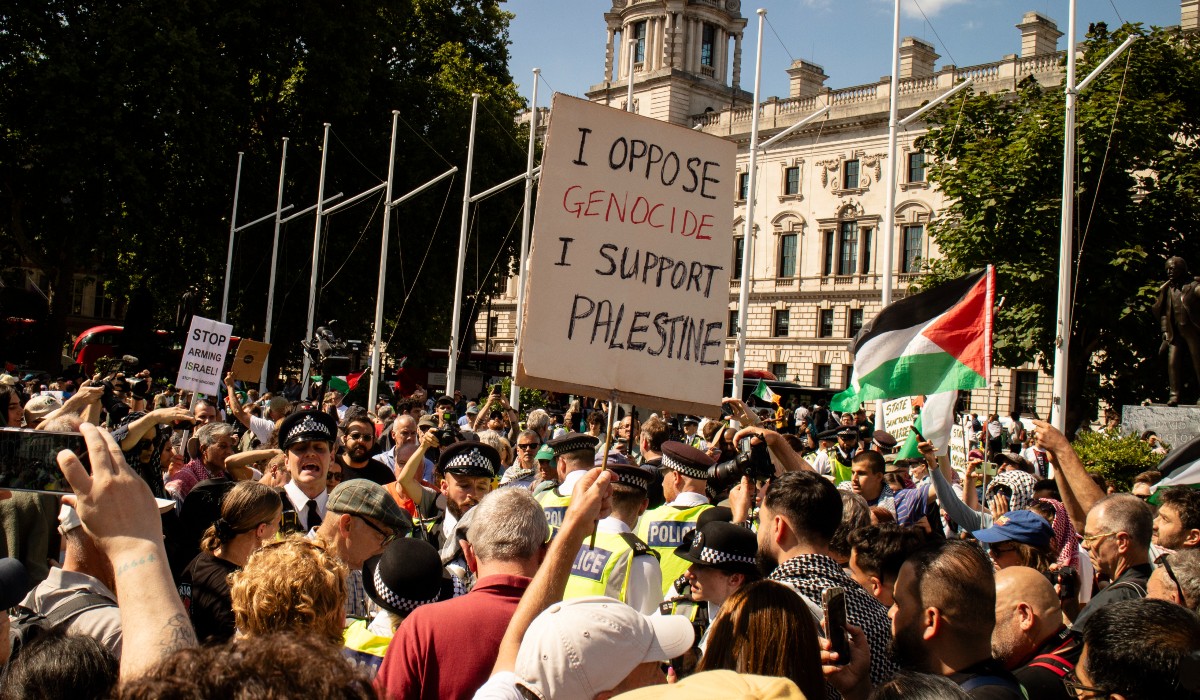
 Defend Our Juries protest in Parliament Square, 9 August. Photo: Steve Eason / CC BY-NC 2.0
Saturday’s Defend Our Juries protest for Palestine was a peaceful demonstration in defence of democratic rights, despite the arrest of over 500 people, reports Carole Vincent
On Saturday, 4 October, I arrived at Trafalgar Square where, having been moved from Parliament Square, I expected to see thousands of people sitting silently in a protest against the proscription of Palestine Action called by Defend Our Juries, their fourth such mass action.
Instead, I thought I’d stumbled upon a police parade ground with all four corners of Trafalgar square, with its iconic lions and fountains, peppered with lines of every police force in the country, gathering in number as the time passed.
I then mingled with the few dozen people who’d arrived just after midday, either with ready-made placards or the materials with which to write the slogan, ‘I oppose Genocide, I support Palestine Action’, which has been proscribed by former Labour Home Secretary Yvette Cooper.
Defend Our Juries had, over the past couple of months, argued that the proscription of Palestine Action as a terrorist group under the Terrorism Act was not lawful, and the ban been challenged by a founder member of the group, Huda Amori. There had been three previous silent protests by members of the public, many of whom had never before protested, let alone put themselves in a position of being arrested under the Terrorism Act, with a possible fourteen-year prison sentence, if found guilty.
As the clock moved towards 1pm, gradually the square was filling up with people of all ages, abilities, ethnicities, faiths and none. They silently sat or lay on the ground with their signs. As they did so, more police vans encircled Trafalgar Square, filling side streets too. The lines of different police-force personnel swelled in numbers, and as supporters watched, the order was given and officers of all ranks moved swiftly to remove what now appeared to be several thousand silent protesters.
Some were clearly targeted by the police, having been pointed out by officers. Cameras and video surveillance were everywhere, while there were also two helicopters watching proceedings, circling the area.
The day was clear and warm, and as the wind direction changed, the spray from the fountains appeared like light rain. The noise of clapping was getting louder with every person who was arrested and carried away being shown support.
Some protesters that stood out were Jewish, including Holocaust survivors asserting, ‘Not In My Name’. Protestors in wheelchairs and electric scooters were lifted up because they wouldn’t break their silence and give their details to police. There was even an elderly blind man tapping his stick as he was flanked by two officers leading him to a police van to be ‘processed’.
There had been a request by the Home Secretary on behalf of the government and the police to postpone the protest following the attack on the Heaton Park Synagogue in Manchester. Following this tragic event, much was made in the media of this vile attack on Jews. However, the same media treats the tragedy that has befallen the Palestinians in Gaza and the West Bank for exactly two years now very differently.
Meanwhile, in Trafalgar Square, more people were being carried or dragged to awaiting vans and detention in custody suites. There were about 500 conscientious people arrested for engaging in entirely peaceful protest against an unjust law. This brings the total number of those arrested over the various demonstrations to about 2000. These arrests lie in stark contrast to the policing of far-right protestors, the character of whose demonstrations is far more like ‘hate marches’ than any of those over Palestine.
We must continue to defend our democratic right to protest, and our government’s complicity with the crime of genocide in Gaza. The National March for Palestine in Central London this coming Saturday, 11 October will mark two years of the war and needs to be as big as possible to show that we will not be silenced. As Nelson Mandela said, ‘We know only too well that our freedom is incomplete, without the freedom of the Palestinians.’
