
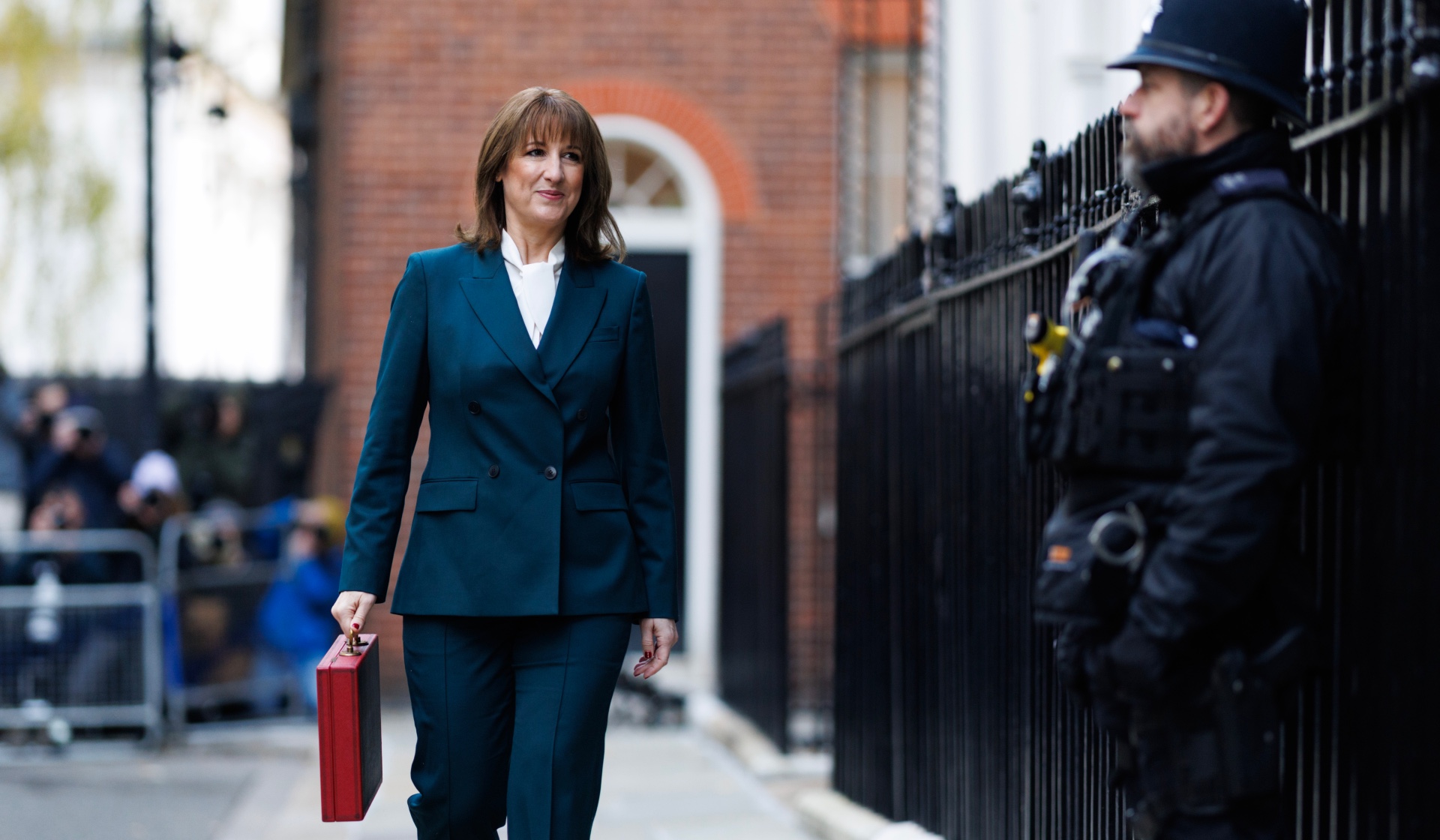
 Rachel Reeves preparing to deliver the 2025 Budget/UK Government, CC BY 4.0, via Wikimedia Commons
Rachel Reeves’ measures have not done anything serious to tax wealth, and will not solve either the cost-of-living crisis or any of the economy’s structural problems, argues Dominic Alexander
This budget immediately looks as if it will please no one, except perhaps the banks, who’ve escaped from any imposition on their profits. There are a range of very small tax rises for the wealthy, like the marginal increase in dividend taxes, and the so-called ‘mansion tax’, which will raise only a paltry £400-450m, but that’s pretty much it. There’s no equalisation of capital gains tax, one of the possible measures discussed in the run-up to the budget but abandoned here.
It is, of course, very welcome that the two-child benefit cap will be abolished in April, and that the minimum and living wages are to rise. However, if there is some relief for the poorest, the freezing of income-tax thresholds will hit those on low incomes who get pulled into the basic rate due to inflation, and the overall burden will closely mirror what an increase in the basic rate of income tax would have done anyway. Raising income tax would actually have brought in more from the wealthy than this measure does. The ‘middle’ (most working people) is being squeezed for some marginal benefit to the poorest, and to avoid making the wealthy pay a fairer share.
Calling this a true ‘Labour’ budget ‘demonstrating Labour values’, as the Tribune group of MPs has, is certainly wide of the mark. Billionaires have seen their wealth grow by more than £370 billion since 2010, and yet there is no attempt at all to tap into this huge hoard of private affluence.
Despite the budget leaving the banks and the City alone, for which the bond markets have shown gratitude by giving the government a good day, it’s unlikely the fiscal hawks will be placated for long. Although the government’s spending ‘headroom’ has increased to £22bn, much remains uncertain about the forecasts, and public-sector debt is projected actually to increase slightly to 96% of GDP by 2030-31. The Office for Budget Responsibility (OBR) thinks the chance of the government reaching its ‘fiscal mandate’ is only 59%, up from 54% in March. It’s worth noting also that the OBR’s projections for productivity growth in the long term have been downgraded to 1%, down from 1.3%. This means that no one thinks AI is going to deliver the benefits that have been promised.
One estimate is that the ‘headroom’ is really only £15bn. The famously pro-austerity OBR notes that while the budget ‘addresses some fiscal risks and increases the margin held against the Government’s fiscal targets, it still leaves the UK public finances relatively vulnerable to future shocks’. In the current world climate, and with the AI bubble likely to burst at some point, shocks are what are most likely to happen, so it won’t take much for this budget to unravel quickly. Despite the Chancellor’s desperate efforts to please capital markets and the austerity lobby, they will return to the attack soon enough. This budget is likely to be a failure in the government’s own terms.
Meanwhile, most people will be affected by the various tax rises, of which the freezing of thresholds is the most important, and together they will raise £26bn, the greater share of which comes from the working class in general, rather than the wealthy. The government’s claim that with the budget’s measures, the poorest 10% gain most relies on including benefits from various other measures on top of the tax changes. Apart from the removal of the child-benefit cap, the calculation depends upon the notional value of improved public services, and yet there appears to be little in this budget that will do anything to relieve the crisis in the public sector. The government’s claims to be helping the poorest is therefore the usual kind of ‘smoke-and-mirrors’ Treasury approach, but the magic trick won’t cover up the continuing cost-of-living crisis for long.
A black hole of political weakness
There is some money for the NHS, but funds for education or measures addressing the housing crisis are conspicuously absent. As for transport, the vaunted protection for ‘regulated’ fares won’t include most of them, so many people’s transport costs will likely go up, and there’s no sign of the investment that’s needed to restore the railways, or to improve bus networks. Apart from the absence of measures to improve services, there is also an emphasis on yet more ‘efficiency’ savings from departmental budgets set for the next few years: £4.9 billion by 2030-2031. Some of these savings are obviously not going to come through, such as those expected from a reduction in the numbers of refugees, while a stated effort to reduce tax avoidance seems to lack the specifics that would show a real commitment to make it work.
There are also various measures which take a vindictive approach to the most vulnerable, which will increase hardship without doing anything much for the government’s finances. Firstly, there are the cuts to the Motability scheme for the disabled to afford cars, and then there is a pledge to ‘rebalance’ Universal Credit rates ‘so that it doesn’t pay to be off sick rather than work’ (Budget, p.3). This appears to mean a reduction in the health-related benefits, (OBR, p.65) which apart from being cruel, will do nothing to fix the poor living and working conditions from which so many are suffering, and which are the real cause of the problems Reeves is trying to punish out of existence.
It didn’t have to be this way. There were all sorts of measures Reeves could have taken, if she had prepared the political ground for them. The Wealth Tax Commission produced a report showing that a one-off wealth tax, their recommendation, could raise £260bn over five years. Other suggestions include equalising capital gains and income tax to bring in £12bn a year, or a windfall tax on banks at £14bn a year, not to mention billions that could be saved by closing down loopholes and spending a few million rebuilding HMRC’s ability to go after wealthy tax avoiders. And there is, of course, the option of simply increasing income taxes on higher earners, or introducing new thresholds at higher levels; the tax system used to be far more progressive than it is now. Not a whiff of any of this can be found in the budget, but that’s because of the nature of this government.
Appeasing the banks, punishing the poor
It is not a great surprise that Reeves has failed to put any serious demands on banks, corporations or the wealthy in order to raise revenue, because the whole trajectory of this government has been one of weakness in the face of pressure from the City and corporate interests in general. Weakness in this direction has been the entire strategy since the beginning of Starmer’s leadership of the Labour Party, as the flip side of his ruthless suppression of the left. The entire approach has been to demonstrate total commitment to the priorities of the ruling class, even in its more reactionary aspects, through attacks on the left and the social movements, the performative cruelty towards refugees, and the victimisation of those who need social support. Attacks on the sick and disabled save meagre amounts of money, and so are really as performative as Starmer’s penchant for flags, but they are feeble gestures of reassurance to capital that the government will continue to attack its own base rather than put the lightest of demands upon business or the wealthy.
This is not just a policy that could be reversed by a simple decision. The weakness has become embedded precisely because the history of these attacks on its own base has deprived the government of any leverage it might have had in negotiations with the avatars of capital if it had been backed by strong public support. Having alienated any such support it might have used, the government cannot take up the genuinely difficult task of forcing capital to cough up its share of the funding the state needs to deal with the weaknesses of the economy.
There are no real wealth taxes in this budget, because having adopted the strategy of weakness from the start, Starmer and Reeves are now too weak to change direction in any meaningful way. In order to tax the banks’ profits, or institute a serious wealth tax, the government would have to be able to face down the bond markets. This would be feasible if the government was backed by strongly expressed public opinion, through powerful social movements, for example. That would enable a strategy of negotiation with key buyers of government debt, such as pension funds, to prepare for a major redistributive budget. However, the government has already destroyed any capacity it might have had to do this.
All that is left to do is rip up this shallow imitation of a Labour government and start building a real social and political force that could confront the social power of capital.
Before you go
The ongoing genocide in Gaza, Starmer’s austerity and the danger of a resurgent far right demonstrate the urgent need for socialist organisation and ideas. Counterfire has been central to the Palestine revolt and we are committed to building mass, united movements of resistance. Become a member today and join the fightback.

Dominic Alexander
Dominic Alexander is a member of Counterfire, for which he is the book review editor. He is a longstanding activist in north London. He is a historian whose work includes the book Saints and Animals in the Middle Ages (2008), a social history of medieval wonder tales, and articles on London’s first revolutionary, William Longbeard, and the revolt of 1196, in Viator 48:3 (2017), and Science and Society 84:3 (July 2020). He is also the author of the Counterfire books, The Limits of Keynesianism (2018) and Trotsky in the Bronze Age (2020).