
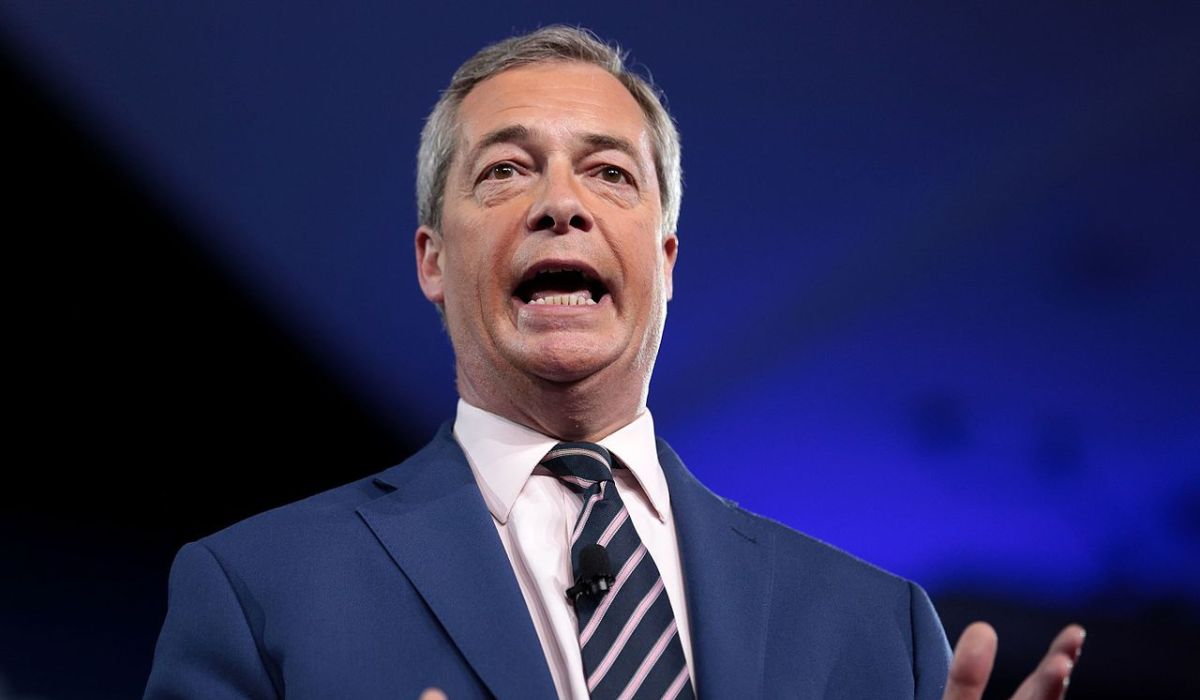
 Nigel Farage speaking at the 2017 Conservative Political Action Conference (CPAC) in National Harbor, Maryland. Source: Gage Skidmore - Wikicommons / cropped from original / CC BY-SA 2.0
Farage’s absurd and hateful plans for refugees are an issue because the media and politicians have enabled him to become important. We need a new politics, argues Kevin Crane
As the summer draws to a close, British political news is dominated by a single story, and that is Reform UK’s bizarrely named ‘Operation Restoring Justice’, an anti-immigration policy that has been unveiled with more fanfare than almost anything the sitting Labour government has delivered in a year. The contents of this document (or screed, if we’re being more accurate) are a note-perfect example of a shock that is not a surprise.
The pledges made by Farage’s party are a classic mix of big-sounding claims and big-sounding numbers, none of which is even intended to stand up to scrutiny. There’s an entirely made-up target of deporting 600,000 people over the course of five years, promises to increase the number of refugees currently in detention by an equally arbitrary 24,000 in eighteen months, along with totally unjustified claims that all this somehow saves money despite being an obvious massive increase in expenditure on enforcement, imprisonment and bureaucratic processing.
The three main political parties have, as has become normal, limited their criticisms of this lunacy to its practicalities. Labour’s main response has been to attack the plans for a ‘lack of detail’, essentially demanding a more thorough explanation of how Reform intends to do all this mass incarceration. With most of the senior front benchers currently keeping a low profile, they have left it to hapless jokers like Angela Eagle (who some of you may remember for a pathetic botched coup attempt on Jeremy Corbyn, if you remember her at all) piping up to say that Labour has deported 35,000 people in the past year, effectively claiming that it is delivering Farage-esque targets already. The Tories have claimed that Reform is simply reproducing their own policies, and the Lib Dems have an even weaker form of the technocratic opposition offered by Labour.
The media has, as is now the norm, mostly ranged from moderate to fanatical support of Reform’s position. The BBC has reproduced Farage’s claims in full, essentially uncritically, while the Daily Mail has run with the headline, ‘At last a politician who gets it’, bringing back dark memories of the days when that same paper carried headlines praising the British fascist movement in the pre-World-War-II era.
Few media outlets pointed out even the most absurd elements of the Reform UK programme, which include revisiting the Tories’ completely failed project of setting up a refugee concentration camp in the country of Rwanda, or creating a fund of ‘up to £2 billion’ to pay countries to take refugees back. Farage explicitly named the government of Afghanistan as one that he’d be willing to pay in this way, and, to the best of my knowledge, the radical news outlet Middle East Eye has been the only news source to point out that this is a suggestion that Britain could directly fund the Taliban. Both Labour and Conservative governments took us to war with this faction for twenty years; now they don’t seem to be too concerned that we might end up allying with them to oppress their own people.
Failure of establishment politics
What no one within our political system will do any more is point out that policies like these were once the preserve of the neo-Nazi far right. The refugee-bashing rhetoric of Nigel Farage today is exactly the same line pushed by the British National Party leader Nick Griffin back in the 2000s. Griffin, however, was a shunned political pariah, regarded as completely outside reasonable and respectable political discussion. Farage is given endless, mostly positive media coverage, and other politicians seem to be absolutely terrified to criticise or oppose him.
No mainstream party politician will call ‘Operation Restoring Justice’ what it is: an absurd manifesto of pointless cruelty and brutality, driven entirely by racism and beneficial only to the private companies that will be given lucrative public contracts to implement (or fail to implement, in the case of bonkers schemes like Rwanda).
The reason for this failure is not some superior political might wielded by Farage himself. Yes, he’s a canny operator, but the conditions in which he’s able to play this role are not his own creation. He is a major political figure, ultimately, because the media, led by the BBC, decided he was in the mid-2000s, and they have treated him as one ever since. Moreover, the issue of refugees arriving in small boats is only a ‘crisis’ because the political-media establishment decided to define it as one. It has taken five years of the press and senior politicians, including former prime ministers like Rishi Sunak, fixating on refugee numbers to turn it into a key question.
Farage has primarily been a vehicle for normalising a state-driven shift toward ever more extreme xenophobia. Politicians from the other parties have pointed to his popularity as a reason why they need to act more like him, freeing him to take even more racist positions and giving them excuses to do things they’ve been wanting to do anyway. It now seems highly likely that Britain is going to leave the European Court of Human Rights (ECHR), which will be a catastrophic blow against the ability of ordinary people to appeal against acts of state injustice. Both Tories and Labour have flirted with breaking with the court for some time. Now the ‘threat’ that Reform could win the next general election will likely provide the supposed justification for doing so.
Another thing no politicians point out about the persecution of refugees, other than the racism, is that none of this actually benefits working-class people in Britain. Indeed, it will only see the government spending more money on the security state, rather than on public services or productive investment. While the political parties join the race to the bottom on immigration, it also means that they can distract from talking about any issues that actually do directly impact working-class life, such as the shocking increases in both inflation and the cost of energy bills that were announced this week. It is crucial that we shift politics in this country, both to oppose the normalisation of racism that is represented by Reform, and also a political consensus that refuses to address the problems faced by ordinary people.
Before you go
The ongoing genocide in Gaza, Starmer’s austerity and the danger of a resurgent far right demonstrate the urgent need for socialist organisation and ideas. Counterfire has been central to the Palestine revolt and we are committed to building mass, united movements of resistance. Become a member today and join the fightback.
