
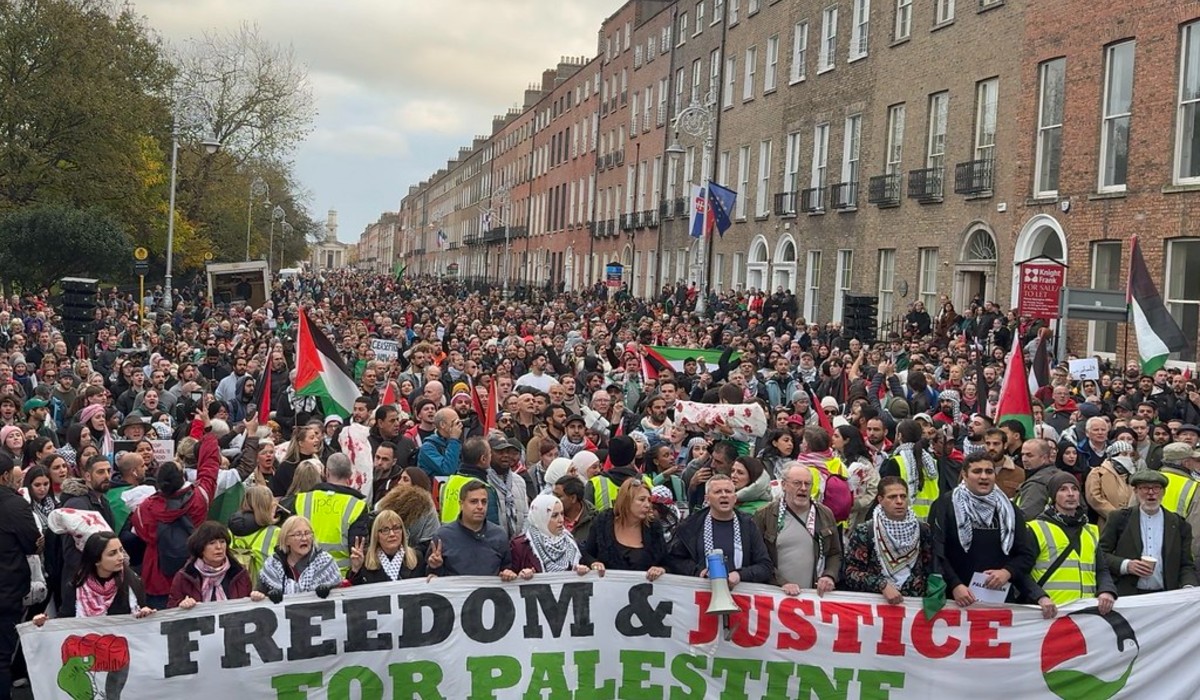
 Palestine solidarity protest. Photo: Sinn Fein / Flickr / CC BY 2.0
Dominic Alexander reviews the authoritative analysis of Zionist history and apologetics by David Cohen and Dawood Moosa, whose incisive arguments are a must-read for the world’s Palestine solidarity movement.
Apartheid South Africa was notoriously an enthusiastic supporter of Israel, so it was all the more significant that it was South Africa that filed a case against Israel at the International Court of Justice in 2023 for the crime of genocide. It was a move rightly celebrated by the Palestine solidarity movement worldwide, while Zionists inside South Africa, of course, reacted with venom.
A threatening letter sent to the University of Cape Town by a prominent South African Zionist, Hylton Appelbaum, accusing it of complicity with antisemitism because of pro-Palestine student protests there, is the starting point for David Cohen and Dawood Moosa to unravel the panoply of modern Zionist self-justifications and apologetics. From this one very particular attack, among so many similar ones across the world, on the Palestine solidarity movement, Cohen and Moosa are able to deliver a comprehensive and devastating critique of the whole range of Zionist ideological manoeuvres.
The positions taken by South African Zionists are revealed as no mere idiosyncrasy of one nation’s particular history, but as revealing the nature of Zionist apologetics in general. Here, the microcosm of the reaction to one student protest reveals the structure of the whole.
South Africa’s history as a settler-colonial state and South African Zionist responses to Apartheid present problems for their present-day representatives that, as the authors show, force them to engage in tortuous denials and obfuscations of their own history in the course of inventing the phenomenon of left-wing ‘antisemitism’ through which to attack criticism of Israel.
In accusing Palestine solidarity of ‘left-wing antisemitism’, Appelbaum and other South African Zionists have to finesse their own history of complicity with the racism of Apartheid and the explicitly colonialist project of the founders of Zionism. Cohen and Moosa show in a detailed and rigorous analysis just how profoundly the Zionists fail to achieve this. The South African Jewish Board of Deputies (SAJBD) now attempts to excuse their failure to speak out during Apartheid on the basis that, as a small minority, the Jewish community could not afford to do so. And yet, a small minority of the Jewish community were, in fact, staunch opponents of the regime, ‘upholding the long-standing Jewish tradition of internationalism’ (p.12).
Cohen and Moosa point out that, in contrast to the SAJBD, ‘the Muslim Judicial Council (MJC) – not renowned for its radicalism – declared Apartheid to be incompatible with Islam’ (p.12), and that today the Board feels it quite within its power to criticise the South African government ‘fearlessly and forthrightly’ (p.15). The argument that they were simply reflecting the majority position of the Jewish community also does not stand up, as Cohen and Moosa point to other times when Zionists were perfectly happy to depart from majority Jewish opinion when it suited their political interests to do so.
The politics of the SAJBD in fact turned on the issue of Israel, and the priority was always to support it regardless of any other ethical or political concern. In 1946, the house journal of the SAJBD, Jewish Affairs, stood against racism and promised to continue to do so. In 1948, that suddenly changed, as it adopted a ‘nonpolitical’ stance, as was explained subsequently by a Zionist spokesman, explicitly over the issue of support for Israel (p.16). They did not want to jeopardise in any way South African support for the new state.
In fact, Zionists in South Africa could not easily attack Apartheid because Zionism itself had been founded and pursued as an explicitly colonialist endeavour, reliant on violence to achieve its aims. Cohen and Moosa document this thoroughly and comprehensively, showing, for example, how Vladimir Ze’ev Jabotinsky, the founder of the paramilitary Haganah, the forerunner of the terrorist Irgun group, and of the IDF itself, was ‘opposed to the idea of a peaceful resolution to the Israel-Palestine conflict. Since Zionism was a colonial endeavour, he argued, the use of violence was indispensable to the Zionist cause’ (p.27). The necessity of displacing Palestinians meant that the Zionist project was dependent upon British imperialism from the start. The current status of Israel as a dependent outpost of US imperial power (p.45) in the Middle East is an inexorable outgrowth of that starting point.
The crisis of Zionism
Since there is no way to avoid this history without distortion, the apologists must engage in desperate attempts at deflection. Thus, in response to the charges of settler colonialism and Apartheid, Israel’s defenders point to differences from the South African case. However, Cohen and Moosa point out that the two countries’ systems do not have to be the same to be comparable, nor does the appellation of ‘settler-colonialism’ to describe Israel’s origin mean that it cannot vary from other instances of the same (p.44).
The weakness of the case in defence of Israel forces the Zionists onto the offensive; thus, the phenomenon of left-wing antisemitism, which must be found whether it exists or not. This is, of course, a pattern not just found in South Africa. The charge of antisemitism was a major weapon in the establishment’s campaign to destroy the threat Jeremy Corbyn posed to the ruling consensus as leader of the Labour Party in Britain (p.92). For South Africa’s Zionists, the idea of left-wing antisemitism serves another purpose as well: ‘Without the false cry of anti-Semitism, they would find it difficult, if not impossible, to influence the country’s political direction for their own benefit,’ since their complicity with Apartheid and ‘disdain for the black working class’ cuts them off from mass support (p.93).
Central to all this is, of course, the International Holocaust Remembrance Alliance (IHRA) definition of antisemitism. The authors devote considerable space to unpicking and refuting the many highly problematic clauses of this through a series of chapters that provide an invaluable resource for the Palestine solidarity movement to deploy against official use of it to suppress activism. Indeed, Cohen and Moosa also show how the timing of the creation and propagation of the IHRA definition was strongly tied to the rise of the Palestine solidarity movement itself (p.86). The vociferous aggression of Zionist defences of Israel lies in direct relation to Israel’s mounting weakness in the court of world public opinion.
Zionists in South Africa are strongly tied into the politics of the Democratic Alliance, the party of big business in the country (p.98), so it is no surprise to find that, when attacking expressions of pro-Palestinian sentiment among striking workers, they also peddle the worst kinds of anti-worker notions about ‘co-operative labour-relations’ (p.98), and side uncompromisingly with the restructuring plans of the employers. Cohen and Moosa point out that the ‘Zionists are using the false cry of anti-Semitism to divert attention from their hostility towards the labour movement’ (p.97).
Zionism as an arm of the capitalist ruling class means that it shares in its woes and crises, and dovetails ever more closely with its worst outgrowths. There was always an unhidden fascistic wing to the Zionist movement (p.37), but the alliance with the far right has recently become ever more evident as they ‘have embraced [Donald] Trump with enthusiasm’ (p.84). Indeed, it has become commonplace to see Israeli flags being displayed at far-right demonstrations in the UK, which renders outrage at comparisons between Israel and Nazi Germany an exercise in special pleading. A better moment for a concerted attempt to push back against official approval and use of the IHRA definition of antisemitism could hardly be imagined.
Cohen and Moosa have produced an authoritative and very valuable analysis and refutation of Zionist history and apologetics. It should be read widely, and its incisive arguments will be of great use to the world’s Palestine solidarity movement.
David Cohen and Dawood Moosa, In support of Palestinian liberation: A reply to Hylton Appelbaum, can be read in full on the Muslim Views website here.
Reposted from Muslim Views.

Dominic Alexander
Dominic Alexander is a member of Counterfire, for which he is the book review editor. He is a longstanding activist in north London. He is a historian whose work includes the book Saints and Animals in the Middle Ages (2008), a social history of medieval wonder tales, and articles on London’s first revolutionary, William Longbeard, and the revolt of 1196, in Viator 48:3 (2017), and Science and Society 84:3 (July 2020). He is also the author of the Counterfire books, The Limits of Keynesianism (2018) and Trotsky in the Bronze Age (2020).