
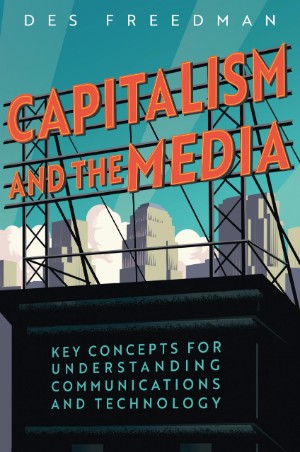
 Des Freedman, Capitalism and the Media: Key Concepts for Understanding Communications and Technology (Cambridge: Polity Press 2026), 300pp.
Des Freedman’s analysis of how capitalism shapes the media is essential reading for socialist activists to clear away the many misconceptions thrown up by its failings, finds Kevin Crane
Roughly thirty years ago, the deeply reactionary Labour MP Margaret Hodge infamously coined the phrase ‘Mickey Mouse degrees’ to describe allegedly pointless qualifications that the then rapidly expanding higher-education sector was introducing as a diversification of their offerings. The common targets of accusations of Mickey Mouse-ness always, but always, included the subject of Media Studies, which was commonly derided in the media (ironically) as an absolutely irrelevant and light-minded thing to treat as a serious subject of study. It has to be said that this off-handed hostility to analysing media in a serious and systematic way frankly looks extremely short-sighted in the mid-2020s, an era in which the quality, content, control and impact of media are a near-constant source of discontent and anxiety from almost all directions.
Today, there is a broad consensus that things have gone and are still going wrong with the media, but absolutely none on what should be done to remedy it. The political right’s ideas about media dysfunction are confused nonsense, which see them swinging wildly between demands for absolute free speech and expression when the issue is that someone, somewhere, is appealing for restraint and moderation, to then endorsing wild repressive censoriousness against ideas or issues they don’t like, most notably the Palestine movement. Never at any point does the right examine its own contradictions on these points, but more importantly, it also has no coherent critique of why the media has become so problematic in our society, usually falling back on claims that some sort of ‘liberal elite’ that is simultaneously all-powerful but also entirely unrepresentative of society has gained control. How this mysterious elite exerts such awesome power with no political legitimacy or economic power is never explained.
Debates on the left tend to be much more substantial, but still controversial and, in many cases, confused. The left has certainly had a series of very rough experiences with media change in the recent past: the shift from analogue to digital electronic communications was hailed by many as the coming of a new age of democratisation and pluralism, a perspective that looks like a sick joke as we look upon a world in which massive conglomerates wield more power than ever as they serve up an ever-more-meagre media diet of propaganda and lowest-common-denominator slop.
One response from what could be described as the radical liberal left has been to renew efforts to set up new and alternative media organisations, of which in Britain Novara Media and The Canary are examples. They believe that they can, by giving audiences a choice that isn’t simply the big corporate and state media, disrupt the stranglehold of establishment control and shift things in a more progressive direction.
While it’s undoubtable preferable that these things exist than not, there is still a solid left critique to make of their approach. New left media has a fairly low ceiling on its capacity to just compete with establishment media. This is partially a simple matter of resources, which are always a struggle for a non-corporate initiative, but there are also deeper problems. Radical liberal media doesn’t appeal to large sections of a general audience for cultural and political reasons: Novara, infamously, became associated with highly divisive culture-war positions during the late 2010s, and played a very unhelpful role in debates around issues like Brexit during the campaigning for the 2019 general election. It also takes disastrously bad positions on issues like the Ukraine war.
It’s not sufficient to simply point out the foibles of others to define one’s own political position, however, you have to present a perspective of your own, which is what this new book by Des Freeman sets out to do. Capitalism and the Media is a thorough and broad take on how socialists should examine the present state of the media in the context of the media’s position within the world’s all-encompassing economic and social systems. It is not primarily a book about how bad the state of the media currently is – there are some pretty good books about that out there already – rather it is about why the media is in a terrible state so that we might seek effective ways to change it.
Back to basics
Each of the chapters of the book follows a fixed structure, picking on a particular aspect of capitalism, running through the first principles of a Marxist position on it and then bringing the topic round to how the media specifically interacts with it. For some readers, this will make the book a moderately challenging read, but the approach serves a firm purpose in grounding the arguments and making clear why divergences between socialist and liberal takes exist and matter.
The opening of the book actually makes the interesting point that one of the strangest aspects of the media’s relationship with capitalism is the lengths it will go to not to talk about it. This often results in astonishing displays of performative stupidity, as news and documentaries and so on frequently have to express bewilderment at events that are entirely comprehensible if you simply analyse them as the result of capitalist pressure. For example, the failure of the internet to facilitate a greater diversity of news sources is understandable when you recognise that the tendency of capital to consolidate and monopolise was destructive to small media operators, many of which willingly and enthusiastically allowed themselves to be bought up and absorbed by a small number of massive tech-media conglomerates, but if you refuse to think about that, then it’s a mystery. The exciting new start-ups we were promised just aren’t there, and that’s that.
These deliberate failures are maintained by a range of structural features. One of these is class composition, which has become insanely narrow in Britain, where a staggering two thirds of people working in news media are from the richest economic social class. I noticed an example of the restrictions such social homogeneity place on the discussion of basic facts in a recent edition of the Private Eye podcast Page 94: sub-editor Helen Lewis actually said to one of her colleagues, ‘Oh, you’re not going on about global capitalism again?’ when he was trying to explain that the fossil-fuel companies are putting up energy prices and that’s why they are high. We simply can’t have explanations for some things, because the explanation is considered rude by the people whose opinions matter.
Even more insidious, however, is the commodification of media products, which imposes multiple layers of restriction on how they can be produced and distributed. Freedman uses the media’s shocking failures to report adequately the Israeli genocide in Gaza as the ultimate example of this. Media organisations have to invest resources to do reporting, and then justify that investment in return, which means not angering state censors, or alienating crucial audiences, or losing the business of advertisers, and so on. In the case of Gaza, there was so much resistance from so many institutions that it is no surprise that the media just chose to be bad at its notional function rather have a series of bruising confrontations.
A sad outcome of the media’s terrible betrayal of Palestinians has been that a worrying minority of people have begun to embrace antisemitic conspiracy theories to explain why a ‘controlled’ media failed to speak out on genocide: these misguided and unacceptable views are actually the result of seeking an explanation that is (distortedly) more comforting that the terrible reality that our society just doesn’t incentivise telling essential truths.
Systemic faults: still there whether you believe in them or not
While it is easy for the left to hyper-fixate on how the media’s failures specifically impact our causes, you can actually see capitalist problems impacting everyone and everything else. Arguably, the political right in Britain is starting to have real problems with its media ecosystem, specifically with serious contradictions that have opened up between their social and political goals, and their commercial concerns. Their media product is dependent, ultimately, on advertising revenues that require appealing to American, rather than British, advertisers.
That’s a problem for them when American and British audiences sharply diverge on an issue: this is probably the reason that almost the whole of the British right – including all the legacy newspapers and the leaderships of the Tory and Reform parties – initially declared full-throated support for Donald Trump’s invasion of Iran, only shamefacedly to drop that belligerent stance when they realised that British people were not enthusiastic and extremely worried about the impact it was going to have on their wallets. It is probably also what lead to bizarre scenes at Tommy Robinson’s recent ‘Unite the Kingdom’ march, at which English far-right protestors were baffled by a very American-flavoured rally: Robinson’s podcasts are a huge part of his grift, and they are dependent on that ad money which privileges American over British consumers.
Away from news media, capitalism is having a well-documented negative impact on culture. Hollywood has been in clear decline for around two decades now, putting out far fewer films than it used to, and producing a much-diminished scope of output. Mid-budget films with grown-up themes and sophisticated stories have scarcely been made since the late 2000s, with the focus having been shifted to hugely-expensive blockbusters – notably superhero films – that have to be suitable for young teenagers in order cram as many people into cinemas as possible.
Meanwhile, streaming services have a very contradictory impact on visual media: initially seeming to offer more choice and lower cost, but when capitalist over-investment resulted in big losses after the Covid-19 pandemic, they suddenly went through a sharp process of contraction, increased advertising and subscription-price hikes. The streamers’ initially much-hyped ability to produce original content has also had very dubious creative results, with audiences and critics often expressing dissatisfaction at the quality of original films and TV shows, as well as the odd phenomenon of such programmes frequently getting pulled from streaming and never rereleased on any other media. The reason for this is that streamers are producing content to satisfy investors and advertising partners, not to entertain subscribers.
Capitalism is in the process of basically eating social media: many of the big-name platforms like Twitter/X and Facebook have been declining in use for years and their business and functional models are failing badly. The decline of ad revenue is hitting the entire sector hard and this applies further pressure on platforms and content creators to try to seek savings and revenue (a key driver of ‘enshittification’) and also to consolidate. The direction of travel is that basically all social media is regressing into YouTube, but also because content creation is being subsumed into increasingly corporate ownership, YouTube is regressing into television.
Debates with substance
One of the things that Capitalism and the Media absolutely excels at is getting to the heart of debates on the left about the media and doing so in a way that gives the other side of the debate the recognition it deserves. That’s not to say it always deserves respect.
The takedowns of liberal myths about the media are dispatched with appropriate harshness. So, for instance, US Democratic supporters, who engage in handwringing about how bad Trump’s attacks on the media are, need to be reminded that all the tools he uses to repress journalism were innovations of Barack Obama’s presidency. Similarly, the BBC style of ‘fact checking’ and identifying ‘disinformation’ is demonstrated to be fundamentally a self-serving exercise in restoring their own legitimacy, driven by a phoney narrative that the public are responsible for ‘fake news’ through their misuse of modern communication technology. The existence of fake news prior to 2006 – like, say, the claim that Saddam Hussein’s Iraq had weapons of mass destruction – is conveniently forgotten in this elitist redefinition of the problem.
In contrast, Freedman engages in much more measured criticisms of more serious figures like Yanis Varoufakis or Naomi Klein. These sorts of people are hugely important figures in the international anti-capitalist movement, so when it’s necessary to differ with them on an issue – like Varoufakis’ concept of ‘technofeudalism’ – it is critically important to frame the argument in a way that starts from firm principles.
This isn’t the sort of book you can read and then pass onto a less political friend; it’s aimed at a socialist audience looking to strengthen their analysis of and arguments about media in our society. It will be of significant value as we on the socialist left are increasingly having to position ourselves in relation to a wider left that is reconstructing itself primarily around the ideas of radical liberalism. As Green and left-nationalist parties seem to be replacing Labour as the main vehicles for reformism, and platforms like Novara Media become increasingly influential, we will need to engage in arguments about why many of the assumptions of these institutions are going to get disproved in the practice of trying to change the world.
One of the most useful short statements that the author makes near the start of the book is that Marxists understand that the ideas in society do not change as a result of ‘free and open debate’, but through the process of struggle. Struggle is definitely coming, and it is that, not the relatively sophisticated arguments of Zack Polanski or Aaron Bastani, which will determine what the future holds. Capitalism and the Media is a solid guide to what shape that struggle is likely to take in the crucial sphere of communications and ideas.
Before you go
The ongoing genocide in Gaza, Starmer’s austerity and the danger of a resurgent far right demonstrate the urgent need for socialist organisation and ideas. Counterfire has been central to the Palestine revolt and we are committed to building mass, united movements of resistance. Become a member today and join the fightback.
