
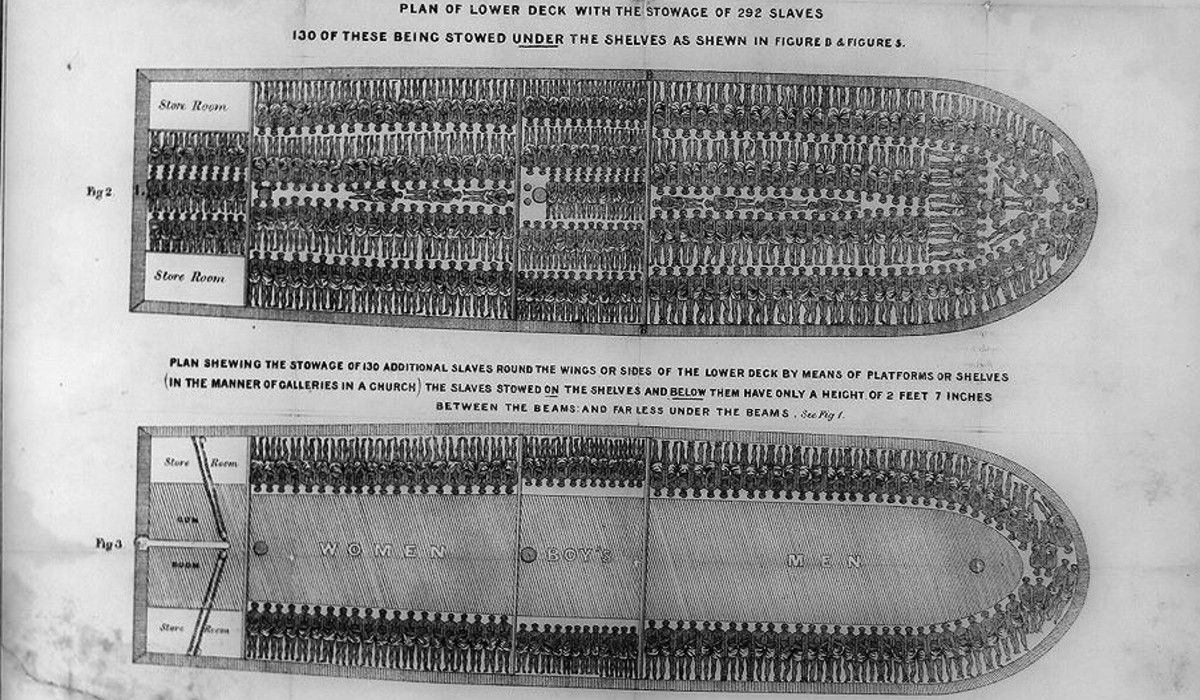
 Slave ship poster - Plan of the lower deck with the stowage of 292 slaves. Flickr / CC BY 2.0. Cropped from original
Vivek Chibber’s polemic denying a role for colonial plunder to the origins of capitalism is rife with errors about how the system came to be, argues Dominic Alexander
The debate about the origins of capitalism is something that never goes away, but a particular iteration of it erupted again recently when Vivek Chibber, in an interview with Jacobin, poured scorn on the argument that colonial despoilation had anything to do with capitalism’s genesis. To the proposition that ‘colonial plunder was essentially responsible for bringing about capitalism’, which is perhaps a caricature of positions some hold, Chibber states baldly that such arguments are ‘utter nonsense. They don’t have a shred of truth to them.’
Chibber concentrates on debunking the idea that ‘primitive accumulation’, effectively enrichment by theft and force, in itself was the necessary spark that ignited capitalist accumulation. A major point here is that the vast amounts of gold and silver taken by Spain and Portugal from the Americas in the fifteenth and sixteenth centuries represent an archetypal form of primitive accumulation, and yet no one could argue that capitalism gained any kind of head start in Iberia as a result. He is quite right that the result was instead a couple of centuries of stagnation in those two countries. Without pre-existing social relations that could absorb and invest the plunder in increased production, it was dissipated in the feudal cycle of attempted accumulation through warfare.
The ‘Great Divergence’
The argument become much more problematic, however, when Chibber invokes the ‘Great Divergence’; when, according to many economic historians, economic growth took off in western Europe, streaking far ahead of China and India. Chibber has capitalism beginning in England in the fifteenth century, such that ‘by about 1550 or 1560, you’ve essentially got a truly capitalist economy. This is about a hundred years before England has any kind of real empire at all.’ Apart from Ireland, England may not have had a colonial empire by this point, but to claim that it was a ‘truly capitalist economy’ by 1560 is at least as much of a nonsense as the case he sets up to argue against.
To take what Chibber claims is an iron-clad consensus around the Great Divergence first, we should be entitled to take the laboriously compiled statistics behind these claims with a heavy pinch of salt, and be wary of the claims some economists build upon them. Records for late medieval and early modern western Europe, or China for that matter, are hardly the stuff of which modern economic statistics are made. There are a number of reasons to think that the nature of the records that survive for Europe would bias the results in a direction favourable to a picture of economic growth.
However, even if we accept the statistics, do they support the case Chibber is making that capitalism had already north-western European economies onto an unprecedented trajectory by the mid-sixteenth century? Certainly, the Dutch had a spectacular sixteenth century in economic terms, driven by their role in commercial networks across Europe. In contrast, growth in the English economy didn’t pass the level of output it had reached before the Black Death, roughly 1350, until the later sixteenth century, at the end of which there was a major collapse.
There was significant change in industry in sixteenth-century England, with new crafts, technology and techniques, but also the switch from wood to coal as fuel.i Growth did amount to 1% over the century, which is greater than any time before, but this was also a time of major population growth.ii English economic growth was far less than shown by the Dutch, where the growth of the share of commodity trading (as opposed to production) in the economy led to a 70% per capita growth across the century.iii It wasn’t until the second half of the seventeenth century that English growth really started to take off and surpass the Netherlands, which by this time had fallen back into relative stagnation.
North-western Europe’s recovery from the Black Death in the course of the fifteenth century was impressive. This was certainly not, however, the result of capitalism. For England, the demise of serfdom is a far more persuasive source of change. The Dutch boom was the result of its successful insertion into various European, and later, world, trading networks, rather than on internal capitalist production, even if its agriculture was, perhaps, broadly capitalist in nature.
Capitalism in England
Was capitalism ‘truly’ in operation in England, nevertheless, by the mid-sixteenth century? Chibber takes as a definition that capitalism ‘is not the presence of a market, but when the market rules society. It’s when everybody becomes dependent on markets.’ This is at least a firm criteria on which to assess sixteenth-century England, whatever we think of its adequacy, but we’ll return to that problem later.
The dissolution of the monasteries in England from 1536 created the possibility of a market in land, which would have been essential for developing capitalist rents and market dynamics in agriculture. This however cannot be said to have emerged before the end of the century, at the earliest. There had been substantial but by no means complete enclosure of lands in areas like Kent and Essex, where the London market encouraged commercialisation of farming, but again these processes accelerated in the early seventeenth century, rather than being in any way complete in the mid-sixteenth.
The peasantry was beginning to be deprived of its lands and common rights in the fifteenth to sixteenth centuries, but was a long way from being largely turned into a rural proletariat even in the seventeenth. Agricultural productivity had not risen markedly in the sixteenth century.iv ‘Improving’ or commercialising landowners and farmers were a growing phenomenon in the later sixteenth century, but tenancies were certainly not yet in any way fully commercialised by then. A market in labour can’t be seen in embryo before the seventeenth century.v It’s a wild exaggeration to imagine that everyone had become ‘dependent on markets’ by the mid-sixteenth century in England, certainly as far as agriculture was concerned.
For industry, guilds remained powerful operators, particularly in towns, into the seventeenth century. They were losing control over industry in rural areas in the course of the sixteenth century, but late medieval structures hadn’t been eliminated by any means. Artisanal industry was of course extensively developed and growing from the second half of the fifteenth century onwards, but, just as Chibber rightly points out, markets alone do not mean the presence of capitalism, so an impressive quantity of artisanal industry is not capitalism. Artisans were still a mass of small independent producers, and the differentiation that was to split them into master capitalists and proletarians was only at its earliest stages. In the mid-sixteenth century, a small number of enterprises that can be seen as capitalist factories did appear, but this is only a sign that capitalist social relations were beginning to take hold.
The economic growth borne of productivity increases, which result in accumulation through relative surplus value, is often seen as a hallmark of capitalism. This process was growing slowly in the seventeenth century, but productivity is actually thought to have declined in the sixteenth century.vi Moreover, it appears that productivity increases were less important in the development of capitalism than increases in absolute surplus value (making labour work harder for longer for less pay).vii
The details of all this can be, and have been argued over endlessly, but this is enough to show that seeing capitalism beginning in the fifteenth century is a non-starter. It would make much more sense to say that crucial elements were coalescing to the point that a system was emerging, or that a nascent capitalist economy could be said to exist by the early seventeenth century, but not much before that. An emergent capitalist economy was sufficient to fuel the social conflicts behind the struggle between Crown and parliament in the 1640s, such that there were class interests that pushed it forward into a bourgeois revolution. That in turn was able to establish a state whose concern was to nurture and protect capitalist interests in a broad sense. This in turn enabled the real take off of capitalism in England in the second half of the seventeenth century.
Thus, capitalism in England, and also in the Netherlands, was at its earliest stages in the seventeenth century when these countries’ eras of colonialism and the slave trade really did begin.
How a system grows
Whenever we date the dawn of capitalism in England, however, the problem is not so simple as to say that: here is capitalism, it existed before colonial conquests and slave plantations, therefore case closed. Part of the problem is a conception of capitalism as something that can be identified by the presence of certain diagnostic criteria: wage labour, markets or the right political-legal infrastructure to protect capital accumulation. These elements are necessary, of course, but for a system, or mode of production, to take shape, they have to be functioning as part of a whole. The existence of the whole system determines the functioning of the parts, rather than the parts growing as little capitalist homunculi within the old system. Because it is often said, fairly, that capitalism grew within the interstices of the old system, the conceptual framework too easily becomes one of treating evidence of capitalist elements as if they prove the presence of a system, rather than as an emerging set of relations.
This is why Chibber’s chronology of capitalism is so important. If capitalism was a complete formation by the middle of the sixteenth century in England and Holland, as he asserts, then colonial plunder had little role to play in its origins. If on the other hand, capitalism was only an emergent system in the seventeenth century, as the evidence actually suggests, then the situation is very different. Capitalism may have begun to develop its distinct social relations and circuits before colonialism, but it should be seen as an ‘expanding totality’viii which could not really have consolidated its domination, or leapt forward into industrial revolution, as it did in the eighteenth century, without the circuits of trade and, indeed, plunder, that the English and Dutch in particular started heavily exploiting in the course of the seventeenth century.
It is particularly worth noting that during the English Revolution, the merchants who most strongly supported the parliamentary cause were those involved in the Atlantic trade, who were outside the older oligarchical merchant companies.ix Their early involvement in trade with American and Caribbean colonial production, with sugar plantations, and, of course, therefore slavery, marked the beginning of England’s entry into the system of trade that would do so much to make capitalism a global predatory system.
Thinking about capitalism as an expanding totality also means widening the focus from just the first two actual bourgeois states, England and the Netherlands. Firstly, it is to recognise that western Europe in general showed emergent capitalist relations of production during the seventeenth and eighteenth centuries. Indeed, part of the deep history of capitalism is the earlier ‘pulses’ of development, first in Italy as early as the fourteenth century, and then in the Rhineland in the fifteenth, where capitalist-like relations of production emerged and then fell back, but leaving impacts on commerce and production that helped the next ‘pulse’ move forward. There was nothing in the nature of pre-Black Death English society and economy that made it a harbinger of capitalism. However, the fact that England was connected to the economic networks of western Europe meant that the emergent waves enabled the new pulse, when it began in England (and the Netherlands), to push the capitalist totality further forward.
What can be said for the emergence of capitalism in Europe can be said about the world. English and Dutch success in building commercial empires depended in large part on their ability to insert themselves as middlemen into existing, well-developed Asian markets. Developing plantations, colonial possessions and manufacturing export industries came afterwards. The massive cities and commercialised economy of seventeenth-century China were clearly important in this. A leap forward into capitalism did not happen there, probably because Chinese industry and trade were really dependent upon the state and its procurement (not entirely unlike conditions in the Roman Empire), and when that fell into crisis, so Chinese proto-capitalism fell away. However that may be, the Asian international networks on which English and Dutch commercial capitalism piggy-backed were clearly crucial to the breakthrough of capitalism as a global mode of production in the eighteenth century. Colonial plunder necessarily did play a major role in this.
Turning back to the Atlantic, there is no question about the importance of the production of sugar and tobacco on slave plantations in the Caribbean, and the associated networks of trade, including the slave trade, between Britain, west Africa, the Caribbean and the American colonies. Saltfish from Newfoundland fed slaves, while sugar from plantations was a cheap way to give industrial workers in Britain the energy to keep up with long hours of factory work; the extraction of absolute surplus value in one area smoothed the path for its extraction in the other. The reduction of the English peasantry to a landless proletariat through the acceleration of enclosures also happened at least as much in the eighteenth century as before, so the maturing of capitalism as a ‘truly’ realised system in England, and then Scotland, occurred once colonialism and its attended trade networks had also coalesced.
That slavery and colonial plunder in general underlay and even enabled the industrial revolution cannot sensibly be denied, and the case has recently been very well made in Steve Cushion’s Slavery in the British Empire and its Legacy in the Modern World (2025). One of the first great financial crises of the capitalist system, the South Sea Bubble (1720) was bound up with the slave trade, and required the newly formed Bank of England to perform probably the first bank bailout scheme.x This is another sign of capitalism coming to maturity as a state-backed system before the industrial revolution, but not before ‘primitive accumulation’, whether through enclosures at home or slave production in colonies, was well up and running.
Varieties of exploitation
In one sense, Chibber is right to say that treasure and plunder are not what ‘triggered’ capitalism, but that framing is not the appropriate one for understanding how a mode of production begins and develops into a totalising system, and so misses what the real point should be. Capitalism did emerge in Western Europe out of inter-regional economic circuits, but began to take root in England and the Netherlands in terms of internal economic cycles. Chibber, following Brenner, sees this as a result of action by landlords forcing peasants onto the market, but an alternative argument is that in fact the relative weakness of feudal extractive powers in those countries enabled accumulation from below. Probably, capitalism needed an interaction of responses from both peasants and landowners to begin to form. Bourgeois revolutions then created the right kind of states in those countries that could then make the most of the colonial ventures and international trade networks that already existed.
Capitalism needed the bourgeois states, but it also needed to feed from sources of absolute surplus value being produced by slaves in the Caribbean particularly, and through the plundering of Asia when that became possible. Capitalism’s maturation as a world system only came in the eighteenth century. Without colonial plunder and slavery, it is possible that capitalism as an emerging mode of production might have receded in its north-western European core if it had been balked from expanding by other non-capitalist powers or resistance of other kinds.
Chibber’s polemic, therefore, falls down when the history of capitalism is examined in its proper frame, but, of course, it was only really a proxy for other arguments. It is an unfortunately one-sided attempt to reassert class politics against those kinds of views which subsume capitalism and class beneath racism and anti-colonial nationalism as the main dividing line for struggle. However, the history of capitalism in fact shows how capitalist accumulation drove both the creation and exploitation of the working class in the core, the enslaved proletariat of the plantations, colonial exploitation and dispossession in general, and that racism was a capitalist creation precisely to justify and consolidate its ability to exploit labour in all its guises. The answer to arguments that hew too closely to one pole (subsuming class and capitalist exploitation) is not to dive completely into the opposite pole (colonialism was irrelevant to the birth of capitalism), but to understand the systemic interrelation between the factors that make up a whole system.
i Ben Baack, ‘The Economy of Sixteenth Century England, A Test of Rival Interpretations’ in Economy and History 21: 1 (1978), pp.29-39; pp.34-5.
ii ‘English Economic Growth, 1270-1700’, (2011), pp.40-1.
iii Roger Fouquet and Stephen Broadberry, ‘Seven Centuries of European Economic
Growth and Decline’ in Journal of Economic Perspectives 29, No. 4 (2015), pp.227-44; pp.229-30.
iv Henry Heller, The Birth of Capitalism: A Twenty-First Century Perspective (London: Pluto Press 2011), p.95.
v ibid. p.96.
vi ibid. p.87.
vii ibid. p.88.
viii ibid. p.103
ix Michael Sturza, The London Revolution 1640-1643 (New York: Mad Duck Coalition 2022), pp.64-5.
x Steve Cushion, Slavery in the British Empire and its Legacy in the Modern World (New York: Monthly Review Press 2025), p.70.
Before you go
The ongoing genocide in Gaza, Starmer’s austerity and the danger of a resurgent far right demonstrate the urgent need for socialist organisation and ideas. Counterfire has been central to the Palestine revolt and we are committed to building mass, united movements of resistance. Become a member today and join the fightback.

Dominic Alexander
Dominic Alexander is a member of Counterfire, for which he is the book review editor. He is a longstanding activist in north London. He is a historian whose work includes the book Saints and Animals in the Middle Ages (2008), a social history of medieval wonder tales, and articles on London’s first revolutionary, William Longbeard, and the revolt of 1196, in Viator 48:3 (2017), and Science and Society 84:3 (July 2020). He is also the author of the Counterfire books, The Limits of Keynesianism (2018) and Trotsky in the Bronze Age (2020).