
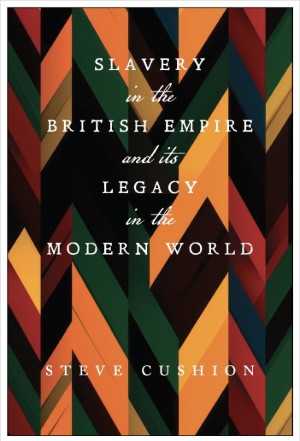
 Steve Cushion, Slavery in the British Empire and its Legacy in the Modern World (Monthly Review Press 2025), 240pp.
Steve Cushion’s history of British slavery firmly roots the system in the exploitation of labour, and shows why compensation is a class question, finds John Westmoreland
The start of Black History Month in the UK was dominated by the publication of Sir Lenny Henry’s The Big Payback and his support for financial compensation for every black person in Britain. Henry supports a financial settlement of £18 trillion.
The right-wing media have rehearsed the argument against compensation so many times it barely needs restating, and it involves the slippery use of that pronoun beloved of nationalist ideologues ‘we’.
Why should we pay for a crime we did not commit? This we includes every British citizen, but us and them are more useful pronouns in this debate. The intention of those demanding financial compensation is not to demand your granny’s pension. The demand is not made of us the working class, but of them the ruling class.
The all-inclusive we has the advantage of stirring fear and anger. That the money will have to come from public resources, and why should it go to a minority when we are all suffering? This stimulates racial antagonism and, it is hoped, binds us all together in opposing this outrageous demand.
Steve Cushion’s excellent riposte to this wailing from the media establishment is a well-researched history that every working-class activist needs to read. It is an outstanding book that explains the way in which slavery helped shape the ruling class that stands over us, their institutions that repress us, and their ideology that devalues and marginalises us.
The book examines ‘the political economy of slavery from both sides of the class divide, as well as the different interest groups within the ruling elites’ (p.23). The tendency of too many books about slavery, to separate what happened in the West Indies from what happened in the home country, gets demolished by Cushion. Every feature of the slave economy came back to Britain and was integral to the development of capitalism and class conflict.
In a developed Marxist analysis, Cushion shows how the ruling class understood, as they still do, the value of labour, and whether that labour was free or enslaved was and is just a matter of detail as far as they are concerned. The issue of compensation is a class issue, and it is in the interests of us to insist that they pay in full. Indeed, the calculations of the compensation due to Black Britons have been made based on the wages slaves would have been paid had they been doing the work of an agricultural worker here, which is not an outrageous demand (pp.181-2).
Slaves and wage slaves
The capitalist class created the working class. And, capital accumulation and the alienation of labour were driven by the development of a slave-based political economy in Britain’s Atlantic Empire.
Capitalist investors who made their fortunes from slavery bought land in Britain, vast estates with neoclassical mansions and the finest décor and furnishings to adorn them. The intention was to pretend that their wealth connected them to some ancient lineage, as noble titles were bestowed on them. The landed estates bought them political power as parliament reflected landed interests, with the Crown as landowner-in-chief. Political power and influence could then be used to defend slavery, and secure the legal and military protections it required.
The slave economy in the Americas created a ruling class which thought of itself as racial gods blessed with the right to capture Africans and work them to death, churning their labour into vast wealth and visible opulence.
Every hateful upper-class snob we see today, think David Cameron and King Charles, had that attitude cultivated in their forebears long ago. The laws that only apply to us for the benefit of them were forged to keep down enslaved workers in the first place.
The Slave Codes of Barbados and Virginia institutionalised white supremacy and engendered modern discrimination by skin colour (pp.32-3). Brutal punishments came within the gift of wealthy white-skinned elites, as did the power to enslave and exterminate.
The sale in Africans carried further crimes in its wake. In North America, indigenous peoples were driven off their lands to make way for cash crops like rice, tobacco, flax and cotton. The exterminations, which might be called genocide or ethnic cleansing, happened through the intensification of farming for profit.
Whole nations were either enslaved or murdered with the development of the means of repression and a repressive state apparatus. The Royal Navy grew into a global extension of British capitalist power, delivering death to foreign enemies and rebellious peoples while exerting a barbaric despotism over their crews.
Mutinies and sedition were prosecuted as treason while complicity was rewarded. Poor whites were enrolled as scouts and rangers who hunted down Indians, getting paid a bonus for captives or their scalps. Dead or alive, no opposition to the land grabbers and enslavers was possible.
Steve Cushion is very good at connecting how land-grabbing and the intensification of labour management on plantations fed into developments in Britain. Land theft in the empire ran parallel to enclosures and the Highland Clearances here. Land ownership was everything to the ruling class who passed laws forbidding the purchase of land by poor whites in the colonies, while charging exorbitant rents to farmers on land that they had stolen at home.
On plantations, the enslaved people were subjected to micro-management techniques that the capitalists brought to bear on the working class in Britain. The measurement of time and productivity started to be recorded. Human lives were appreciated by the capitalists only as units of economic value. Workers were born to work, as hard and as cheaply as possible, and this applied to ‘free’ labour as much as the enslaved.
Obviously, workers tried to get round the restraints imposed on their lives. Poaching, pilfering, begging, stealing and piracy were alternative life styles for runaway slaves and runaway apprentices who chose to avoid being worked to death. For enslaved peoples who broke the myriad laws that kept them on the plantation, this meant brutal floggings, branding, mutilation and execution. Even the barbarity was measured carefully. Slaves were property, and property had to be preserved.
Similar barbarities were visited on British workers who failed to submit; examples of which are the Black Act of 1723 (aimed at stopping poaching) and the Vagrancy Act of 1824. Land ownership and the subjection of labour had the same capitalist root. ‘Commodifying land and commodifying people went hand in hand’ (p.74).
The fear of slave rebellion led to the development of militias and policing techniques alongside a missionary arm. The Protestant religion carried British imperialist ideology into the colonies. Each colonial outpost was organised to keep the enslaved population under control, and again this was visited on British workers.
Keeping the working class down meant depriving them of wealth and the right to organise themselves into trade unions. Their only salvation was to be through labour and obedience.
In east London, the West India Dock was built to handle slave-produced goods and, as in the colonies, it was defended militarily. The dock was surrounded by a wall, a moat and defended by the first British police force, the River Police. This prevented dock workers from gleaning produce that they had customarily been able to do, and impoverished families down towards levels of poverty seen by enslaved labourers. The contempt that their white masters felt for enslaved Africans helped shape the attitudes of capitalists to workers here.
Organised labour
Internationalism is the highest expression of working-class solidarity. Internationalism recognises that the working class the world over are sisters and brothers, that their interests are interwoven one with the other. The first International was formed in the context of international solidarity between British workers and enslaved workers in the southern states of the USA during the civil war there. As Marx put it, ‘Labour cannot emancipate itself in a white skin where in the black it is branded’ (p.161).
In 1833, Britain passed the Abolition of Slavery Act. It came after the industrial capitalists routed the land-owning aristocracy from their domination of parliament. The triumph of the capitalists through the 1832 Great Reform Act saw a new approach to the control of labour. The 1832 act was quickly followed by the Abolition Act and in 1834 the Poor Law Amendment Act. The PLAA confirmed that the working class would only survive through labour. Those unable to work faced the workhouse.
In the West Indies, emancipation meant little without compensation in money and land. The slave owners received £20 million in compensation for their loss of ‘property’ and then kept formerly enslaved workers on the plantations with the same draconian powers they had before.
Steve Cushion’s chapter on organised labour is a superb exposition of the Marxist method. He follows Marxists like Eric Williams and CLR James in showing that revolts of enslaved workers played a massive part in their self-emancipation, and how their struggle connected with workers in Britain.
Alienated workers here thought of themselves, and rightly, as wage slaves, trapped in never-ending labour dictated by the machines they served. The American Civil War brought working-class solidarity onto the stage of history as never before in the history of capitalism.
In the slave states, cotton was king. It was the USA’s most important export and allowed the slaveocracy that ruled it to dominate politics. However, the south was in reality utterly reliant on northern manufactures from the cotton gin to the leather whip. What’s more, cotton used up the land and demanded constant expansion and the opening up of new lands under their sway. The growth of enslaved labour put labour in jeopardy and conflict simmered. When war broke out, the north attacked the south at the root: slavery.
The free states prevented the export of southern cotton to the Lancashire cotton mills and divided politics here. The capitalist class, the aristocracy and the Crown were all for declaring war on the north. Every leading British newspaper called for military intervention on the side of the Confederacy. Two warships were built in Birkenhead and sent gratis to the Confederacy.
Yet, despite the poverty caused by the cotton famine, the British workers stuck with the free states to such an extent that material support for the Confederacy became impossible.
As Steve Cushion writes, ‘In was in this atmosphere that the International Workingmen’s Association (IWA) was formed at a large international meeting in Covent Garden.’ And as Marx said in his address, ‘the heroic resistance’ of the working classes prevented their ruling class from the ‘propagation of slavery on the other side of the Atlantic’ (p.148).
Marx and Engels were unequivocally on the side of the free states from the start, and Cushion puts up a robust defence of this position against those who said Marx was ‘soft on capitalism’. Marx and Engels never saw a Chinese wall separating merchant and industrial capital, as many dogmatists insist on. Marx considered capital and labour to be the decisive categories that economists have to understand. The ‘starting point of the development that gave rise both to the wage labourer and to the capitalist was the enslavement of the worker. The advance made consisted in the change in form of this servitude’ (p.160).
Make them pay
Steve Cushion makes the case for compensating every black British worker in full a compelling one. The enslavement of Africans in the development of capitalism offered no benefit to the working classes here. Enslaved and free labour produced the cotton exports, tobacco and sugar that enriched the capitalist and gave impulses to the development of a banking and financial oligarchy, a bloated imperial bureaucracy and an imperialist state that would continue to oppress and exploit workers across the globe.
Compensation would be a final stage in the promised emancipation offered to enslaved Africans in 1833. Changing the form of labour while keeping the repressive apparatus of the slave economy in place gave little, and that has to be put right.
Steve Cushion has, in his own way, paid a considerable amount of compensation by stripping away the condescension of British history towards the former people of the empire, and by reconnecting the struggles of enslaved and free workers to their mutuality. Anti-imperialist history is vital in overcoming the divisive ideology pouring out from the right-wing pestilence that seems to be growing. I strongly recommend this book.
Before you go
The ongoing genocide in Gaza, Starmer’s austerity and the danger of a resurgent far right demonstrate the urgent need for socialist organisation and ideas. Counterfire has been central to the Palestine revolt and we are committed to building mass, united movements of resistance. Become a member today and join the fightback.

John Westmoreland
John is a history teacher and UCU rep. He is an active member of the People's Assembly and writes regularly for Counterfire.