
The World Inequality Conference has put forward a plan for ending world poverty and the climate crisis, but its focus on redistribution will not change the system, argues Michael Roberts
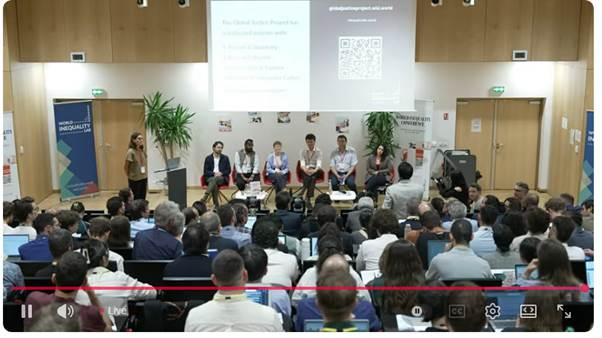
Last weekend, the World Inequality Lab (WIL) organised the third edition of its World Inequality Conference, held at the Paris School of Economics.
The WIL hosts and maintains the World Inequality Database, the open-access database on global inequality. Probably the most famous of the WIL team are directors, Thomas Pikkety and Gabriel Zucman, the former for his magnum opus Capital in the 21st century and subsequent books.
The conference had attendees from 58 different nationalities and concentrated on presenting the WIL’s Global Justice Report. In the opening address, while global inequality has fallen sharply since Keynes raised the possibility of solving the ‘economic problem’ of achieving prosperity and leisure for all. , the economic problem remains The world still faces “stark and rising inequalities and an increasing environmental crisis”, (note no reference to regular and recurring crises of production and investment). But the ‘economic problem’ can be solved and with “achievable concrete scenarios” and the future can be not “a techno dystopia but one of prosperity for all: utopia” (Piketty).
In the report, the authors claim to “set out a new vision for global progress in the 21st century: grounding human development and equality in planetary habitability.” As such, in my view, it is both ambitious and moderate at the same time. It is ambitious in showing how global prosperity and solving the climate crisis might be achieved; but it is also moderate – as according to the authors, it cannot be achieved for 75 years! That’s a long time for several billions of humanity and the planetary species.
The report set some key targets. The aim is to converge per capita monthly national income across the globe to €5,000 in every country, thus closing a 16-fold gap.
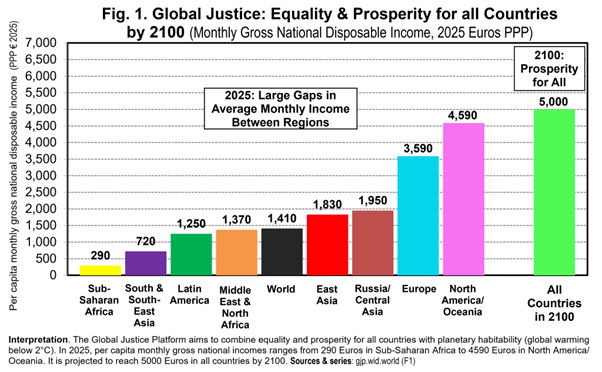
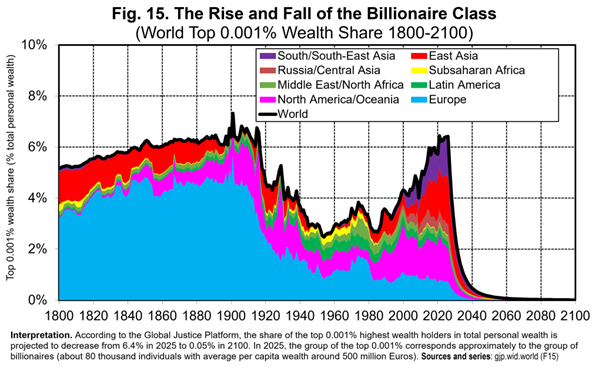
To achieve this, the share of the bottom half of global wealth must increase from 2% to 30%, while the share of the billionaire class globally decreases from 6% to 0.05%. Nearly 90% of the world’s population would double their income while working roughly half as many hours as they do today. Global warming would rise from its current average 1.5C above pre-industrial levels, but it would be capped at 1.8°C by 2100, rather than accelerate to over 4°C under projected baseline macroeconomic and policy trends. So the target is: global equality of income; an end to global warming; shorter working hours for all, massively improved education and health systems; reforestation and the end of industrial farming.
How is this to be done? A Global Justice Fund would be set up that raises funds sufficient to make annual expenditures of 10.3 % of world GDP per year on average over the 2026-2060 period – a massive jump from present spending by international agencies and governments of just 0.4% of GDP a year.
Some of the funds raised and susbsequently reinvested income would go into a World Sovereign Fund equivalent to 60% of world GDP. The funds raised would come from a global wealth tax (rising from 0% at 10 times the world average wealth to 20% per year on billionaires) and a global income tax (rising to 90% at the very top), both targeting around 1% of the world population. Basically, billionaires’ incomes would be drastically reduced by taxation and then redistributed. The global wealth tax would mean that the share of the bottom 50% of the world’s wealth distribution would rise from about 2% today to about 30% by 2100, a 15-fold increase, while the wealth share of the world’s billionaire class would fall from 6.4% to 0.05%, a decline of more than a hundred-fold. The Global Justice Fund would be democratically controlled by national governments with voting power relative to populations.
The authors reckon that global convergence to a higher level than E5000 per month would not be possible as well as keeping global warming within a 2°C carbon budget. So it’s a trade-off. The report rejected a crude ‘degrowth’ scenario ie where all the people in the rich countries of the global North suffer a loss of income to help raise the income of those in the Global South. The authors reckon they can square that circle, by redistributing wealth and incomes within countries in the Global North from the billionaires to the majority, and also by lowering hours of work through increased productivity and increased investment in education and health. They find that “targeted sufficiency can be more effective than aggregate degrowth. For instance, a 60,000 Euros per capita GDP target with a large consumption shift to immaterial sectors, change in food habits, and implied reforestation leads to a temperature rise of 1.8°C in 2100, i.e. less than the 1.9°C associated with large uniform degrowth (15,000 Euros for all in 2100) but without sufficiency and structural transformation.” At the same time, fossil fuel production would be phased out and replaced totally by renewable energy to reduce the damage from global warming.
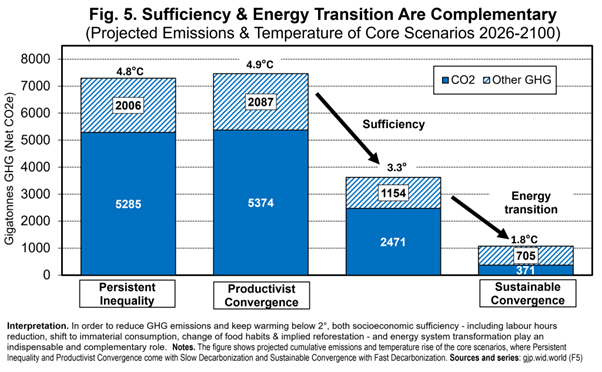
What can we conclude from this? Are these targets for global equality and the capping of global warming below 2C, feasible, economically and politically? Mainstream economists have been quick to trash the report. Noah Smith, a well known economic commentator, called the report “wacky and total nonsense”. According to Smith, the report’s claim that global warming will reach 4C by the end of century is out of date and wildly exaggerated just so that Piketty and his pals can justify their ‘over the top’ wealth tax.
Smith continues that the report advocates the “political non-starter” of degrowth (which is not true, as explained above) and it envisages ”global economic planning that would put Gosplan to shame.” “Even more ridiculously, Piketty envisions a global fiscal authority to carry out this insane plan via global taxation.” From the point of view of capital and the super-rich, Smith is right: to achieve even these modest targets (global equality and climate control by the end of the century) would require global planning and international cooperation. Smith sees that as “insane”, but he offers no alternative to the current insanity of continuing to destroy the planet and allow ever-rising poverty and inequality.
My own criticism of the report is that it bases itself on distribution after the event, not on ‘predistribution’ ie having collective ownership and control of corporate power. The policy answers offered in the report are: redistributing income through progressive taxation and social transfers; more public investment in education and health; and a global currency system. What is missing here? There is no policy to change radically the socio-economic structure of the world economy – in effect, capitalism is to remain. The owners of capital: the banks, the energy companies, the tech media companies, big pharma and their billonaire owners – these are not to be taken over. Instead, we must just tax them heavily and governments must combine to use the tax money to spend on investing in social needs. So the policy is one of redistribution of existing income and wealth inequality, not pre-distribution i.e changing the social structure that engenders these extreme inequalities, namely the private ownership of the means of production.
A very small elite owns the means of production and finance and that is how they usurp the lion’s share and more of the wealth and income. And wealth concentration is really about the ownership of productive capital, the means of production and finance. It’s big capital (finance and business) that controls the investment, employment and financial decisions of the world. A dominant core of 147 firms through interlocking stakes in others together control 40% of the wealth in the global network. A total of 737 companies control 80% of it all.
This is the inequality that matters for the functioning of capitalism – the concentrated power of capital. And because inequality of wealth stems from the concentration of the means of production and finance in the hands of a few; and because that ownership structure remains untouched, then any redistibutive policy based on increased taxes on wealth and income will always fall short of solving the ‘economic problem’.
At this point, it is often argued that public ownership of finance and key sectors of the major economies of the world is impossible and utopian – it will never happen short of some popular revolution – which in turn will never happen. My reply would be that the adoption of supposedly less radical policies like progressive taxation and/or a step change in public investment; or global cooperation to break the transfer of value and income from the Global South to the rich elite in the Global North, are just as ‘utopian’. And indeed, that is the view of pro-capital economists like Noah Smith.
What G7 government in the world is prepared to adopt such policies? None. How close have they got to adopting any of the report’s policies in the last ten or 20 years? Not close at all – on the contrary, governments have cut taxes for the rich and corporations and raised them for the rest; while public investment in social needs has declined. And is there any global cooperation on ending exploitation by the multi-nationals and banks in the Global South or in ending fossil fuel production and private jets?
The authors of the report say: “Inequality is a political choice. It is the result of our policies, institutions, and governance structures.” But inequality is not the result of “our” policies, institutions and governance structures, but the result of the private ownership of capital and governments dedicated to sustaining their power and wealth. If that does not end, inequality of income and wealth globally and nationally will remain and continue to worsen and climate change will reach irreversible tipping points.
Resposted from: https://thenextrecession.wordpress.com/2026/06/09/solving-the-economic-problem/
Before you go
The ongoing genocide in Gaza, Starmer’s austerity and the danger of a resurgent far right demonstrate the urgent need for socialist organisation and ideas. Counterfire has been central to the Palestine revolt and we are committed to building mass, united movements of resistance. Become a member today and join the fightback.
