
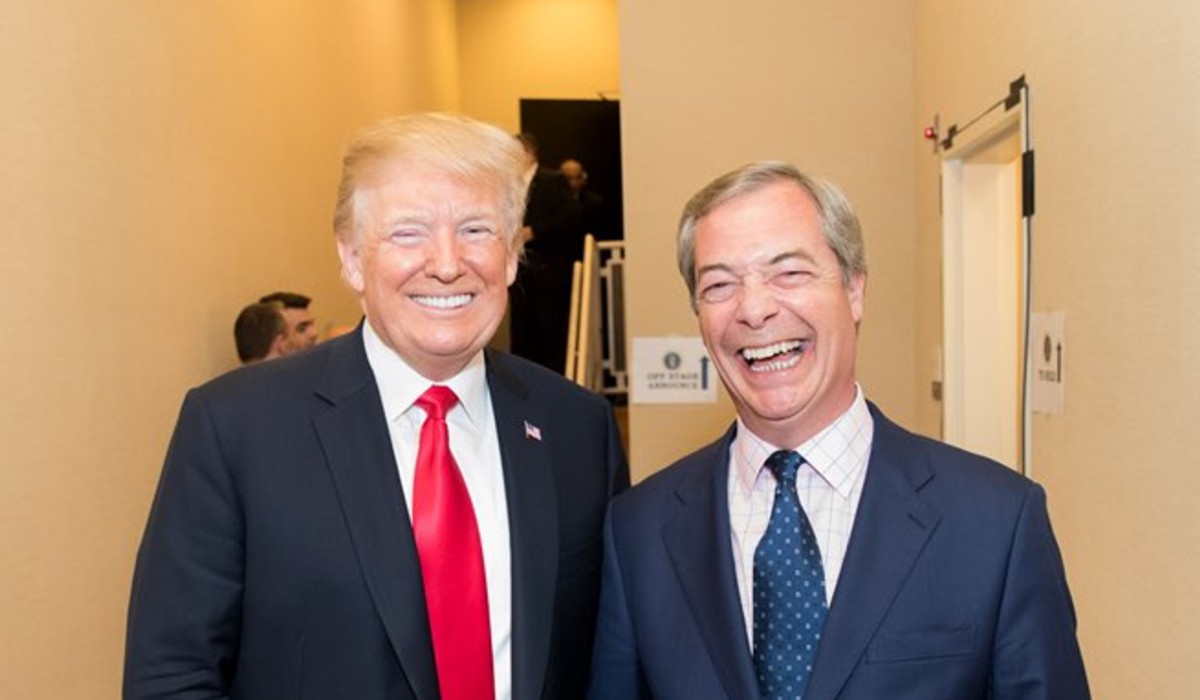
 Donald Trump, Nigel Farage. Photo: Public Domain
There has been a steady rise in the authoritarianism of today that has its roots in Thatcherism, argues Mike Wayne
In the 1970s, the academic and ‘Godfather’ of Cultural Studies, Stuart Hall, coined the term ‘authoritarian populism’ to analyse the growing trends towards a more muscular state coercion project that would culminate in the rise of Margaret Thatcher to power. The ‘populism’ part of the term, is meant to indicate that the growing use of force from above, comes to be demanded by various social groups from below, to rescue society from what appears to be a moral collapse.
The concept of authoritarian populism came back to me as I read about the ICE agent who shot Renee Nicole Good in the face three times in Minneapolis. He is, apparently set to become a millionaire via at least two Go Fund Me pages rewarding him for murder because, it seems, two women were not sufficiently deferential or scared of him and his proto-fascist brigade.
Populism meant for Hall, not just that small ‘c’ authoritarian conservatism was becoming popular but that it was successfully aligning various demographics with the power bloc and neutralising the contradictions that ‘logically’ exist between those demographics and the interests the political representatives serve. Trump in America and Farage in the UK epitomise the class contradiction of millionaires championing the concerns of ‘the people’.
If the ‘people’ can be a slippery term disguising class relations, another difficulty with the term ‘populism’ is that it is very easy to slide from this technical definition that is about vertical alliance building into the term ‘popular’ which can over emphasise the real extent of mass enthusiasm for a political project. Hall himself was sometimes criticised for doing precisely this on the question of Thatcherism.
Trump’s popularity
The whole question of what is and is not ‘popular’ in this more quantitative sense is a tricky empirical issue. Trump is clearly popular at one level. You cannot say that someone who got 77 million votes in the last Presidential elections is crashing and burning. But how things get counted can always cut the cake of popularity up in different ways. In terms of the electoral vote in the US’s peculiar electoral college system, Trump thumped his Presidential opponent, Kamala Harris by 58% to 42%. But in terms of the ‘popular’ vote the victory was very narrow (49.81% to 48.34%). Whether Trump has the ‘popular’ base on which to continue his authoritarian project all the way to fascism is very much open to question. On the other hand, once political power is achieved then the levers of state power (such as his beefing up and deployment of ICE) kick in and it may be that he does have a sufficiently large popular base to crush mass resistance.
The Left
The British left’s critique of ‘electoralism’, that is opportunistic deference to what appears to be the dominant ‘popular’ positions on this or that issue, and subsequent abandonment of policy promises, is of course justifiable. But it also contains the danger that the left fails to appreciate the critical importance of stopping the electoral victory of a new political force that may open up the country to radical and unprecedented change.
In the 1970s, Hall’s use of the term ‘authoritarian populism’ tracked the way the crisis of social democracy caused by the crisis of British capitalism, was translated into other terms and frames of reference more congenial to the state and corporate power. Historical, political and socio-economic problems became moral absolutes. A whole range of threats to moral order, from sexual mores, fashionable educational theories, trade unions demanding wage rises the ‘nation’ could not afford, delinquent (particularly black) youth, communist leftists, immigrants, and so forth required a state clampdown. Margaret Thatcher rode these conservative currents to electoral victory and the although she was initially very unpopular, managed to turn things around via the Falklands War. The rest, as they say, is history.
Neoliberal crisis
Today history seems to be repeating itself in new conditions. It is neoliberalism that is in crisis, not social democracy which, as an institutional politics, (but not a ‘popular’ aspiration) is long dead. When Melanie Phillips published her book Londonistan in 2006, about the apparent takeover of the capital city by Islamic jihadis, most reviewers treated her translation of Samuel Huntington’s ‘clash of civilisations’ thesis into a UK context as wildly off beam. But now it is becoming increasingly mainstream or ‘popular’. In a social media post, shortly before being sacked for planning to defect to Reform, Robert Jenrick presented a similar vision of Birmingham. Here Islamist extremists had successfully pressured, according to Jenrick, the West Midlands chief constable Craig Guilford into banning Israeli football fans, Maccabi Tel Aviv, from attending a match against Aston Villa. The post garnered much support from people who fear that their culture and identity is at threat of being ‘swamped’ to use the word that Thatcher once infamously used, by an ‘alien’ one. In the time of Thatcher, that turned out to be the existing Black British population. Today it is the existing British population of South Asian and African descent.
Islamophobia
The racism of the Islamic ‘take over’ thesis is without doubt, growing in popularity and seeding the ground for a right-wing populist project. Interestingly, this has yet to translate into the international arena, a weak spot then for authoritarian populism. There is little doubt that attempts to forge a connection between right wing populism at home and sympathy for Israel’s genocidal Gaza assault, remains asymmetrical. The reason for that is partly because of the clarity with which Gaza presents itself to all those who retain a moral compass. The images of Gaza reduced to a moonscape of rubble does indeed speak of genocidal intent. Much of the British media cannot meet this simple moral threshold, as when Nick Robinson of the Today programme of Radio 4 routinely says to the effect that ‘many people would question the use of the term ‘genocide’’ when anyone has the temerity to use the word which in fact best describes the actions of the Israeli state.
The other reason for this asymmetry is because on this issue of moral clarity there has been organised opposition to the British state’s complicity with a war crime, from Stop the War to Defend our Juries. The difficulty now is in translating this success into the infinitely more complex arena of domestic politics. Here there is a precise reversal of where the asymmetry lies. The left continues to be in disarray on the domestic front, while the right, a term that now stretches from Reform through to the Labour leadership, will continue to look to strengthen their cause on the international front. For the moment, the Europeans are bigging up the threat of Russia as they ramp up military spending and talk grows of conscription. If they succeed in making this war footing and militarisation project ‘popular’, then the circle or perhaps the noose, will be closed. The stakes are that high.
Before you go
The ongoing genocide in Gaza, Starmer’s austerity and the danger of a resurgent far right demonstrate the urgent need for socialist organisation and ideas. Counterfire has been central to the Palestine revolt and we are committed to building mass, united movements of resistance. Become a member today and join the fightback.
