
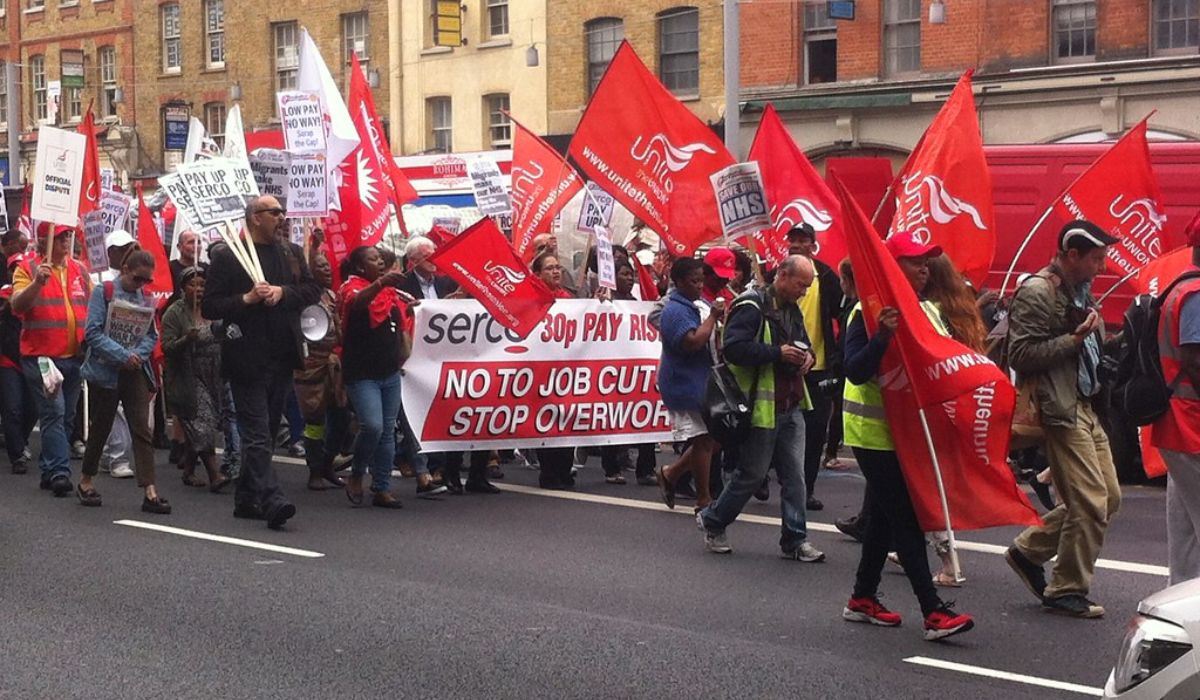
 Barts strikers organised a demonstration and rally, July 2017. Source: War on Want - Flickr / cropped from original / CC BY 2.0
In counterposing workers’ rights and the just transition, Unite risks slipping into the fallacy that the interests of the workers in any industry are the interests of that industry, finds Elaine Graham-Leigh
Unite General Secretary, Sharon Graham, is claiming victory as the government prepares a retreat on rules on the sale of zero-emission electric vehicles (ZEVs). The ZEV regime, introduced by the Tories in 2023, attempts to force carmakers to shift from producing petrol and diesel (ICE) vehicles to electric, by setting escalating targets for the percentage of sales that have to be of ZEVs. This leads up to a complete ban on the sale of ICEs from 2030 and on plug-in hybrids from 2035.
The change is that from 2030, 50% of cars sold will be permitted to be plug-in hybrids, rather than 20% in the original rules, and the quotas for each year leading up to 2030 will also change. This might sound like a mere technical tweak, but it is in fact significant. Car companies hate the ZEV rules, claiming earlier this year that having to meet the original targets was costing them, collectively, £10 billion and threatening to get their ZEV sales to the required percentage by limiting their ICE production and therefore slashing jobs. The government’s move shows them that those threats have worked: Starmer is not going to force companies to shift to less environmentally damaging production if they don’t want to. Government sources are apparently stressing that the projected 2030 ban on the sale of new ICE vehicles remains in place, but it’s not so long ago that then Transport Secretary Keir Mather was stressing that the commitment to the electric vehicles rules was ‘iron-clad’, and we now see how much that was worth. Expect the deadline to creep back to at least 2035 in fairly short order.
Unite has some salient objections to the way that the ZEV rules work, pointing out that they do nothing to help workers who are facing jobs in ICE plants being lost to ZEV production based in countries where wages are lower. This means that even where companies as a whole are committed to producing electric vehicles, this may not protect workers in British plants. BMW, for example, has invested heavily in ZEVs, but its British plants produce exclusively ICEs. In this sense, a 2025 report by Unite’s automotive sector argued, ‘the ZEV mandate may benefit the multinational, but it punishes the company’s UK workforce’. Little of that nuance, however, makes it into the press release, which reads as a straightforward celebration of the ICE sector, apparently ‘a jewel in the crown of UK manufacturing’. So, what does this tell us about Unite’s attitude to the climate crisis?
In theory, Unite is committed to a just transition to green energy and industry. In 2023, for example, Unite Scotland backed a report calling for a worker-led just transition for oil and gas workers in the North Sea, and the current Unite Community Energy for All campaign includes ‘a worker-led transition to renewable energy’ as one of its three demands. In practice, though, Unite’s celebration of the government’s climbdown on ZEVs is just the latest example of how the union increasingly counterposes environmental needs with defence of members’ jobs.
This is evident in Unite’s campaign to open the Rosebank and Jackdaw oil and gas fields, on the basis that this would protect ‘jobs, communities and our energy security’. The union is right to point out that the government has ‘no credible plan for jobs’ for North Sea workers, but given the environmental cost, any answer which simply calls in response to ‘Keep the North Sea Working’ is giving up on any genuine commitment to just transition.
In part, this is Unite slipping into the fallacy that the interests of the workers in any industry are the interests of that industry. As the Unite members who wrote an open letter to the Unite Executive protesting about their stance on Rosebank and Jackdaw, Unite has been ‘parrot[ing] the oil industry’s talking points’ on North Sea oil and gas, as if the only way to represent the workers in the oil and gas industry is to support the demands of the oil and gas companies that be allowed to continue production as if the climate crisis wasn’t happening. Unite shows the same thinking on ZEVs, that the only way to look after members in BMW’s ICE plants is to ensure that BMW can make as much money making ICEs as possible. A worker-led just transition, on the other hand, demands as its first step that we remember that the interests of the workers and the interests of the bosses are not the same.
For all Sharon Graham’s trumpeting of the ‘back to the workplace’ agenda, Unite’s abandonment of just transition shows a distinct distrust of rank-and-file members when it comes to the climate crisis. Unite reportedly believes that they may have the most members supporting Reform of any trade union, and fear of the far right appears to be shaping the policy positions the executive chooses to take. The 2025 automotive sector report, for example, notes the far right’s use of anti-net-zero rhetoric and argues that to counter it, Unite must ‘challenge deindustrialisation’. In this context, that appears to mean accepting the far right’s weaponisation of environmental policies and fighting to defend the profits of companies in high-carbon industries.
Unite’s attitude to the climate crisis reflects its attitude to militarisation. Ramping up defence spending is apparently welcome if it protects Unite members’ jobs, never mind the consequences for everyone else. It’s a profoundly cynical view of Unite members, that we have no interest in preserving a marginally liveable climate or in stopping endless war. In fact, a poll of workers in oil and gas recently showed that the vast majority would support a worker-led just transition, but understood that the oil and gas industry was not going to provide that transition unless they were forced to. In the same way, the Unite branches supporting, and the Unite members attending the International Anti-War Conference in London on 20 June recognise that it is in all workers’ interests, even those who work in the defence industry, to stop our government’s turn to war. Unite absolutely does need to play its part in countering the threat of Reform, but turning towards war and against addressing the climate crisis is not the way to do that. Unite’s leadership needs to trust its rank-and-file members more, and employers and government rather less.
Before you go
The ongoing genocide in Gaza, Starmer’s austerity and the danger of a resurgent far right demonstrate the urgent need for socialist organisation and ideas. Counterfire has been central to the Palestine revolt and we are committed to building mass, united movements of resistance. Become a member today and join the fightback.

Elaine Graham-Leigh
Elaine Graham-Leigh is an activist and writer of history, politics and fiction. She is the author of The Southern French Nobility and the Albigensian Crusade, (Woodbridge: The Boydell Press, 2005), A Diet of Austerity: Class, Food and Climate Change, (London: Zero Books, 2015), Marx and the Climate Crisis, (London: Counterfire, 2020), The Caduca, (Canterbury: The Conrad Press, 2021) and Revolution in Carcassonne: The Story of a Fourteenth-Century Rebellion, (London: Whalebone Press, 2025). She is a founding member of Counterfire.