
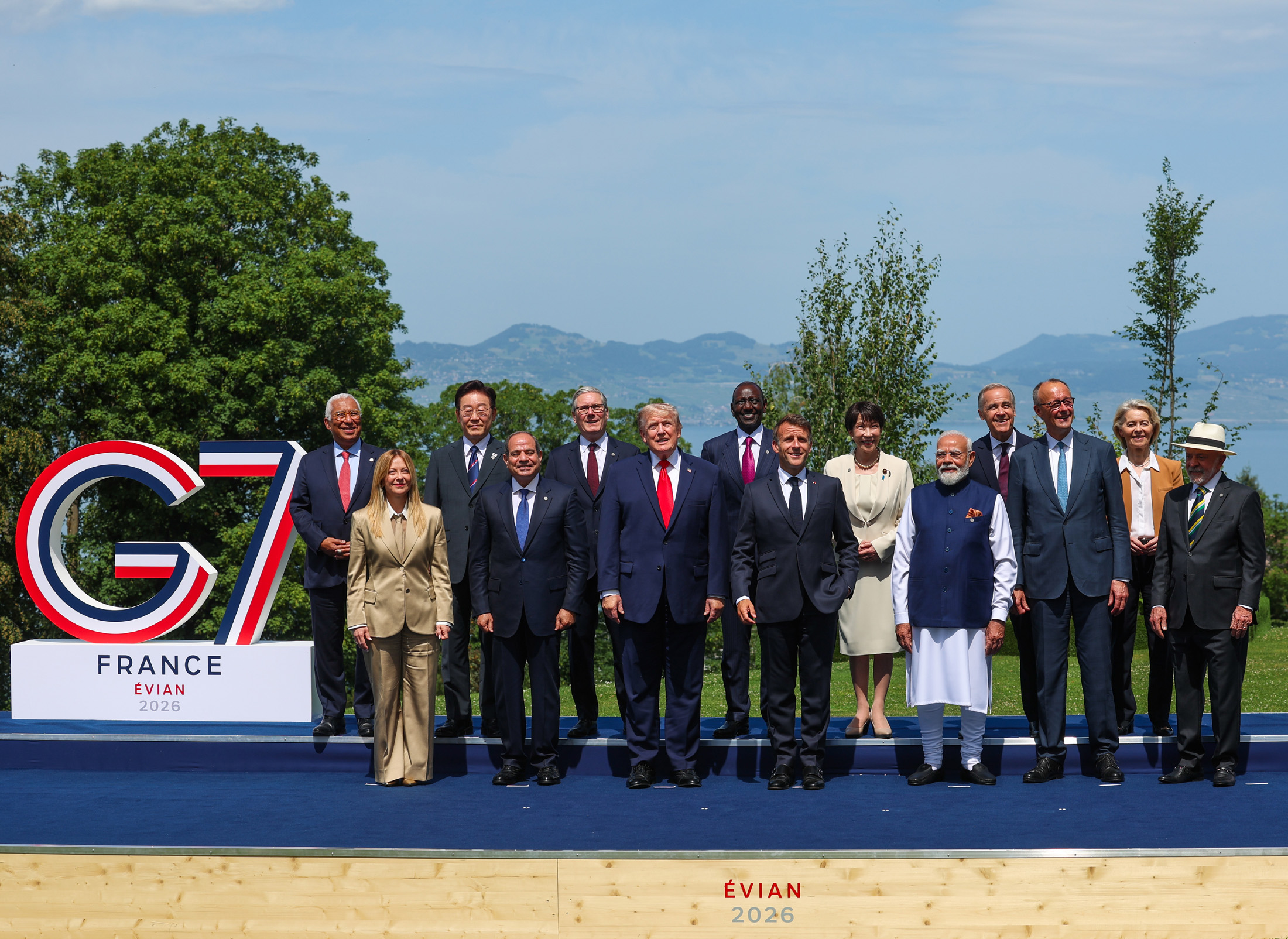
 G7 summitt in Evian, France, June 2026. Photo: Indian Prime Minister's Office / Wikimedia Commons / Indian Government.
The IMF and the World Bank are failing to recognise the massive rupture in the nature of the capitalist world order that has happened under Trump, argues John Clarke
As the Trump administration’s belligerent but often erratic effort to ‘Make America Great Again’ plays out on the world stage, the international institutions that were created at a time when the US was capable of being the cornerstone of a relatively stable global order exist in something approaching a state of denial.
Both the World Bank and IMF have recently offered rounds of advice on how to navigate troubled economic and political waters. In doing so, they express their horror at Trump’s course of action in the most muted terms, striking a note of optimism while warning of the dangers ahead.
The World Bank’s recent ‘flagship report’ on Global Economic Prospects doesn’t want to mention the name ‘Trump’ but its contents nonetheless point to major differences with the present occupant of the White House. It informs us that ‘global economic outlook has shifted markedly as the conflict in the Middle East has generated major disruptions in energy markets.’ Furthermore, disruptions to ‘flows of energy and other commodity supplies from the Gulf region have led to sharp commodity price increases’ (p.4) that are fueling inflationary pressures.
The report goes on to warn that ‘in this context, global growth is forecast to slow this year to 2.5 percent, the lowest rate since the COVID-19 pandemic, as higher energy prices, rising inflation, tighter monetary conditions, and weaker trade weigh on activity.’ It rather hopefully predicts a modest improvement next year but feels compelled to acknowledge that the ‘outlook is subject to substantial downside risks … if energy supply disruptions prove more severe than currently assumed and are accompanied by substantial financial stress, global growth could fall to just 1.3 percent in 2026, and inflation would rise to 4.4 percent’ (p.7).
The World Bank’s writers predictably reflect the questionable optimism of the leading representatives of global capitalism with regard to the prospects of a limitless profit bonanza flowing from investment in AI. They also offer firmly worded advice on the need for fiscal restraint and continuing austerity measures. However, the glaring but unspoken reality is that the US, as the necessary lynchpin of the international effort they propose, is no longer at the table in any meaningful sense.
Global picture
Writing for the IMF blog on 15 June, the institution’s managing-director, Kristalina Georgieva, strikes a very similar note. Like her counterparts at the World Bank, she is restrained, avoids alarmist formulations and keeps the name ‘Donald Trump’ out of the picture but she nonetheless warns of the seriousness of the situation in no uncertain terms. She suggests that while more than three months ‘into the war in the Middle East, the global economy appears to be holding up … an overall resilient global picture masks significant disparities.’
Georgieva notes that the closing of the Strait of Hormuz poses a serious economic threat but she stresses that major damage to ‘infrastructure in the Middle East’ has created problems that a fragile resolution of the conflict won’t overcome. She goes on to offer advice to the political stewards of global capitalism that is essentially the same as that which is to be found in the World Bank report.
The IMF proposes ‘policy discipline and agility,’ which essentially means a firm commitment to austerity with a readiness to switch temporarily to stimulatory measures in response to crises. However, the question again arises of just who she thinks is likely to take her advice with regard to international cooperation.
Georgieva proclaims that the ‘IMF remains on high alert. We are also deeply mindful of the economic damage some of our members are already suffering. We will work with them to manage the shock and limit its negative impacts, especially on the vulnerable. Our commitment to our membership is unwavering.’
These words sound very confident and resolute but they inadequately camouflage a reality of which the IMF’s leading representatives are only too aware. The team effort that is being heralded has been completely undermined by the departure of the US captain and global capitalism is still struggling to find its feet in the wake of this.
As the global economy shudders under the impacts of Trump’s Iranian debacle and his erratic turn to protectionism and tariffs, both the World Bank and IMF continue to function as the ghosts of deceased world order. The failed attempt to subjugate Iran has taken things to an alarming new level but the passing of an established system of international relations within global capitalism was already clear before the attack on Iran.
Last year, Atlantik-Brücke was already presenting Trump as ‘a threat to the global financial system’ and spelt out the fate that was looming over the World Bank and the IMF. It pointed out that these two ‘Bretton Woods institutions’ had functioned ‘as cornerstones of the post-World War II global economic order.’
Tellingly, however, the article explains that, though these bodies were dominated ‘by the US as the major shareholder, they were nevertheless multilateral institutions based on a shared vision and shared values. Together with the Marshall Plan, it signified the beginning of Pax Americana.’ Thus, it is hardly surprising that as President Trump ‘sets about defenestrating the multilateral system of global governance that has prevailed since WWII, their role — conceivably their existence — is under threat.’
No strategy
As we see from the latest offerings of the World Bank and the IMF, however, there is no coherent strategy to deal with the shattering impacts of the massive strategic shift coming out of Washington. The Bretton Woods institutions don’t even admit to the fundamental change that has taken place. They grumble about the instability it has created but offer no realistic proposal for global cooperation in the wake of it.
The closest thing to an effort to wrestle with implicaitions of this enormous crisis came from Canadian prime minister Mark Carney in a speech he gave to the World Economic Forum in January. Addressing the gathering as a representative of one of the imperialist junior partners of the US, he acknowledged that: ‘For decades, countries like Canada prospered under what we called the rules-based international order. We joined its institutions, we praised its principles, we benefited from its predictability. And because of that, we could pursue values-based foreign policies under its protection.’
Carney then candidly pointed out that this ‘bargain no longer works. Let me be direct. We are in the midst of a rupture, not a transition.’ With a measured show of defiance, he went so far as to assert that: ‘You cannot live within the lie of mutual benefit through integration, when integration becomes the source of your subordination.’ As the political leader of a ‘middle power,’ he went so far as to note that ‘many countries are drawing the same conclusions that they must develop greater strategic autonomy, in energy, food, critical minerals, in finance and supply chains.’
Though it garnered international headlines and won praise in some quarters, Carney’s intervention at Davos hardly proved to be a rallying call for an alliance of the abandoned junior partners. None of them, including Canada, have any clear sense of how they can replace a functioning world order in which the US was seated at the head of the table.
It must be added that Trump’s America First turn, while it may be conducted with erratic incompetence under his command, is an expression of a decline in US power that future administrations will not be able to wish away. Carney’s use of the word ‘rupture’ was actually very well chosen.
Under Trump, however, there is no doubt that the US shift is being conducted with the maximum degree of disruption and chaos. Even if his administration is able to secure a durable peace deal with Iran, which is far from certain, the political and economic costs of Trump’s massive blunder will be profound and long lasting. The hardship that will flow from it, especially in the Global South, is already clear but the hastening of the decline of US power and the increased instability of global capitalism will be major considerations.
The ‘predictability’ of the now discarded world order that Carney spoke of at Davos may have been greatly exaggerated but the enormous uncertainty of what has been left in its place is very real. The state of denial that we see coming from the World Bank and the IMF reflects the harsh truth that, for global capitalism, it is very hard to see an effective and durable alternative to ‘Pax Americana.’

John Clarke
John Clarke became an organiser with the Ontario Coalition Against Poverty when it was formed in 1990 and has been involved in mobilising poor communities under attack ever since.