
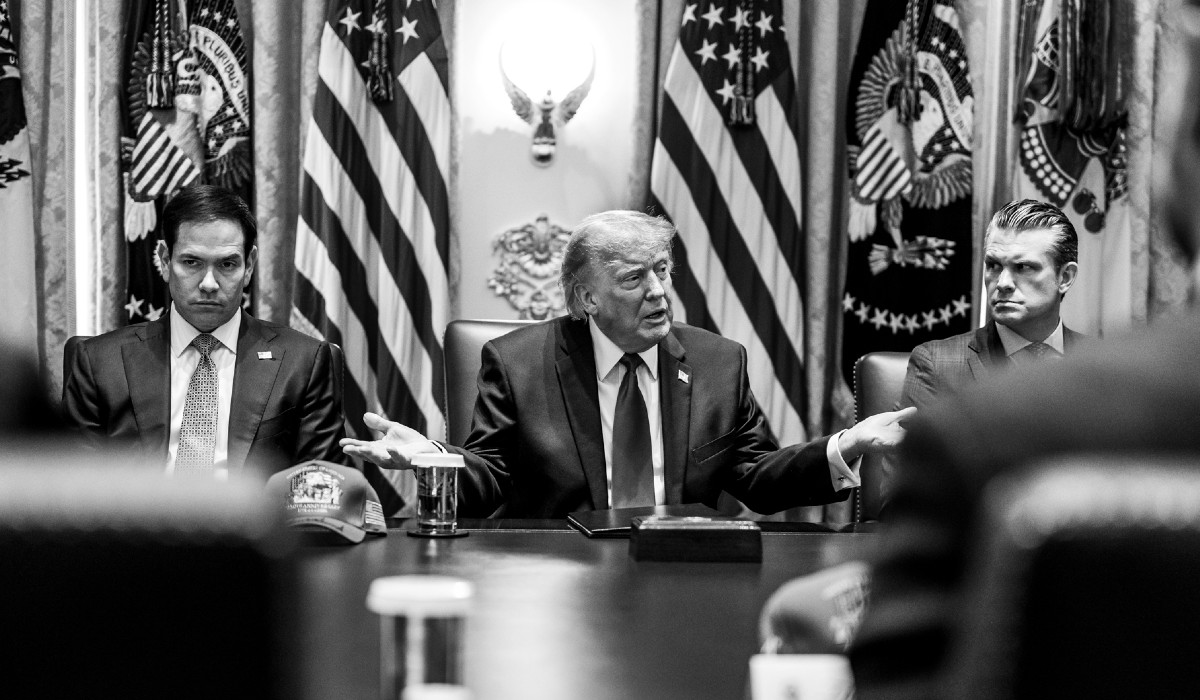
 Donald Trump, Marco Rubio, Pete Hegseth. Photo: White House / Public Domain
The US is facing its biggest defeat since Vietnam and any peace treaty with Iran will underline a new balance of power in the Middle East, argues Chris Bambery
What is happening between Iran, the USA and Israel? Part of the answer is that the last two are coming up against the new balance of power in the region. Tehran is making it abundantly clear that peace with the US depends on peace in Lebanon, and possibly Palestine.
Another part of the answer is that Benjamin Netanyahu does not want peace. He agreed to Donald Trump’s demand to cease bombing Beirut, after he threatened to destroy the southern suburb of Dahieh, a Hezbollah stronghold. But he is still bombing Tyre and other parts of Lebanon. On Sunday night, Iran fired missiles into Israel in retaliation for its continued attacks on Lebanon.
As Trita Parsi points out:
‘This is the first time Iran has struck Israel after Israel struck another country’s territory (that is, not Iran). This means that the battle lines have been moved. Iran’s deterrence had already been restored in the sense that Israel knew that any strike on it would be responded to. But now, Iran has proven that it will also respond to Israeli strikes on Lebanon. This is the first time in decades that a regional power has the means, capacity, and willingness to put hard power against Israeli military maneuvers or aggression against a third party.’
Iran is asserting itself as a power in the region in ways unthinkable before 28 February, when Israel and the US attacked it. As American intelligence reports, the US and Israel failed to destroy Iran’s arsenal of missiles and Iran has shown it can hit Israel despite the Iron Dome missile defence.
Israel responded by bombing a residential building in Dahieh, claiming it housed Hezbollah commanders. In reality, they would be deep underground.
In response to all this Trump stated: ‘Hopefully Israel is not going to retaliate. If Bibi strikes them back it’s just gonna keep going like the last 47 years, or the last 3000 years.’ He added: ‘We are very close to a final deal with Iran. It is going to be a good deal. I don’t want it to blow up because of what is happening now.’
He claims he controls Netanyahu but the latter is intent on fighting a forever war in Lebanon. He wants to destroy Iran but can’t do that without America.
What is interesting is that for decades, Washington has backed Israel unconditionally because it saw it as being the regional power which could guarantee regional stability. Since the 1973 war with Egypt and Syria, no state in the region has dared to challenge Israel directly, until now.
However, Washington, Saudi Arabia, the Gulf States and international capitalism want a peace deal with Iran to let oil, liquid gas, fertiliser and much else flow through the Strait of Hormuz. But despite Trump’s claims that a deal is in the offing, in talks brokered by Pakistan, this does not seem to be true.
His headline issue in negotiations is Iran’s nuclear programme. That’s the last point to be brokered in any deal for Iran. Tehran has demanded the US releases its frozen assets, worth between $100 billion and $120 billion, to demonstrate goodwill. As noted, any peace deal must apply to Lebanon.
The price of peace
Trump has also said he wants the Strait of Hormuz to be open but that is the territorial water of Iran and Oman who have agreed on charging a fee for ships going through, as Turkey does in the Dardanelles. At $2 million a tanker, that’s a pretty penny for both Oman and Iran.
The simple truth is that in this poker game, Iran holds all the cards. It controls the Strait which the Americans cannot force a way through. In the recent skirmishes between the two, Iran demonstrated again it could hit American military assets in Kuwait and Bahrain. Its naval base in the latter has suffered badly since 28 February. Iran can also escalate, together with the Houthis, by closing the Bab-el-Mandeb, the southern maritime gateway to the Red Sea Suez Canal. That would do immense damage to the world economy.
Iran is not suing for peace at any price. In many ways it can live with a situation of no peace, no war, punctuated by skirmishes with the Americans. Trump faces a situation where Americans, about to go on vacation, face a doubling of the price of a gallon of petrol. That could come back to haunt him in the November mid-term elections.
In all this, Israel is sidelined. By that I don’t mean it cannot do tremendous damage to Lebanon and Palestine, but the Israeli Defence Force admits it cannot destroy Hezbollah as Netanyahu pledged to do.
But Israel no longer looks like the regional strong man and that will have been noted in Washington. It was not a Jewish lobby which underlined American support for Israel but rather Washington saw it as key to its interests in a vital region.
That calculation has now been undermined and reports of Israel spying inside the US will add to a growing frustration with Tel Aviv (the espionage was because Israel has been frozen out of the US talks with Iran and they wanted to know what was cooking).
This is not the first case of Israeli spying inside the US. In 1984, Jonathan Pollard sold numerous state secrets, including the National Security Agency’s ten-volume manual on how the US gathers its signal intelligence and disclosed the names of thousands of people who had cooperated with US intelligence agencies. In 1987, he was sentenced to life in prison for violations of the Espionage Act. He left prison in 2015 and relocated to Israel in 2020. Today, he is a parliamentary candidate for a far-right party espousing the total ethnic cleansing of Gaza.
Returning to Iran: on 28 February, few would have predicted it would emerge strengthened from a war with the US and Israel but it has. It has split the Gulf States, effectively allying with Oman and Qatar and strengthened its alliances with China and Russia.
Other states will have noted that. This week, Egypt held naval exercises in the Mediterranean with Russia. It has also established a naval base in Port Sudan. Turkey has ambitions to become a sub-imperialist power. Saudi Arabia has reached a treaty with Pakistan whereby Islamabad extends a nuclear shield over it.
On 28 February, Trump expected a quick victory; Israel pledged that would happen although American commanders did not believe it. Trump listened to Netanyahu and Mossad rather than them.
Now he is bogged down in the region, desperate for an off-ramp but not finding one, he will recall Netanyahu’s pledge with rancour. America has suffered its biggest military reverse since Vietnam. Israel has lost its aura of invincibility. The balance of power in the region have been changed fundamentally.
Before you go
The ongoing genocide in Gaza, Starmer’s austerity and the danger of a resurgent far right demonstrate the urgent need for socialist organisation and ideas. Counterfire has been central to the Palestine revolt and we are committed to building mass, united movements of resistance. Become a member today and join the fightback.

Chris Bambery
Chris Bambery is an author, political activist and commentator, and a supporter of Rise, the radical left wing coalition in Scotland. His books include A People's History of Scotland and The Second World War: A Marxist Analysis.