
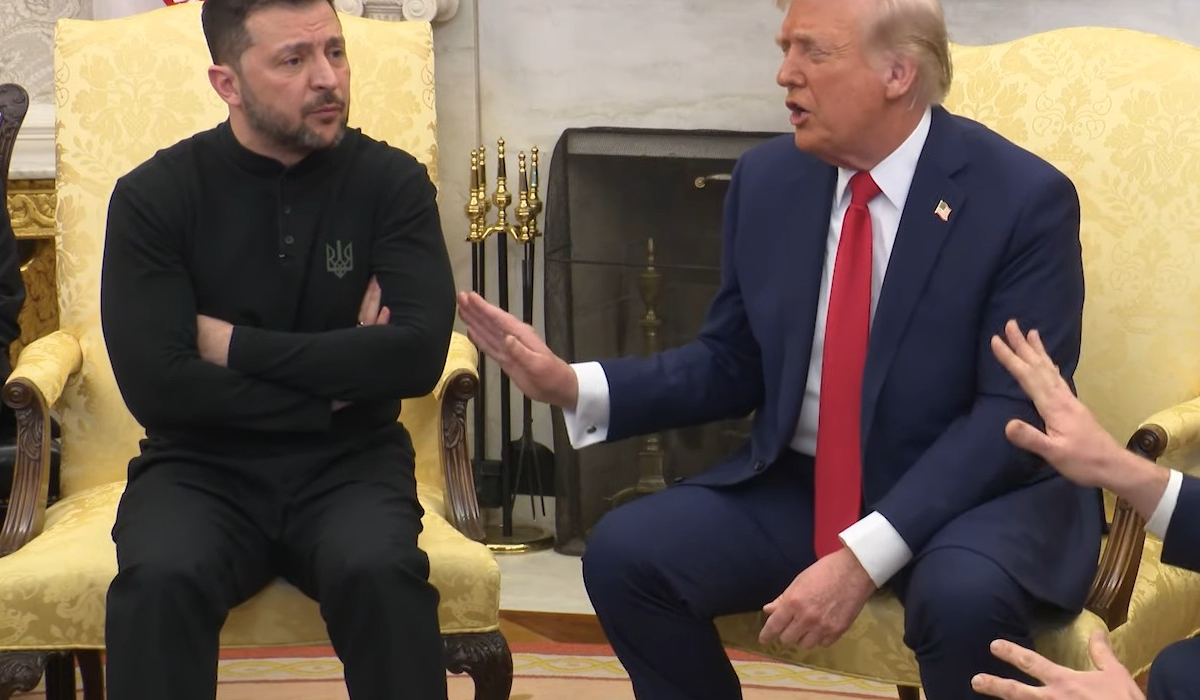
 Volodymyr Zelensky and Donald Trump at the Oval office, February 2025. Photo: Wikimedia
Lindsey German on imperialist transition
The demand by Donald Trump that Ukraine accepts a peace deal with Russia by Thanksgiving (the US holiday this Thursday) has sent the European powers and Ukrainian president Zelensky into crisis. The proposed deal reveals the brutal reality of what this war is about. Trump is, according to reports, wanting to use frozen Russian assets to help rebuild Ukraine – 50% of profits from which operation will go to the US. The cavalier attitude to carving up parts of the east of the country is similar to Trump’s approach to Gaza and peace plan there – although this one looks like a masterpiece of detail in comparison.
The working-class people of Ukraine and Russia will be no doubt relieved at the end of a war which has been horrific for so many, but they will get little from this deal. The casualties are truly frightening and more akin to those of the Iran-Iraq war of the 1980s or even the First World War. According to one source, around 800,000 Russian troops have been killed or injured, with another 50,000 missing since the start of the war. On the Ukrainian side 400,000 have been killed or injured, with 35,000 missing. Civilian casualties are much lower but still run into thousands. These figures may be underestimates: both Trump and the British Ministry of Defence estimate Russian losses at around 1 million, and Trump puts the Ukrainian losses at 700,000.
Add to this destruction of infrastructure, insecurity, long term disability and illness, environmental damage, mass exodus of refugees, draconian conscription laws that are bitterly opposed by much of the population, and you can see why the majority of Ukrainians and Russians want some sort of negotiated peace.
Yet this is precisely what Starmer and the EU leaders oppose. They dress this up as concern and solidarity with the Ukrainian people but it is anything but. They are tied to a massive programme of rearmament and military spending, to strengthening infrastructure to allow a land war in Europe, and to the expansion of Nato. This war is a proxy between them and Russia, with Ukraine the victim. They are both terrified of and obsequious to, Trump, who reckons that the US can effectively franchise out its military operation in Europe at a high cost economically and politically to the European powers. The extent of this can be seen by his comment that the head of Nato should be a German general – something unique in the history of the organisation, which has always had a US general at its head.
It is in the interests of the EU leaders, Starmer and Zelensky to keep the war going. The Ukrainian leader is mired in a very serious corruption scandal, is losing popularity and has no way of winning the war other than forcing Nato to escalate into full-blown war with Russia. That Nato has no intention of doing at present, given that it would be a war between two nuclear powers. But every day the war is continued it is leading not just to more death and destruction but more instability and militarism which can spill over into direct conflict between the major European powers. Their alternative of continuing the war is no real alternative, which is one reason some version of this peace deal might succeed.
The tragedy is that it will likely be similar to one proposed at the beginning of the war at talks in Istanbul nearly four years ago. That deal was scuppered by, among others, Boris Johnson who believed Russia could be openly defeated then. That hasn’t happened.
The Nato powers always had unrealistic expectations of this war. They ignored the ongoing war in the Donbas, the concerns of the Russian minority over rights and language, and support for Russia in some areas, although these were always going to be issues. They wished away Russian opposition to Nato expansion, even though this has been a major issue since the end of the Cold War. They have expanded eastwards right up to Russia’s borders and then engaged in a damaging proxy war.
While they project Russia as an existential threat to Europe, the reality is different. Putin has had remarkably limited success in his war, now occupying only 12% of Ukraine since 2022. Russia’s advances are real but they are very slow in taking territory. The Russian economy is now suffering from sanctions, and he is desperate to be readmitted into the robbers barons’ outfit of the G8 (now G7) – a point included in the peace deal.
Huge resources were poured into Ukraine from US and Europe, with gradual escalation of types and amounts of weaponry. But every single supposed turning point didn’t alter the nature of the war, whether Abrams tanks, F16s, or longer-range missiles. There is nothing to say that any future escalation would work. So the words ‘rock’ and ‘hard place’ come to mind. As one commentary sympathetic to Ukraine put it:
For all the public bravado, there has been a private admission in some parts of the Ukrainian elite that a deal may need to be done sooner rather than later, even if everyone sees Moscow as a bad-faith negotiating partner.
We can be certain of several things if that happens. It will not be brought about, or in the interests of, the ordinary people of those countries, who will have to reckon with their own ruling classes. It will not bring real peace to the region which is now armed to the hilt. And it will not stop the obscene levels of arms and military spending at the expense of our health and welfare that our government is engaged in.
This week: I will be joining the People’s Assembly protest on the eve of Budget day, speaking about precisely why we need welfare not warfare. Then I will be at the Stop the War Xmas party and quiz – please join us if you can. At the weekend there are two important events: the Palestine demo which is as important as ever, given the horrors still going on. And there’s the Your Party conference in Liverpool where I very much hope those present will be able to achieve a stronger and more democratic organisation, and the degree of unity necessary to carry it forward.
I also want to recommend an extremely good film Judgment in Nuremburg which is on BBC iPlayer. It is a 1961 film with a cracking cast – Spencer Tracey, Burt Lancaster, Maximilian Schell, Marlene Dietrich, Montgomery Clift and Judy Garland, plus a young William Shatner. Its power is in its serious argument about what happened and why under Nazism, and the hypocrisy of ruling classes everywhere. Made only 15 years after the war, it is much more serious and honest about this than much of the cultural output today.
Before you go
The ongoing genocide in Gaza, Starmer’s austerity and the danger of a resurgent far right demonstrate the urgent need for socialist organisation and ideas. Counterfire has been central to the Palestine revolt and we are committed to building mass, united movements of resistance. Become a member today and join the fightback.

Lindsey German
As national convenor of the Stop the War Coalition, Lindsey was a key organiser of the largest demonstration, and one of the largest mass movements, in British history.
Her books include ‘Material Girls: Women, Men and Work’, ‘Sex, Class and Socialism’, ‘A People’s History of London’ (with John Rees) and ‘How a Century of War Changed the Lives of Women’.