
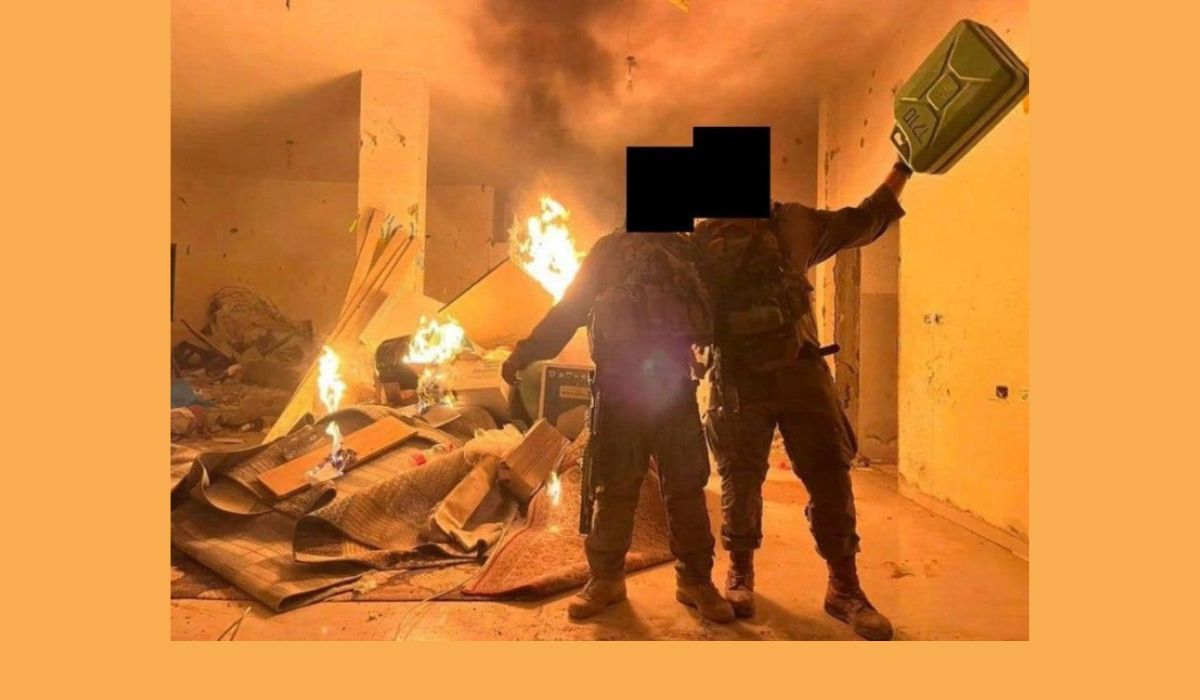
 Light unto the nations? Israeli soldiers torch a home in Gaza City on the night of 9 October 2025. Photo: social media via Drop Site; faces obscured by Drop Site.
While there is no reason to believe a word Trump or Netanyahu say, the background to the current ceasefire is that Israel is in deep trouble, argues Robert Dale
Somehow it feels different this time round. The media babble has a different tone, a little more critical of Israel, a little more humanising towards the Palestinians. Trump’s plan is grotesque, but the document signed by Hamas commits only to the ceasefire, the prisoner exchange and further talks.
In this piece I’ll take a look at where things have got to in the different arenas of the conflict and whisper the idea that we might be seeing the beginning of the end of the Zionist state and its settler-colonist project. I am in no way suggesting that this is inevitable, but I do believe we should consider the possibility.
A world of trouble
Israel’s leaders can’t like what they are seeing: the resistance in Gaza battered but unbowed, a smouldering insurgency in the West Bank, a Yemeni naval blockade lifted only for the ceasefire. Iran is now able to retaliate militarily. Jewish Israelis are leaving in significant numbers, exacerbating economic tensions. A large and resilient pro-Palestine movement driving international boycotts and diplomatic shifts. Jewish support is eroding, the Zionists are even losing the US right.
Palestinian resistance
The heart of the story is the Palestinians’ own resistance of course, civil and military. Much is yet to be told, there’s so much we still don’t know. What we do know is that the IDF tried repeatedly to take control of Gaza City, and failed every time. The most recent Israeli assault, launched mid-September, got nowhere and was abandoned with the ceasefire. (One reading would be that its failure necessitated the ceasefire.) Resistance fighters are now moving openly in many urban quarters in Gaza. For an insurgency, mere survival is victory. For the occupying power, stalemate is defeat. The impact on the Zionist self-image can hardly be overstated. Their sense of para-racial superiority, the legend – now myth – of their army’s invincibility. Up in smoke.
The West Bank is a powder keg. Israeli settlers conduct relentless pogroms – yep, that’s what they are – under the eyes of the Israeli security forces. The ‘Palestinian Authority’ is highly unpopular, seen as feeble and corrupt. Armed resistance groups are active; Jenin is a centre. The general strike in April and the jubilant welcome for the released prisoners in Ramallah indicate that potential for mass civil resistance remains. Had the Israelis succeeded in crushing Gaza, the West Bank would have been next. (Intra-Palestinian politics will be a key factor in the coming period.)
Iran
Militarily, the Israelis believed they were invincible in the region. Iran and Yemen have shown them otherwise. The missile exchange with Iran in June 2025 must have come as a shock. While Western media parroted Israeli denials that any harm had been done, independent military analysts tell a different story: major damage to military and intelligence facilities, ports, refineries and more.
Iran now has missiles and drones capable of overwhelming Israeli (and American) missile defences and accurately striking sensitive targets. This was not a fluke, and the Israelis know it. None of the West’s current missile defence systems is capable of stopping that scale of combined missile and drone attack. In connection with the current ceasefire, Netanyahu reportedly told Iran via Moscow that he had ‘no intention of restarting a war’.
Iran’s drone and missile capability is also directly relevant for Washington. Any serious American attack would risk retaliatory strikes on its many bases in the region. Iran can also close the Strait of Hormuz, choking off much of the world’s oil supply.
Yemen
Speaking of closing shipping routes, Ansarallah’s blockade of the Red Sea has been remarkable. This unorthodox Islamist movement, commonly known as ‘the Houthis’, governs part of Yemen. By threatening – and conducting – missile strikes on merchant vessels connected with Israel, they closed off the Israeli port of Eilat (which is now bankrupt) and denied access to the Suez Canal. They also attacked Israel directly with drones and missiles.
Israel responded with punitive bombing raids. As did the Americans. And the British. One Israeli attack deliberately murdered more than half the Houthi cabinet in a single strike on 28 August this year. Ansarallah’s response was to send more drones and missiles. On 1 October, shortly before the ceasefire announcement, they struck and disabled the MV Minervagracht, which they claimed had been visiting Israeli ports.
The key moment in the Red Sea blockade was the US-led naval and aerial bombing campaign in early 2025, seeking to force the Houthis to back down. Instead they struck back, targeting the Western warships with missiles. After burning US$3 billion and losing three aircraft and seven high-tech drones, Trump declared ‘victory’ and the US navy left the area – leaving Israel to fend for itself. Apparently Netanyahu wasn’t even informed until the deal had been done. The Houthis agreed to permit US vessels to pass but continued to target ships associated in any way with Israel (ownership, port visits, etc).
Insecurity and emigration
Israelis who believed that threatening their neighbours with death and destruction would secure them a peaceful life have been shown their vulnerability. Hezbollah’s intervention caused 100,000 civilians to be evacuated from northern Israel for more than a year. Like Hamas, Hezbollah appears to have come through damaged but defiant.
Across the Israel, the occasional Yemeni drone or missile had people running for the air-raid shelters right up to the ceasefire (157 alerts on 5 October). It’s worth reminding ourselves of the geography. As the crow flies, it is just seventy kilometres from Gaza City to Tel Aviv or Jerusalem (less than the distance from central London to Colchester). From the Yemeni capital Sana’a to Tel Aviv is 2,000 kilometres (London to Morocco or Iceland).
Net immigration of Jews was negative in 2024. Rarely in the country’s history have there been more Jews leaving than arriving. Polling shows 23% considering departure, and 37% among the youth.
While the economy has not collapsed, it is under great stress. Political leaders are talking about autarchy (economic self-sufficiency). Direct US aid accounts for less than 1% of GDP. International trade is significant, with the United States and Europe accounting for two-thirds of Israel’s exports. (If I were looking for a neuralgic point for the movement to apply sanctions, Ireland’s microchip imports would be on my list.) Almost all the Arab states trade with Israel, although the volumes are comparatively small.
Supporters running for the doors
The walkout at Netanyahu’s speech to the UN General Assembly on 26 September epitomised his country’s loss of international diplomatic backing. Even the imperial heartland has been dragged – kicking and screaming – into recognising the state of Palestine. Most of the Global South did so in …1988.
As Chris Bambery outlined on this site recently, Israel also has lost large parts of the American right, which has been a bedrock in the States. This is a recent, sudden and unexpected development.
International solidarity
Last but certainly not least, we have the international solidarity movement and significant developments that are intimately bound up with it. The movement itself is, I think it is fair to say now, the biggest and toughest anti-war movement since Vietnam. Significant sections are explicitly anti-imperialist (this varies from country to country), and even where they are not, they are highly critical of the role of their own respective governments (also, I think, reflecting a generalised antagonism towards current rulers).
The movement has powered through vicious attacks by the forces of the state. Who would have thought we would see mass strike action to support an anti-imperialist cause? It is this mass movement, more than anything else, that has catalysed the breakthrough of the boycott campaign and accelerated the erosion of Jewish support for the Zionist project. And of course very many Jewish people have been at the forefront building the movement. In the dark days of autumn 2023, the bravery of Jewish Voice for Peace played a crucial role in breaking the speech and demonstration bans here in Germany.
The boycott, divestment, sanctions (BDS) movement has gained real momentum. To pick out just some of the highlights: mass protests in Spain disrupted the Vuelta a España cycle race in September, with the Israel-Premier Tech team excluded from two subsequent events in Italy. A UN committee has recommended that Fifa and Uefa suspend Israel from international competitions, and its matches are turning into pro-Palestine demonstrations.
European broadcasters are under pressure to exclude Israel from the Eurovision Song Contest (which is as dear to Jewish Israelis as cricket and rugby were to white South Africans). Spain, Ireland, Slovenia, Iceland and the Netherlands are talking about pulling out if Israel participates. The decision has been postponed to the EBU’s general assembly in Geneva (4 and 5 December in case you’re interested).
The loss of Jewish support for Zionism is spectacular, especially in the United States, where between one-third and half of the world’s Jews live. This is obviously a key constituency for Israel, into which it has poured enormous resources. A recent poll found that 40% of American Jews believe Israel committed genocide in Gaza; 50% among the young.
Finally, for a very long time, the Zionist state has orchestrated an underlying feeling, very widely shared in some form or other, that ‘the Jews’ ‘deserve’ the state of Israel because of the unspeakable horrors of the Holocaust. The past two years in Gaza have dissipated a lot of that, direct comparisons are no longer verboten: genocide, Warsaw, the camp fence. Even for those who don’t follow the ins and outs, the images of cities turned to rubble communicate mindless vengeance. To top it all off, we have the sickening para-racial supremacism of IDF soldiers gleefully blowing up universities and desecrating mosques – and putting it all on Tiktok.
The boss has the shakes
So far so good. Or so bad. Israel is in a pickle. But it can still run to daddy, can’t it? For many decades now, the United States has backed Israel to the hilt, however atrocious the crime (Sabra and Shatila, 1982, to name but one of multitudes), however rude the insult (the strafing of the USS Liberty, 1967).
Nonetheless, the United States is finding itself forced to relinquish certain possessions and outposts. The imperial overlord has now suffered three major defeats in the space of four years: Afghanistan (with images evocative of Saigon), Yemen and the Red Sea (passed completely under the radar, like the Houthis’ missiles), and Ukraine (sealed though not yet signed). US generals have learned that their forces are, to put it politely, not suited to modern warfare, but have not even begun responding (not that I’d want them to).
Ukraine has also shown the United States (and the rest of the West) that they no longer possess the manufacturing base required to fight a long war (just as well, we’d say). There are plans afoot to try to make a start at beginning to remedy that, but it will be decades, if they get off the ground at all. And that’s before we get to the nitty-gritty.
Things like rare-earth elements. These are needed to make high-performance magnets and microchips which are vital for the West’s high-tech weaponry (from drones and guidance systems to warplanes and submarines). China controls most of the mining and virtually all the refining, and has just tightened its export controls.
The war in Ukraine and the clashes in the Red Sea have revealed much of the West’s arsenal to be out-of-date and unreliable (long may it stay that way). Exorbitantly expensive too (for which we are being made to pay). In multiple conflicts, the Western powers are facing adversaries armed with better missiles, drones, guidance systems and air defence.
It is in response to these multiple pressures that the draft 2025 US defence strategy proposes prioritising the ‘Western Hemisphere’, pulling back a little from active confrontation with Russia and China. Of course, we can’t know whether they will carry this through, nor how far it will go. But that seems to be the way the wind is blowing. So headwinds for Israel, possibly a storm brewing.
On 29 September, immediately before the ceasefire plan was unveiled, Trump made Netanyahu apologise to the Qatari prime minister for the missile strike of 9 September, when Israel tried to assassinate Hamas negotiators in the Gulf state (yes, negotiators). The eminently well-connected Elijah Magnier believes Washington’s relationship with Israel has shifted. He reports an Israeli official admitting off the record, ‘For the first time, we’re being treated like a client, not a partner’. We’ll see.
However it plays out, the process will be complex and messy. The unfolding events will often be hard to interpret. It remains a liberation struggle, and an armed one. Expect good news and bad. We will undoubtedly hear stories about violence committed by the resistance. They will not always be untrue. Israel has proxy forces doing its dirty work, armed gangs essentially. A number of collaborators were executed in the days following the ceasefire. Don’t expect the mainstream media to report more than a tiny fraction of Israel’s barbarity.
When peering through the fog, I will be looking for bellwethers: Will Israel release Marwan Bargouti, the most respected leader across the different Palestinian currents? Will Hamas surrender its arms, and to whom? Will Israel continue bombing its neighbours? (Lebanon and Syria in particular). This time round, I am not seeing reports of Israeli civilians ransacking aid convoys.
All the resistance has signed off on for the moment is a ceasefire, the prisoner exchange and further talks. Powerful currents in Israel want to drive the Palestinians out entirely. Trump’s proposal to install Tony Blair as the Gulf-funded viceroy of a Gaza protectorate is preposterous. One wonders if it might be a diplomat’s nudge-and-wink for: ‘No, we don’t actually mean this seriously.’
Some on the left see it in stark terms, arguing that only revolutionary action by the wider Arab masses can put an end to Zionist oppression. Much as I would like to see that happen, I think we should not rule out the possibility of other trajectories, including some kind of progress on the national question that falls short of socialist revolution. In the 1980s, parts of the anti-apartheid movement firmly believed that only socialist revolution could end racial supremacism in South Africa. I was among them. We were wrong.
Keep up the pressure
So what do we do now? However the ceasefire process develops, our solidarity will further the cause in Palestine. I’d also see potential to turn some of the movement’s anger and energy towards opposing the far right and the shocking militarisation that is currently under way.
The boycotts have momentum, and we should keep piling on the pressure. The dockers and logistics workers refusing to handle arms for Israel are an inspiration, as are the strikes for Gaza in southern Europe. It is no longer entirely starry-eyed to wonder whether workers might impose broader sanctions from below.
Robert Dale lives in the Berlin region, where he has been active in socialist politics since the 1980s.
