
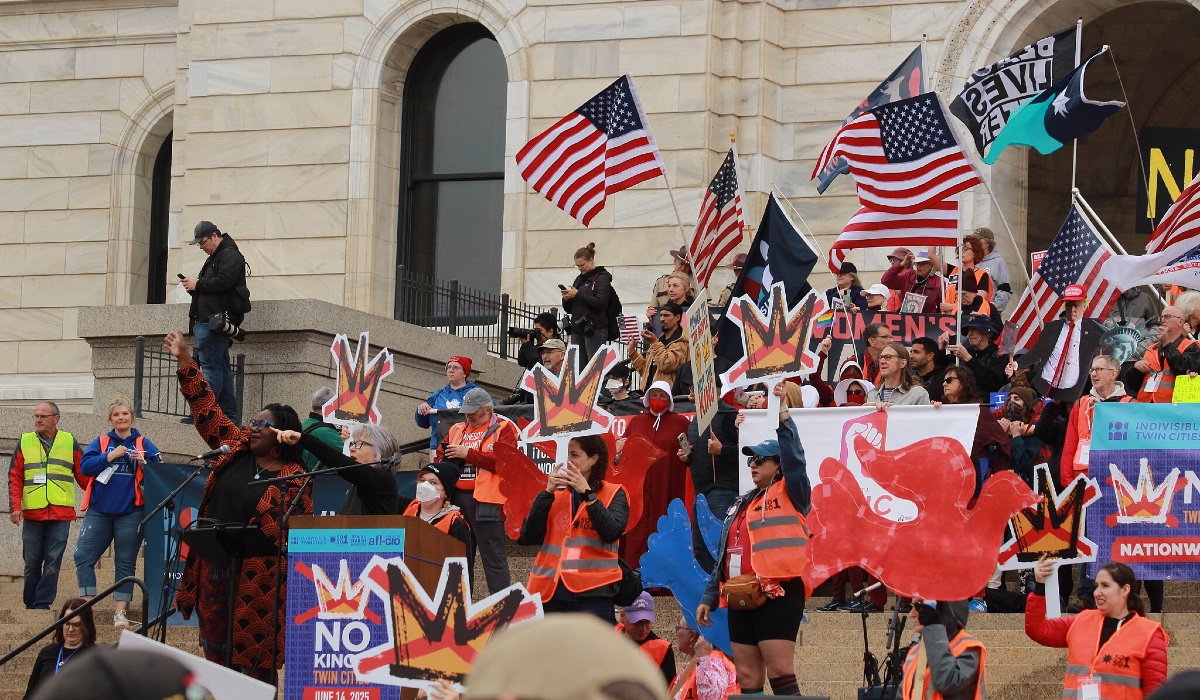
 Minnesota State Capitol No Kings Protest 14 June 2025. Photo: Myotus, CC BY 4.0
 Trump was certainly rattled by the huge marches across the US last Saturday, but a decisive movement against him must advance a genuine working-class alternative, argues John Clarke
The No Kings protests against Trump that took place across the US on 18 October unleashed a truly massive social mobilisation that expressed deep-seated anger and a determination to defeat the authoritarian agenda that the administration is imposing with terrifying speed.
A report in Time notes that organisers ‘estimated some 7 million people protested across the country in suburbs, towns and most major cities. Huge crowds were reported in New York, Washington, D.C., Los Angeles, Chicago and Boston. Protests were also seen in deep red [Republican] states—in Birmingham, Alabama and Billings, Montana. Some experts have speculated that the demonstrations could be the largest in modern U.S. history.’
The overall objective of the protest movement is to ‘defend democratic norms and reject authoritarianism.’ This formulation, while it has a positive side, carries with it an implication of defending a status quo that is to the liking of Democratic Party backers of the protests but that fails to meet the needs of the millions who took to the streets on 18 October. I shall return to this major contradiction shortly.
Trump rattled
Trump was clearly rattled by such a vast expression of hostility to his administration. Though he hardly seemed amused, he insisted, according to Newsweek that the protests were ‘a joke,’ while preposterously asserting that they were ‘very small, very ineffective, and the people were whacked out.’ He told reporters aboard Air Force One that, ‘I looked at the people, they’re not representative of this country. And I looked at all the brand-new signs paid—I guess it was paid for by Soros and other radical left lunatics. It looks like it was, we’re checking it out.’
The responses to the No Kings mobilisation by several of Trump’s allies reinforced this pattern of questioning the legitimacy, even the permissibility, of the initiative. According to National Public Radio, ‘House Speaker Mike Johnson slammed Saturday’s protests as a “hate America rally,” and other Republicans have derided the event as anti-American.’
Prior to the protests, every effort was made to create a climate of fear and an expectation of the threat of violence. The day before the demonstrations, Fox News reported that ‘federal officials are raising concerns about public safety and who may be funding adjacent movements like antifa, a term for loosely organized groups used to describe far-left activists and protesters.’
The right-wing news outlet went on to suggest that on ‘the surface, the movement appears grassroots, collaborative, and nonviolent, promoting anti-authoritarian messages and democratic resistance to President Donald Trump’s priorities during his second term.
The president and other federal officials say that beneath the chants and posters lies growing unease about national security and social order.’
Even more ominously, according to Yahoo News, as the mobilisation was unfolding across the country, ‘Vice President JD Vance took the stage at an event and live artillery demonstration at Camp Pendleton in California, honoring the 250th anniversary of the U.S. Marine Corps.’ California governor, Gavin Newsom, stated that, ‘Firing live rounds over a busy highway isn’t just wrong — it’s dangerous. Using our military to intimidate people you disagree with isn’t strength – it’s reckless, it’s disrespectful, and it’s beneath the office he holds.’
The mobilisation of such a vast expression of opposition to Trump all across the US is a development of enormous significance and one that raises great possibilities. The fear and loathing with which Trump and a number of his key supporters responded to the day of protests were also heartening. However, no realistic balance sheet of the No Kings initiative can fail to take note of its considerable weaknesses and limitations.
The very choice of the name ‘No Kings’ is problematic and raises questions as to the objectives of the whole initiative. Hillary Clinton, who has been justifiably accused of war crimes in her former capacity of secretary of state, was among those calling for participation in the protests. The Hill reports that she issued a statement in the lead-up period that urged people to join ‘No Kings this Saturday at an event near you to push back on Trump’s power grabs and make it clear—we don’t do monarchs here.’
Clinton, along with other senior Democrats and those close to them who have played a major role in this initiative, seek to set the boundaries for any movement of social resistance that challenges the Trump administration. They present Trump as a strangely discordant note, an exceptional figure who is pursuing dictatorial ambitions that threaten an otherwise admirable US system of democracy that must now be defended. If this threat can be overcome, then all will be well, as far as people like Clinton are concerned.
False trail
Though there is certainly an acute need to defend vigorously basic democratic freedoms in the face of Trump’s authoritarianism, the threatened status quo that the Democrats want to preserve isn’t an option for the millions of working-class people now taking to the streets against the present administration.
Writing for Counterfire before Trump took office, I argued that it ‘is important, if we are to understand properly the significance of Trump’s return to power, to appreciate the travails of the US system of government, as its dominant position in the world becomes ever more precarious in the face of economic uncertainty and global rivalry. In this regard, the glaring failures of the Biden Administration are decisive and can’t be understated.’
Trump’s brutal and authoritarian agenda and the ruthlessness with which it is being implemented do indeed flow from the instability and uncertainties facing the US but also from
the complete failure of the discredited Biden interlude to generate any effective alternative to this reactionary course. That being so, the political forces responsible for this failed effort simply can’t provide anything other than a false trail when it comes to defeating Trump and the huge dangers that are posed by his administration.
An effective movement against Trump must embrace perspectives and advance demands that go beyond those which the Democratic Party can accept and, indeed, fight for objectives that it will utterly oppose. The authoritarian threat that Trump represents is very serious but the US working class is confronting an agenda of union busting, austerity, an assault on migrants, environmental degradation, militarism and global domination that the Democratic Party advances in a more ‘moderate’ form than Trump.
As Trump demonises protests against his administration and threatens to use the ‘unquestioned power’ of the Insurrection Act to suppress dissent, it is clear that he won’t be forced to abandon his objectives without a challenge that does more than register its opposition. Huge protests are, or course, vitally important but blocking Trump’s agenda will require a serious level of disruptive defiance that must include an escalating use of mass strikes.
During his speech to the No Kings rally in Chicago, that city’s mayor, Brandon Johnson, did evoke the notion of a general strike against Trump and this doubtless reflected the anger that the administration’s immigration raids and other measures are unleashing. It is not realistic, however, to believe that the Democratic Party machine or those who function in its orbit will work for the kind of movement that could drive Trump out and defeat his agenda or advance a viable working-class political alternative.
Clearly, Trump and his cohorts are systematically trying to generate an ‘enemy within’ that justifies the adoption of emergency powers with which to suppress the rights of dissent, expression and assembly.
There is a huge and vibrant opposition to this threat that is rooted in workplaces and communities across the US and the scale of the nation-wide No Kings protest proves this. A dangerous contradiction, however, exists in the fact that those presently leading the movement against Trump have no capacity or intention to take the struggle against him to the decisive levels that are needed.
The fight to overcome these restraints and limitations that must emerge from within unions, social movements and communities under attack, is the vital question in terms of thwarting the authoritarian danger. Without such a reorientation and change of direction for the movement, Trump will not be stopped.
Before you go
The ongoing genocide in Gaza, Starmer’s austerity and the danger of a resurgent far right demonstrate the urgent need for socialist organisation and ideas. Counterfire has been central to the Palestine revolt and we are committed to building mass, united movements of resistance. Become a member today and join the fightback.

John Clarke
John Clarke became an organiser with the Ontario Coalition Against Poverty when it was formed in 1990 and has been involved in mobilising poor communities under attack ever since.