
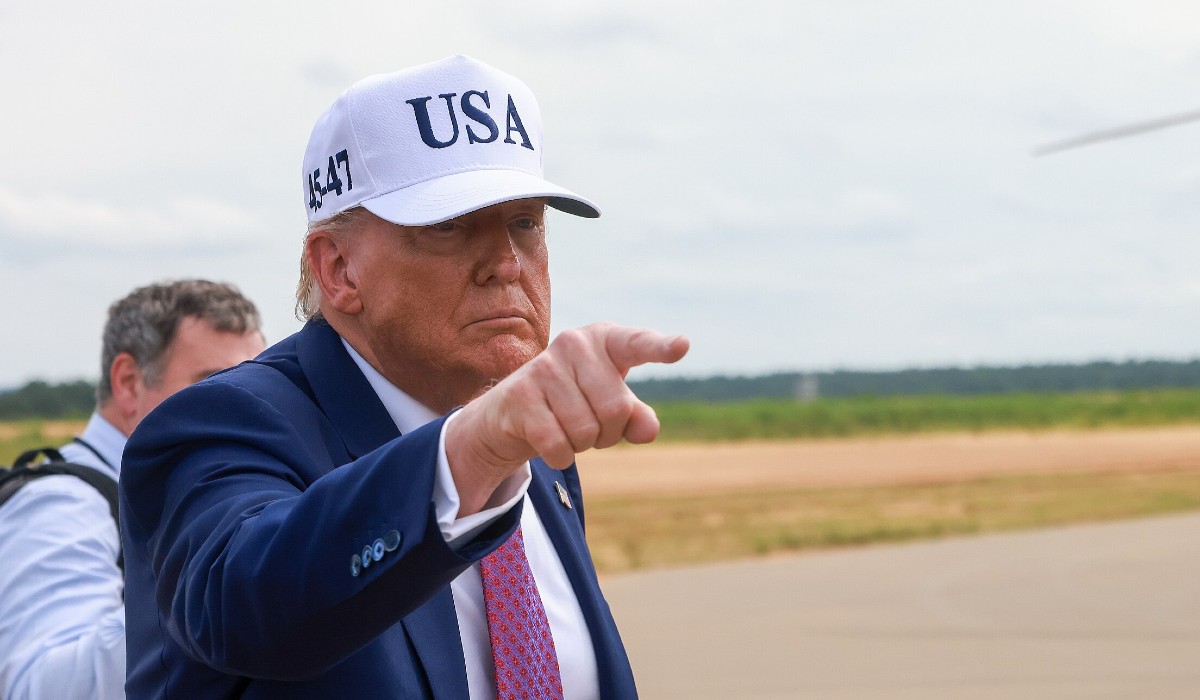
 Donald Trump. Photo: Public Domain
China is retaliating to Trump’s tariffs and embargoes, but the danger to the US, and world, economy is huge, argues Chris Bambery
China and the United States, the two biggest economies in the world, seem to have launched a full-scale trade war between themselves. On Friday, President Trump announced he will impose an additional 100% tariff on goods from China, on top of the 30% tariffs already in effect, starting from 1 November or even sooner.
Trump posted on his Truth Social social-media account that: ‘The United States of America will impose a Tariff of 100% on China, over and above any Tariff that they are currently paying. Also on November 1st, we will impose Export Controls on any and all critical software.’
He added that China is ‘becoming very hostile’ and that it was holding the world captive by restricting access to rare-earth metals and magnets. Trump was reacting to Beijing increasing export controls on its critical rare-earth exports, vital to the production of many electronics. In response, Trump appeared to have called off, via social media, a meeting with Chinese President Xi Jinping that was scheduled for later this month in South Korea.
On Sunday, the Chinese Commerce Ministry responded to Trump, saying: ‘China’s stance is consistent. We do not want a tariff war, but we are not afraid of one … Frequently resorting to the threat of high tariffs is not the correct way to get along with China. … If the U.S. side obstinately insists on its practice, China will be sure to resolutely take corresponding measures to safeguard its legitimate rights and interests.’
The statement added, ‘the U.S. has introduced several new restrictions in recent weeks, including expanding the number of Chinese companies subject to U.S. export controls.’ On rare earths, the Ministry said that export licenses would be granted for legitimate civilian uses, noting that the minerals also have military applications. ‘The new regulations include a requirement that foreign companies get Chinese government approval to export items that contain rare earths sourced from China, no matter where the products are manufactured.’ Beijing said the move was a national-security measure, but it is widely seen as retaliation for Washington’s tightening restrictions on Chinese technology firms.
Under the new rules, announced by China’s Ministry of Commerce, any company, Chinese or foreign, must now seek Beijing’s approval before exporting products containing more than 0.1% rare earth content by value. The ministry also expanded its list of restricted materials and banned the export of rare earths for foreign military use.
China and rare earths
China produces over 90% of the world’s processed rare earths and rare-earth magnets. The seventeen rare earths are vital materials in products ranging from electric vehicles to aircraft engines and military radars.
Exports of twelve of these are now restricted after China’s Commerce Ministry on Thursday added five, including holmium, erbium, thulium, europium and ytterbium, along with related materials.
The Commerce Ministry stated on Sunday that it would grant foreign companies general-purpose licenses and license exemptions. ‘China’s export controls are not export bans. Any export applications for civilian use that comply with regulations will be approved, and relevant enterprises need not worry.’
Trump claimed in his Truth Social post that trade hostility from China ‘came out of nowhere.’ That’s simply not true. The United States has been trying unsuccessfully to get China to increase its supply of rare-earth magnets. Trump has, in recent months, repeatedly accused China of violating the terms of existing trade agreements. Chinese rare earths are embedded in everything from iPhones and electric-vehicle motors to fighter-jet sensors.
Trump first responded by putting restrictions on sales of American technologies to China, including a key Nvidia AI chip. Many of these restrictions were later lifted. Earlier this year, Trump froze exports to China of ethane, a chemical essential to China’s petrochemical industry.
China has blocked imports of American soybeans, replacing them with imports from Brazil. Last year, China imported more than $12bn worth of US soybeans. This year, it will purchase none, cutting off the country that makes up about half of US soybean exports. Then, the Trump administration announced that it would soon impose fees on goods transported on Chinese-owned or -operated ships. China countered with a similar plan on American ships that came into effect last Friday.
China’s Ministry of Commerce, on Thursday, unveiled its most drastic rare-earth export controls thus far, restricting not just exports of raw materials and magnets but also any devices that incorporate those elements. It has also blocked exports of machines and expertise to process rare earths plus all the specialised equipment and technical know-how to turn rare earth into usable materials. In addition, there are export controls on high-performance batteries, specifically those above 300 Wh/kg needed for long-range electric vehicles and advanced drones, and, again, on all the factory equipment to make them. The ban includes the materials inside batteries, both graphite anodes and cathode materials (the two electrodes that are essential for batteries to function at all).
Also included are restrictions on the sale of industrial diamonds and cutting tools, the ultra-hard materials that are used in precision manufacturing, for instance to cut silicon wafers for computer chips. All of this will hit the production of advanced semiconductors which use rare earths and related equipment, battery-powered vehicles and drones, and precision manufacturing across industries using superhard materials. China is copying the US semiconductor export controls that were used against them.
Impact on US economy
Larry C. Johnson notes: ‘The social media trade war between China and the US appears ominous. However, if viewed in macroeconomic terms, neither country is dependent on imports and exports from the other in terms of GDP growth. But the real impact is on the microeconomic level … The US is dependent on China for drones, drone components, processed rare earth minerals and magnets. The US has no alternative source for these resources in the short and medium term. Limiting those exports to the US will have a major deleterious effect on the US defense industry.’
One insider involved in the US rare earth-related industry gave his views on the new trade war: ‘Our country is so addicted to sourcing from other places, it’s like, at what point do we go and put ourselves into rehab and really look at how we solve this problem. Honestly this problem has been going on for 20 years. People just don’t know how screwed we are.’
Cameron Johnson, a senior partner at Shanghai-based supply chain consultancy Tidalwave solutions, warned, after the Chinese ban on rare-earth exports, that: ‘They still have not done it in pharmaceuticals, biotech or chemicals — China tomorrow could shut down our [the US] economy, and there’s simply nothing we could do about it.’
An X-post by Zhao DaShuai who does not represent the government of XI JinPing, but generally reflects it views, stated: ‘We are simply sick and tired of the nonstop demonization of anything related to China by the US. This export ban of rare earth minerals is just the start. If the US does not correct its course, and stop interfering our legitimate rights for development, then we will engineer global economic collapse. Do you really think you can take China down, without us taking you down too? After that, we will let our weapons do the talking.’ Wang Dong, executive director of the Institute for Global Cooperation and Understanding at Peking University, said regarding Trump’s tariffs: ‘At the minimum, there is a deep-rooted sense of arrogance and self-righteousness on the US side.’
Wang Yiwei, an international-relations scholar at Renmin University in Beijing, said China’s trade with the US was diminishing in favour of countries in the global south and those participating in the Belt and Road Initiative infrastructure scheme. China’s retaliatory measures were aimed at telling the US to return ‘to stable trade relations and not play a game any more.’
China’s advantage
So, what lies behind such confident statements? Yanmei Xie, a senior associate fellow with the Mercator Institute for China Studies, said: ‘There are way more American companies producing in China than the other way around, and some of them, like Apple and Tesla, are the crown jewel of corporate America.’
China is the third-largest export market for the United States, behind Canada and Mexico, with US exports exceeding $195 billion in 2024. That year’s $295 billion U.S. trade deficit with China is the lowest since 2009, but it’s still the United States’ largest trade deficit with any country.
Chinese exports to the US make up around 13.5% of the market, just behind Mexico. Many of these imported goods are technologies such as computers, electric batteries, and video displays. China also has a substantial holding in US treasury bonds, roughly $760 billion, making it the second-largest foreign creditor to the United States, after Japan.
In 2024, total Chinese exports to the US came to $461 billion (in 2018, they were $540 billion). China’s exports to all countries represents18.5% of its GDP. Exports to the US equates to 2.59% of its GDP. US exports to China totalled $198.2 billion in 2024. Overall, US exports (to all countries) represent a modest 11.5% of its GDP.
Seen through that lens, the two economies are not as inter-connected as many would have us believe. However, the US is highly dependent on Chinese imports in the defence, technology, and manufacturing sectors.
China provides the US with 80 to 90% of its commercial drones; 70 to 90% of its drone components; 70 to 80% of its rare-earth magnets; 70 to 77% of its processed rare earths. These now carry a 130% tariff.
Hutong Research said in a note on Saturday that if Beijing chooses not to respond to Trump’s tariff increase, it may mean that that it is no longer seeking a long-term deal with him, because they are no longer confident in his ability to restrain anti-China hawks in his administration or to stick to his commitments. It added: ‘Key watchpoints now: Whether Beijing moves to freeze or complicate the TikTok sale, given its political symbolism. Proceeding with the sale under current conditions would be seen as a major concession (from Beijing).’ Trump has insisted China has to sell its Tik Tok operation in the US to a US-Abu Dhabi consortium spearheaded by a prominent Zionist.
A trade war will see higher inflation in the US as well as problems in the production of the sectors mentioned earlier. US public debt is over $30 trillion, amounting to 99% of the U.S. gross domestic product last year. Lower economic growth would exacerbate this, threatening a new financial crisis.
Economist Bruno Colmant warns: ‘The financial fragility of the US is the main factor explaining the aggressiveness of the Trump administration, which seeks to compensate for internal vulnerabilities with a belligerent stance on the international stage. At the heart of this fragility lies the explosion of US public debt. Fuelled by a chronic budget deficit and exacerbated by stimulus policies and massive tax cuts, it could reach up to 140% of GDP, according to projections. Its viability depends entirely on the US’s ability to impose the dollar as the global reserve currency. But this confidence is gradually eroding. In a multipolar world marked by competing powers and growing US isolationism, the dollar’s hegemony is increasingly being challenged – as evidenced by the downgrading of its sovereign debt outlook, which directly points to US fiscal policy as a major risk factor.’
As China moves production to other parts of the world, the United States eventually purchases Chinese goods from other trade partners, such as Mexico and Vietnam. A loss of confidence in the US economy would hit the dollar and any fall in the value of the dollar would affect confidence in the US’s ability to service its growing debt and in the role of the dollar as the global reserve currency. A weakened dollar and heightened US debt would be the recipe for a global economic crisis.
Before you go
The ongoing genocide in Gaza, Starmer’s austerity and the danger of a resurgent far right demonstrate the urgent need for socialist organisation and ideas. Counterfire has been central to the Palestine revolt and we are committed to building mass, united movements of resistance. Become a member today and join the fightback.

Chris Bambery
Chris Bambery is an author, political activist and commentator, and a supporter of Rise, the radical left wing coalition in Scotland. His books include A People's History of Scotland and The Second World War: A Marxist Analysis.