
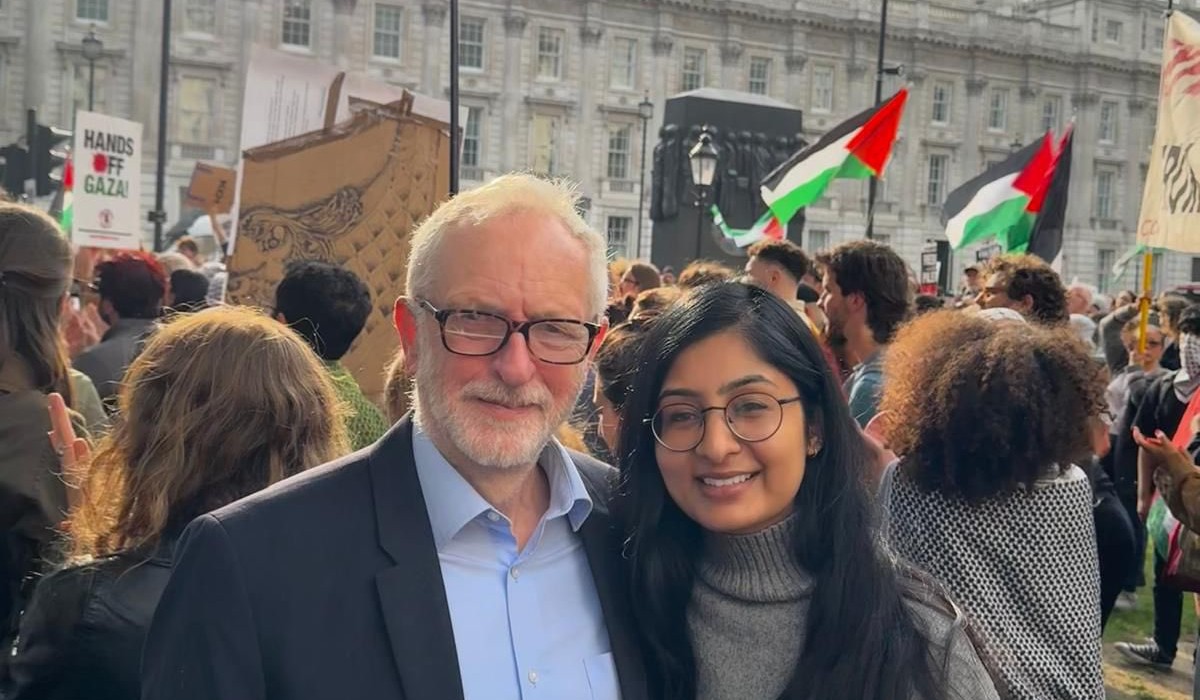
 Jeremy Corbyn and Zarah Sultana at a Palestine protest. Photo: Zarah Sultana
A new party to the left of Labour is highly welcome, but it will need to be rooted in the social movements, organised democratically and prepared to resist attacks, argues Michael Lavalette
On Thursday evening this week (3 July), the internet and left-wing circles across Britain buzzed into life with a press release from Zarah Sultana MP announcing she had left the Labour Party and was working with Jeremy Corbyn to form and lead a new left-wing vehicle to challenge the Starmer Government.
Sultana’s statement made clear the reasons for her break with Labour. Starmer’s complicity with the Gaza genocide was central. So too were the cuts to pensioners’ fuel allowances, the refusal to remove the two-child benefit cap and the attack on disability benefits which are all symptomatic of Labour’s austerity mark 2. As she asserted: the ‘billionaires already have three parties fighting for them. It’s time the rest of us had one.’
The announcement has drawn wide support across activist circles. As I’m writing this, over 12,500 people have signed up on-line to register interest in the new party. The BBCs Newsnight programme on Thursday evening suggested the new party would immediately get 10% in the opinion polls and would be the favoured party amongst 18-24 year olds.
By Friday lunch time, Jeremy Corbyn’s press release promised that ‘real change’ was coming and congratulated Zarah on her ‘principled decision to leave the Labour party’ and join the founding of a real democratic alternative. ‘Together’ he said ‘we can create something that is desperately missing from our broken political system: hope.’ Though the statement seemed to indicate there are some tensions and issues to be resolved before any formal party is announced.
The founding of a new left of Labour electoral vehicle is something that we should all welcome. It has been obvious for some time that there is a significant demand for a new left party of some form.
It was clear at the general election just a year ago that there was a real appetite for a left of Labour challenge that was rooted in the social movements. The performance of the Independents this time last year emphasised that a break with Labour was possible. The last year has been frustrating for many who felt that the delay in announcing a new party was leaving a space for Reform to grow by portraying themselves as the antiestablishment voice, something, of course, that is far from the truth.
At the same time, we should recognise that there will be significant hurdles that we will need to cross as the new party develops.
Over the last two decades, there have been many attempts to break with social democracy to the left. In Britain, there was Respect and then the Corbyn-led Labour Party. Across Europe, there have been numerous experiments from Syriza in Greece to Die Linke in Germany, from Rifondazione Comunista in Italy to the Red-Green block in Portugal. All have come up short.
Although each of the above organisations or projects were different, there were common themes in their demise. First, there is the question of principle under pressure. There is no doubt the new organisation will come under huge pressure from the media and the state. The press are already rolling out the play book, talking about the ‘hard left’ and it can only be a matter of hours before claims of ‘antisemitism’ raise their head. The new party will need to be tough! It needs to stand its ground and not capitulate under pressure (as too many did under the antisemitism assault on Corbyn’s Labour).
Yet, it’s more than simply this: there are clear principles that we must stand on. We can’t under any circumstances have MPs of the new party calling for troops to break strikes (as unfortunately happened in Birmingham) and when the Starmer government attacks the Palestine movement, we must make it clear that all MPs are expected to attend parliament and vote against any curtailing of our rights and freedoms.
Secondly, there is the relationship with the movements. Any new party cannot simply be reduced to a vehicle to get people into parliament. Yes we want MPs and councillors, but they go to Westminster and the council chamber to be the megaphones for our movements. They are there to represent our communities, but also our Palestinian movement, the anti-austerity movement and our trade unions.
Finally, the more democratic it is, the more the new party will succeed. It shouldn’t be left to a small group of self-selected individuals to determine the structure and nature of any new party. It must be open, democratic and member led. It must reach into every community, in every town and city in the country. And it must be open to all; open to and working with the range of organisations and networks which organise and work in our communities, our social movements and our unions to put the interests of working-class communities first.
Before you go
The ongoing genocide in Gaza, Starmer’s austerity and the danger of a resurgent far right demonstrate the urgent need for socialist organisation and ideas. Counterfire has been central to the Palestine revolt and we are committed to building mass, united movements of resistance. Become a member today and join the fightback.
