
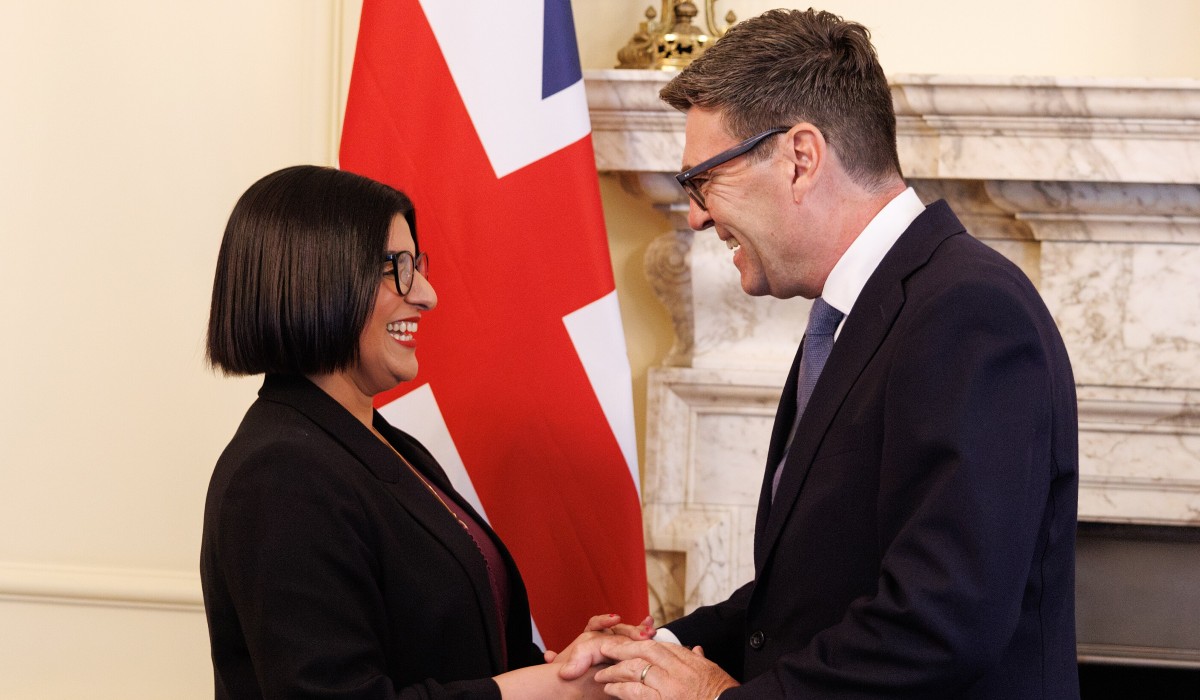
 Andy Burnham reappoints Shabana Mahmood as Secretary of State for the Home Department / Photo: Simon Dawson
Theresa May announced the Undercover Policing Inquiry some eleven years ago. The Home Office recently announced a consultation that may see it wound up before it concludes. James Simpson examines the implications
The long running Undercover Policing Inquiry (UCPI) into the decades long saga of police officers extensive infiltrations into activist groups has been a vital mechanism to further evidence and understand the reality of political policing in the UK.
The inquiry is currently hearing evidence from Special Branch officers regarding the Special Demonstration Squad (SDS). It has heard evidence from police officers and those spied on from the unit’s inception in 1968 to its closure in 2009. The present tranche of evidence concludes at the end of July, culminating with the senior management overseeing Special Branch in its final years. This will include hearing evidence from former Metropolitan Police Service (MPS) Commissioner, Sir Paul Condon.
However, this is only the end of the third tranche of five. The next tranche due to be heard, moves on to the SDS successor – the National Public Order Intelligence Unit (NPOIU). These units ran concurrently from 1999 to 2009, when the MPSB ended and political police intelligence work moved under the national umbrella of Counter-Terrorism Command. The fifth and final tranche is due to look at undercover policing as a whole, including in a criminal as well as political context.
The Unit is where the story began with the revelations that Mark Stone, an environmental activist, was in fact Mark Kennedy, an undercover policeman. It is here the public at large first started to hear about the sexual deception of activists and the circumvention of due process by a political police force.
The consultation process is due, say the Home Office, to the spiralling costs of the UCPI (over £138 million), and the duration of the process, which was planned to last three years. This can entirely be explained by looking at the major benefactors if the UCPI ends or has its already limited transparency further curtailed. Namely the police and the state.
Delays and prevarications
From the announcement in 2015 of the UCPI it took six years to actually start hearing evidence. A cursory look at the UCPI website (www.ucpi.org.uk) under any of the names, cyphers, or cover names of undercover officers, sees documents detailing years and years of back and forth between police lawyers and the inquiry team. Spurious claims of danger from activists, multiple mental health conditions and representations over the UCPI contravening their human right to privacy, have led to prolonged battles to get police witnesses to take the stand. It has conveniently led to this consultation.
Just a month ago it was revealed that a number of trade unions, social movements, family justice campaigns and individual activists and campaigners, core participants in the UCPI, had had some of their Special Branch Registry Files destroyed. This was just as the first evidential hearings were belatedly sitting in 2021 and despite assurances that they would be preserved until the UCPI was over. Further demonstrating the lack of assistance and transparency, the MPS and state actors have given to aid and abet the UCPI, and activists, reach the truth about their infiltrations.
The news came hot on the heels as The Public Office (Accountability) Bill – also known as the ‘Hillsborough Law’ – passed through the House of Commons (Hillsborough Law Bill – GOV.UK). This had been cautiously celebrated by activists at the UCPI, as the tantalising prospect of there now being a legal duty of candour placed upon public officials giving evidence at public inquiries became law. If implemented it would be a welcome relief for anybody that has sat through dozens of former MPSB officers give selective evidence at the UCPI. The next day, the Home Office announced the consultation plans for the UCPI’s future.
Flawed consultation process
Core participant pressure groups, Police Spies Out of Our Lives, made up of women sexually deceived by undercover police officers, and Campaign Opposing Police Surveillance, have released statements detailing their position on the Home Office consultation (links at the end of the article). In it they quite rightly surmise that by using a multiple-choice format for the answering of questions into the UCPI’s future, already demonstrates fore thought into its outcome and limits their ability to respond. They have asked non-state, non-police core participants, invited to partake in the consultation, time to gather thoughts and advice before deciding whether and how to respond.
Why now? The answer lies within the nub of what the SDS and NPOIU were all about. Political policing. Britain, particularly its ruling class and petit bourgeoisie, often espouse the virtues and fairness of the police and justice system in this country. Huge political capital has been made about the excesses of the Stasi when its extensive networks and infiltrations of society were revealed. Never mind that the SDS by then was already over twenty years into a developing political security apparatus that was already at least as intrusive.
Police surveillance today
The SDS can be said to represent the crimes of a forgotten unit within a unit that does not exist anymore. The veracity of this is questionable to say the least, but there is the opportunity to politically distance current for the MPS, Home Office and others, from the “sins of the past” when, the second, inevitably damning, interim report by UCPI Chair Sir John Mitting is released in 2027. The first already said the SDS should have ceased to exist by the early 1970s, only years after it began.
The NPOIU, to be investigated by the UCPI next, is a different kettle of fish all together. It sits within the Counter Terrorism Command structure, where names may have changed and some things may have evolved, but fundamentally it remains how political policing intelligence is gathered and disseminated today. Its continued existence in the sphere of political thought and expression in Britain means that when those hearings begin and the criticisms follow, there will be much less chance to shift the blame onto archaic policing practices.
Policing and politics, arguably has never been more meshed than it is today. From MPS Commissioner Mark Rowley’s repeated public lies on the intentions of the Palestine coalition to target synagogues, to the enforcement of the proscription under terrorism legislation of non-violent direct-action group, Palestine Action, to the increasingly draconian use of new rules and legislation around protest; the use of police as a bulwark to protect an ever more militaristic and authoritarian political establishment has become increasingly apparent.
The UCPI and investigation into the Spycops scandal flies in the face of that. It spits in the eye of a desperate government keen to maintain the illusion that politics and law and order are, on the whole, separate. Every Home Secretary had communications with the SDS over the years, from Leon Britton to Michael Howard to Jack Straw, that reality has shifted.
SDS dirty tricks
The SDS were disrupting anti-war, anti-racist, environmental and animal right movements, spying on family justice campaigns, contributing reports to corporate blacklists, and habitually abusing members of the public. At the behest of senior MPS management, the security services, multi-national corporations and the Government. The next tranche into the actions of the NPOIU brings that investigation kicking and screaming into the here and now of the modern-day British policing apparatus.
Although Section 14 of The Inquiries Act (2005) does offer the power to terminate a statutory public inquiry where it is no longer deemed possible or necessary for one to continue. This is clearly not the case with the UCPI, and it would be completely without precedent. The only beneficiaries would be the state actors wishing to maintain a veil of secrecy over their willingness to use the most extreme and invasive measures in curtailing political expressions that undermines their economic and foreign policy objectives. The show must go on.
Look out for the social media and public statements of the Campaign Opposing Police Surveillance (COPS), Police Spies Out of Our Lives, the Undercover Research Group and the Blacklist Support Group for updates on campaigns, and how the left can respond to this latest attack on the fight to learn about the width and scope of political policing in the UK.
Links to the Home Office, COPS and Police Spies Out of Lives
Spycops Survivors Fear Home Office Will Shut Down Inquiry
Statement on Home Office consultation on future of #Spycops Inquiry – Police Spies Out of Lives
