
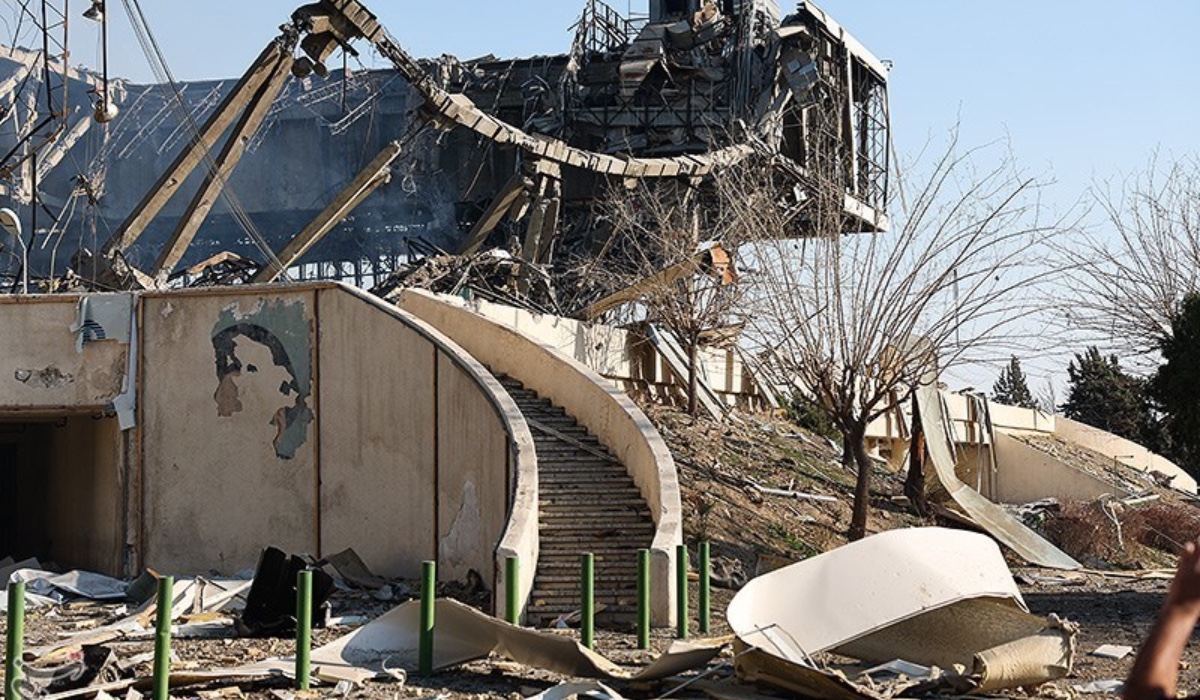
 US Airstrike on 12,000-seat Azadi Hall, March 2026/ Tasnim News Agency, CC BY 4.0
 As the United States barbaric attempt to topple the Iranian regime continues, Chris Bambery considers Trump’s options
For two weeks now the USA and Iran have been engaged in tit for tat strikes. Hundreds of Iranian civilians have been killed. The US has lost three servicemen with 100 wounded.
What is the strategy being pursued by each side? The US is concentrating on the destroying Iranian bridges and means of communication, in the belief that will inflict damage on a precarious economy.
There are two problems with that. First, the US did that and more to Germany and Japan in World War 2 but that did not destroy the will to resistance. That took a land invasion of Germany by the Soviets in the main, and the US and UK. In Japan it took a Soviet invasion of Manchuria and the dropping of US atomic bombs.
Secondly, it is clear that Iranian nationalism has kicked in big time even among those who are no fans of the regime. Added to that it a deep mistrust of the US which twice attacked Iran while negotiating with it and has now launched strikes after trying to open the southern, Omani side of the Strait of Hormuz. In Iran that is seen as breaking the Memorandum of Agreement (MOU) signed by both states in June by which Iran was given the last say over how the Straits would be run.
US bases under attack
For the Iranians the strategy has been to concentrate fire on US military assets in the region. Former CIA analyst, Larry Johnson, has highlighted how effective that has been:
‘This has produced a de facto evacuation of US forces and equipment from most of these bases. The US Navy’s Fifth Fleet Headquarters in Bahrain is in shambles; the Combined Air Operations Center (CAOC) at Al Udeid in Qatar has been closed and moved to Shaw Air Force Base in South Carolina.’
He adds:
‘Iran also has pummelled the Muwaffaq Salti Airbase and the Prince Hassan Airbase in Jordan. There are grainy satellite images showing that the United States has removed all aircraft from the open-air parking lot at the Muwaffaq al-Salti airbase, fearing that they would be destroyed by Iranian missiles.’
In addition, the US Navy MQ-4C Triton surveillance drones have been removed from Jordan’s Al Hussein Air Base and are now operating from Sicily. These were America’s eyes and ears in the Gulf after the Iranians took out its sophisticated radar stations along the southern shore back in February.
Depleted stocks
The crucial weapon in the missile defences of the US, Israel and the Gulf state are the Patriot missiles. America entered this war with an already depleted stock but in the first five weeks back in the spring they burned through 86% of their combined Patriot inventory. They are no way near being fully replaced.
The Strait of Hormuz is effectively shut because Iran has shown it can hit vessels trying to go through the Omani channel, which is also relatively shallow. We are all aware of the economic effects of that globally.
Additionally on Monday the Houthis announced that they will not permit Saudi Arabian vessels to go through the Bab al-Mandeb Strait – at the southern end of the Red Sea through which about 12% of the world’s trade usually passes. This is in retaliation for a decade long economic blockade of Yemen by Riyadh.
Dilemma
It’s hard to see what Trump is going to do about that. The US has tried to use airstrikes to defeat the Houthis to no avail, as did the Saudis over a considerably longer time. Because of the dangers to the US and global economy Trump must be under considerable pressure domestically and from allies to end this conflict. Both sides are still involved in talks in Islamabad brokered by Pakistan and Qatar.
In Israel Haaretz reports that the Netanyahu government is happy to leave the fighting with Iran to the US but he is trying and failing to get a meeting with Trump. All of that reflects that Israel took a pounding from Iran earlier this year and with an election looming Netanyahu does not want round two.
Meanwhile, the Iranian Revolutionary Guards (IRGC), at the centre of the Islamic Republic, have named their peace plan: the lifting of all sanctions and UN resolutions, the release of Iranian assets held overseas, reparations, and Iran’s right to nuclear enrichment.
That reflects the fact that they and many others in Iran, as demonstrated at the funeral of the Supreme Leader, Ali Khamenei, were unhappy with the signing of the MOU in June. Firstly, because they believed they were winning; secondly because they did not trust the Americans.
They were right about the latter, now they want to see how much pain Trump can take.
Before you go
The ongoing genocide in Gaza, Starmer’s austerity and the danger of a resurgent far right demonstrate the urgent need for socialist organisation and ideas. Counterfire has been central to the Palestine revolt and we are committed to building mass, united movements of resistance. Become a member today and join the fightback.

Chris Bambery
Chris Bambery is an author, political activist and commentator, and a supporter of Rise, the radical left wing coalition in Scotland. His books include A People's History of Scotland and The Second World War: A Marxist Analysis.