
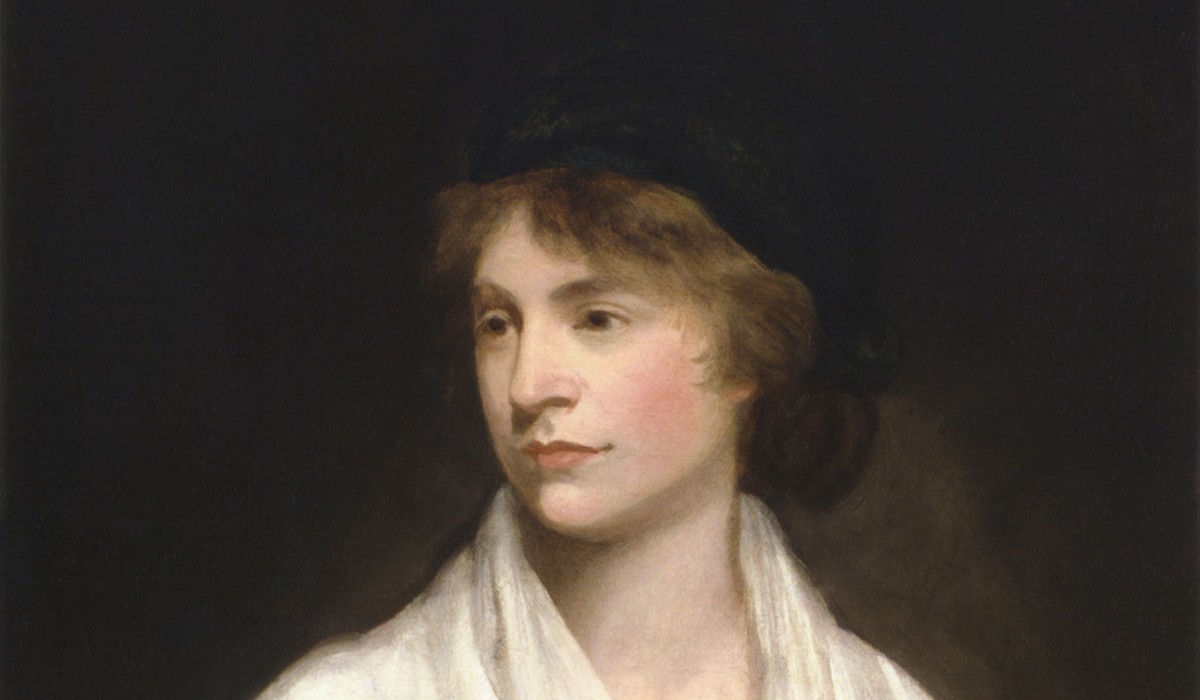
Katherine Connelly looks at the radical life and ideas of Mary Wollstonecraft
Mary Wollstonecraft’s burning anger against the oppression of women was ignited in the mid-eighteenth century when she was still a child. Young Wollstonecraft physically defended her mother from her violent father.
A voracious reader, Wollstonecraft was devastated that she was denied the formal education afforded to her brother Ned, who trained as a lawyer. As a girl from the ‘middling’ class of society, Wollstonecraft was expected to learn accomplishments to attract a respectable suitor.
Instead, she established a girls’ school in Newington Green, a centre for radical Dissenters (who worshipped outside the Church of England) grouped around Dr Richard Price, the minister at the Unitarian chapel.
Wollstonecraft swiftly became friends with Price and his intellectual circle. Inspired by the high-minded ideals of the Enlightenment, which championed reason, progress and virtue against superstition, conservatism and corruption, they questioned established institutions including the Church, slavery and the monarchy.
When Wollstonecraft published her stories, they were illustrated by William Blake, one of the most politically radical and stylistically innovative artists of the era.
The French Revolution, which broke out in 1789, also had a profound impact on Wollstonecraft’s writing. But before she wrote her book on women’s rights, she wrote about the rights of man.
In 1790, the philosopher and politician Edmund Burke published his Reflections on the Revolution in France. Although once seen as a progressive figure, Burke denounced the French revolutionaries, and its supporters in Britain, including Richard Price.
The most famous riposte to Burke was Thomas Paine’s Rights of Man (1791), but Wollstonecraft was there first. Less than a month after Burke’s book appeared, she published a stinging attack on the famous philosopher’s deteriorating reasoning and his reactionary opposition to liberty.
Two years later, A Vindication of the Rights of Woman was written to challenge the French revolutionaries. In 1791, France instituted a system of free education inspired by the work of Enlightenment philosopher Jean-Jacques Rousseau. But while Rousseau had envisaged an Enlightened curriculum for boys, girls were left out.
Wollstonecraft dedicated her book to Talleyrand, a member of the French National Assembly.
The French revolutionaries, she charged, were betraying their revolutionary principles. Didn’t the argument ‘that woman ought to be subjected because she has always been so’ sound just like ‘the same arguments that tyrannic kings and venal ministers have used’? By suggesting that there were different moral standards for men and women, they were betraying their Enlightenment ideals.
Citing the tedious conduct books written for young middle-class women, Wollstonecraft showed that women were encouraged to conceal their real feelings and prioritise appearance above character. Told that these were the sources of their power in the narrow confines of a ‘gilt cage’, women would become ‘either abject slaves or capricious tyrants.’ Hardly model revolutionary citizens.
Wollstonecraft’s book was written in the language of revolution. And the revolutionary reorganisation of society in France informed the breadth of her vision of change. She sought nothing less than the transformation of human behaviour: ‘It is time to effect a revolution in female manners’ in which women would ‘labour by reforming themselves to reform the world.’
Relationships between men and women would be egalitarian, not hierarchical and exploitative. She did not want women to have power over men, ‘but over themselves’.
The belief that human beings can change if the society in which they lived is changed is often mocked by cynics and people who don’t want us to change the world. But Wollstonecraft lived at a time which proved that huge social changes inspire people to think and live in new ways.
As the revolutionary movement in France came under increasing assault, so did Wollstonecraft’s ideas. In the nineteenth century, many campaigners cautiously separated the struggles to advance women’s economic, social and political rights.
But Wollstonecraft’s bold vision of human emancipation remained inspirational to the most radical activists. The suffragettes laid flowers on her grave.
And today in Somers Town, Wollstonecraft’s last home, campaigners against unaffordable housing have painted her image on hoardings around a new building site.
Wollstonecraft reminds us we don’t have to accept the ‘inevitable’, we can change the world instead.
Before you go
The ongoing genocide in Gaza, Starmer’s austerity and the danger of a resurgent far right demonstrate the urgent need for socialist organisation and ideas. Counterfire has been central to the Palestine revolt and we are committed to building mass, united movements of resistance. Become a member today and join the fightback.

Katherine Connelly
Kate Connelly is a writer and historian. She led school student strikes in the British anti-war movement in 2003, co-ordinated the Emily Wilding Davison Memorial Campaign in 2013 and is a leading member of Counterfire. She wrote the acclaimed biography, 'Sylvia Pankhurst: Suffragette, Socialist and Scourge of Empire' and recently edited and introduced 'A Suffragette in America: Reflections on Prisoners, Pickets and Political Change'.