
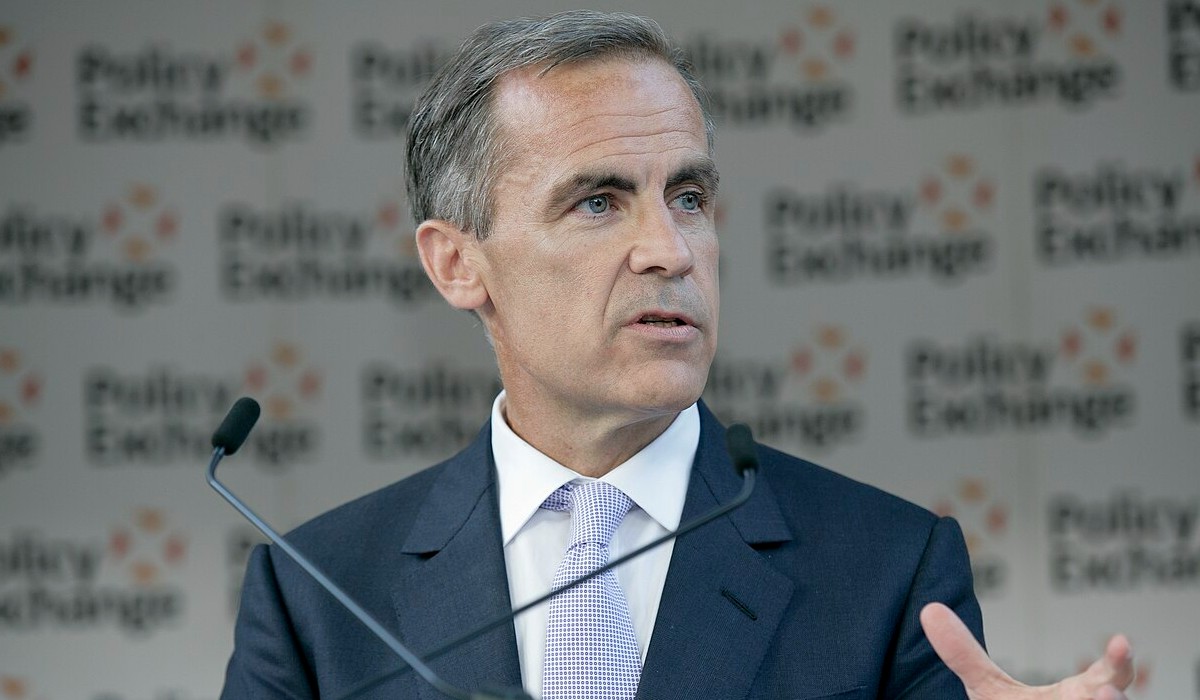
 Mark Carney. Photo: Policy Exchange / Flickr / CC BY 2.0
Prime Minister Mark Carney is responding to Trump’s America First policy with catastrophic austerity and environmentally disastrous measures which must be resisted, argues John Clarke
The strategy that Canada will adopt in the face of US trade-war measures remains a work in progress. On 13 September, prime minister Mark Carney acknowledged the gravity of the present situation, telling reporters that: ‘What’s going on is not a transition. It’s a rupture. And its effect will be profound.’ He added that a ‘new age of economic nationalism and mercantilism’ has arrived that is also an ‘age of adversity’.
In this situation, the Carney government is seeking an accommodation with the Trump administration, while looking for every opportunity to diversify trading relationships. Given the huge volume of trade that takes place with the US and the high level of economic integration that exists between Canada and its more powerful neighbour to the south, the Liberals are only too aware of the enormous difficulties and dangers they face in this situation.
Trade talks between Canada and Mexico, held last week, centred on the fact that the Canada-United States-Mexico Agreement (Cusma) is due to be renegotiated next year. Some hope was expressed that the two countries could work effectively together to counter ‘Trump’s attempt to strengthen the rules of origin, particularly on automotive goods,’ which threaten to undermine the highly integrated manufacturing processes that have developed between the US and its two neighbours.
The talks were also an opportunity to work towards increased trade between Canada and Mexico. International trade lawyer, John Boscar, told CTV News that the development of trade with Mexico had largely been ignored until recently, despite the trade agreement. ‘I do think Canadian companies have not really been forced to look at other markets until the Trump tariff threat of this year,’ he said. ‘And now, they’re really being forced to look at that.’
Such efforts at diversification, however, can’t possibly overcome Canada’s very high level of dependency on trade with the US. So it was that, last month, the Carney government dropped a number of retaliatory tariffs it had imposed and resumed negotiations with the US. Given Trump’s commitment to imposing harsher trading terms on rival powers and allies alike, it is inevitable that, if a deal is obtained, it will increase the costs of trading with the US to a major degree.
Major projects
Carney fully appreciates that, whether his government settles for a punishing deal with Trump or focuses on efforts to diversify trading relationships, it will be necessary to greatly increase the exploitation of workers, while diverting state resources into measures that will increase the ‘competitiveness’ of Canadian manufacturers and exporters. Accordingly, he is moving on both of these fronts simultaneously.
On 11 September, the first five initiatives that would be supported by the government’s Major Projects Office (MPO) were announced. As the role of this office is taken forward, it will, according to the government, ‘work to fast-track nation-building projects by streamlining regulatory assessment and approvals and helping to structure financing, in close partnership with provinces, territories, Indigenous Peoples, and private investors.’
At the same time, the ‘MPO will help to identify projects that are in Canada’s national interest and accelerate their development, including by creating a single set of conditions – reducing the approval timeline for projects of national interest to a maximum of two years and working with provinces and territories to achieve a “one project, one review” approach.’
Responding immediately to this announcement, Indigenous Watchdog noted that a ‘major carbon bomb sits atop Prime Minister Mark Carney’s first tranche of major projects, sparking backlash from environmental and Indigenous communities who say that doubling down on liquified natural gas is placing a dangerous bet on Canada’s future.’
‘The LNG Canada terminal in Kitimat, BC, [which is the most major of the five projects] is the primary way to export liquified natural gas (LNG) from the Montney Play. This region of British Columbia and Alberta is home to gas fields that, if fully tapped, would surpass Canada’s 2030 emissions targets 30 times over. It is a globally recognized “carbon bomb,” and LNG Canada Phase 2 — that doubles capacity at the site, making it the second largest facility of its kind in the world — was announced Thursday as a priority for Ottawa.’
Grand Chief Stewart Phillip, of the Union of British Columbia Indian Chiefs, responded to the announcement bitterly. ‘Rather than being met with partnership, we are given an ultimatum: accept fossil fuel expansion or be pushed aside,’ he said. ‘LNG Canada is not only a massive source of greenhouse gas emissions, but also drives destructive fracking, further threatening our lands, waters and communities — emissions do not recognize territorial boundaries.’
Given this commitment to vigorous state intervention, in order to maximise environmentally destructive projects, it is hardly surprising that the Carney government is backtracking on its climate goals. With jarring cynicism, the Liberals are refusing to uphold their targets for 2030, while promising that the 2050 objectives will be adhered to.
As Carney explained, on 8 September, ‘… focus on what can we do in order to drive emissions down in a way that makes the country more competitive is crucial.’ For good measure, he added that the government ‘is focused on results’. Obviously, the ‘results’ that Carney has in mind relate to increased levels of major investment and the profits that may flow from them and not the enormous environmental harm that these projects will leave in their wake.
Intensified austerity
The costs that the Canadian state will take on, in developing fossil-fuel projects, along with a massive increase in military spending that the government is committed to, will be paid for by a brutal intensification of austerity, major social cutbacks and an assault on public-sector workers. As a federal budget approaches, Carney has left no room for doubt on this score. He recently told reporters that: ‘It’s a budget of austerity and investment at the same time and that’s possible if you have discipline.’
On 18 August, The Maple pointed out that the federal government is now bargaining with the Public Service Alliance of Canada (Psac), over collective agreements that cover some 125,000 public-sector workers that will expire in October.
At the same time, overshadowing ‘the negotiations, however, is the threat of deep cuts to the federal public service. PSAC and other federal public sector unions have been warning for months about the potentially catastrophic impact of the Liberal government’s proposed plan to cut spending by 15 per cent.’ Psac has revealed that 10,000 of the jobs that its members perform were lost last year alone and the term ‘catastrophic’ is hardly an exaggeration.
Just as critically, the impact of this level of austerity will be deeply felt by people all across Canada who rely on services provided by the federal government. Comparisons are being made to the devastating cuts that were imposed by federal governments in the 1990s. At that time, provincial and territorial governments across the country emulated the approach coming out of Ottawa and instituted major cuts of their own.
Moreover, Carney’s austerity onslaught will impact upon a social infrastructure that has already been seriously undermined by decades of relentless austerity measures. As such, the effects will be truly dreadful and will go over to the level of outright social abandonment.
The Maple’s article draws two entirely valid conclusions that are worth stressing. First, it argues that the ‘threat posed by United States President Donald Trump’s trade war is providing the Carney Liberals with the political and economic justification to undertake their program of austerity. Federal workers and the public they serve are being forced to bear the cost of the trade war and the economic fallout.’
Secondly, the article suggests, very accurately, that federal ‘public sector unions will be the first line of defence in opposing this regressive agenda. Successful resistance, however, requires that unions build alliances with a broad section of the public to ensure that the costs of capitalist crisis aren’t imposed on workers and service users.’
The America First turn of the Trump administration, and the resort to protectionism that this involves, are producing major consequences globally. In Canada, sharing a border with the US and being economically integrated with it, there are particularly serious implications that flow from this development.
With the full support of the major institutions of capital, Carney is implementing a strategy to turn the trade war into a class war and impose massive and unprecedented levels of austerity on workers and communities.
A common front of all those in the path of Carney’s onslaught is needed in this dire situation. Without a mass mobilisation that includes the decisive use of the strike weapon, serious defeats and severe social consequences are inevitable. A Canada-wide fightback is entirely possible and absolutely essential.
Before you go
The ongoing genocide in Gaza, Starmer’s austerity and the danger of a resurgent far right demonstrate the urgent need for socialist organisation and ideas. Counterfire has been central to the Palestine revolt and we are committed to building mass, united movements of resistance. Become a member today and join the fightback.

John Clarke
John Clarke became an organiser with the Ontario Coalition Against Poverty when it was formed in 1990 and has been involved in mobilising poor communities under attack ever since.