
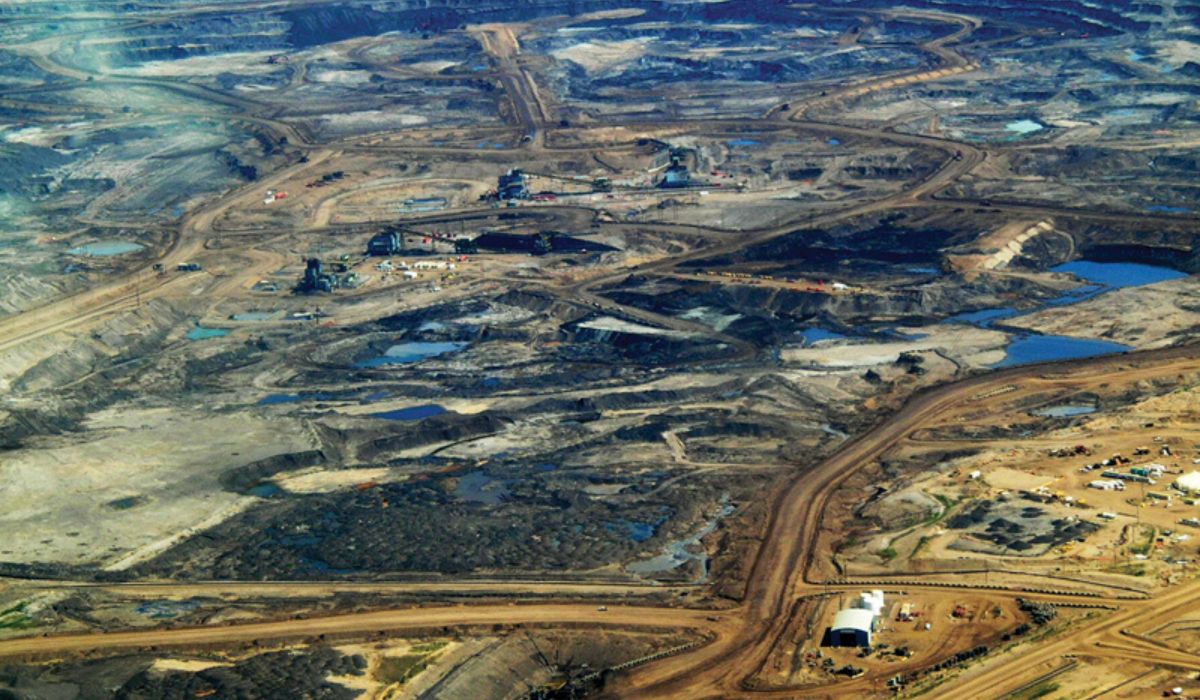
 Aerial photograph of open pit mine in the tar sands oil fields of Alberta, Canada. Source: Dru Oja Jay, Dominion -wikicommons / cropped from original / CC BY 2.0
Tensions between the Federal government and the provinces have long been a feature of Canadian politics, but, as John Clarke reports, the threat of breaking away has become a tool of the fossil fuel industry and far-right interests
The government of Alberta has announced that a referendum will be held in October on whether or not to put separation from the rest of Canada to a subsequent vote. Underlying this development is a web of interconnected factors that have simmered for decades but that have come to a head in the recent period. The particular interests of a section of the capitalist class are being asserted, but a wider mood of reactionary rage is also being expressed.
The CBC reports that Alberta Premier Danielle Smith has determined that the question that will be put to voters is ‘(s)hould Alberta remain a province of Canada or should the Government of Alberta commence the legal process required under the Canadian Constitution to hold a binding provincial referendum on whether or not Alberta should separate from Canada?’
Polls indicate that some 35% would vote ‘yes’ in the upcoming referendum, with 30% ready to vote for independence if they are eventually given the opportunity. While this is far from indicating any immediate likelihood of separation, it does show that such a project has a very major base of support.
Having declared that the referendum will take place, ‘Smith reiterated that she supports Alberta staying in Canada and, like Carney, will campaign for the ‘remain’ side ahead of the Oct. 19 vote.’ This demonstrates the degree to which this measure is being adopted as a pressure tactic by her government.
Smith also suggested that the referendum was made necessary by ‘Albertans’ frustrations’ and added that ‘I would also remind all Canadians that we should not dismiss the legitimate grievances of Albertans. Instead, we should focus on addressing these issues, restoring hope in Canada and demonstrating that our country can work and is working.’
For his part, Prime Minister Mark Carney expressed regret that the referendum was occurring. He spouted inevitable rhetoric about national unity and Canadians being stronger and wealthier if they remained united. Tellingly, however, he also suggested that recent agreements around further fossil fuel extraction and the creation of more pipelines indicate that ‘he is pursuing “co-operative federalism” designed to hold the country together and placate regional concerns.’
Carney indicated that a review of the referendum question would be conducted under the Clarity Act. This is a piece of legislation that was previously adopted to undermine the possibility of Quebec obtaining independence, which gives the federal government the power to disallow a provincial vote on separation if it finds that the wording of the question to be put before voters is unclear. It is, however, highly unlikely that Carney would precipitate a major political confrontation by interfering with the Alberta vote.
Divided interests
Underlying the Alberta referendum are questions of disparate levels of regional political power and influence within the Canadian state and an effort to assert the particular interests of those capitalists who are invested in resource extraction in the Western part of the country, especially in Alberta itself.
Ever since the Canadian Confederation in 1867, regional discrepancies and tensions have been part of the life of the country, often taking the form of resentment of the relative strength of ‘Central Canada.’ Though it is only one of ten provinces, Ontario has roughly 40% of the population and the same share of Canada’s GDP. This imbalance in terms of economic power and political influence has always been a source of discord.
Alberta is by no means a poor province, but its wealth has been based overwhelmingly on fossil fuel production. The capitalists involved in this have always worked to ensure that their particular interests are advanced and their political influence maximised.
As the climate crisis has intensified and the prospect of government measures to limit fossil fuel production has been posed, oil and gas interests have been determined to overcome any such restrictions and increase production at all costs. They are equally determined to prevent any assertion of Indigenous control over land use from prevailing. Indeed, the notion that a move towards separation would involve the abrogation of existing treaty obligations towards Indigenous nations has already generated an angry response.
When Justin Trudeau was prime minister, the very limited and tokenistic green gestures his government put forward were responded to in Alberta as if they were sweeping and radical measures. In February, as reported by The Winnipeg Sun, Danielle Smith used a federal Conservative Party conference to condemn the ‘woke’ environmentalism of the Liberal government, throwing in her reactionary hatred for ‘unsustainable immigration levels.’
This effort to resist any and all attempts to limit resource extraction has long been a major focus for Alberta’s political leadership, and it has now been seized on by far-right forces that have presented fossil fuel production as vital for the province’s survival and central to its ‘way of life.’ The referendum has, indeed, been called in response to pressure from the right that included a major petition drive.
The core organisers behind the infamous ‘Freedom Convoy,’ that brought a convoy of trucks to Ottawa in 2022 to protest public health measures during the pandemic, were all active in Alberta-based far-right politics. The prelude to this action was a ‘United We Roll’ convoy to the national capital that was organised in defence of ‘Alberta’s beleaguered oil and gas sector.’ Both of these actions were efforts to find ‘hot button issues’ that could tap into a mood of reactionary rage and increase far-right political influence.
‘Wexit’
Separatist agitation is a natural field of operations for the far-right in Alberta, given the sense of ‘Western alienation’ that exists and the degree to which calls for ‘Wexit’ resonate among a section of the population. Political momentum on this issue is all the easier to generate because more mainstream conservative forces and oil and gas interests that may not want political independence for Alberta understand that keeping the pot boiling on this issue is a useful way of advancing their interests.
For Alberta’s fossil fuel capitalists and their political agents, this is a moment to intensify pressure to the greatest degree possible. The present Liberal Prime Minister, Mark Carney, has jettisoned any of the timidity and pretences associated with the Justin Trudeau years.
Faced with the impact of the Trump administration’s America First turn and the protectionist measures that are part of it, Carney is implementing a strategy to maximise the profits of Canadian capitalism, and a huge extension of fossil fuel production and mining is a big part of this. His government has plans ‘to enable’ a trillion dollars of investments in such initiatives over the next five years.
Alberta’s resource extraction interests want to make sure that the environmentally destructive bonanza that is underway continues unabated and that their share in it is as large as possible. They have a hard-right provincial government at their disposal and a reactionary sense of grievance and alienation within a section of the population that the federal government will be anxious to placate in this unstable period, when any divisions within the Canadian state structure will be hugely problematic.
Sun Summit Minerals, which issues a regular ‘mining report,’ recently argued that the referendum ‘sends a strong signal to Ottawa that Alberta’s patience with federal policies — particularly carbon pricing, pipeline delays, and equalization – is wearing thin.’ The report also suggests that ‘(f)or the Canadian mining and energy sectors – pillars of national wealth creation – the stakes could not be higher.’
The present separatist initiative won’t lead to independence for Alberta, but it is being used by the province’s fossil fuel capitalists and political leaders to ensure that the present destructive intensification of extractive projects unfolds on terms that are to their economic and political advantage. It is also providing conditions under which the influence of the most reactionary and even fascistic elements can gain ground.
These developments are a particularly stark manifestation of the instability and tension that exists within Canadian capitalism and its structures of state power. The great majority of Albertans have no stake in a reactionary separatist movement or in the Carney brand of ‘national unity.’ The posing of independent working-class demands, including a just transition from fossil fuels, and the building of a united movement to win them, is the only way forward.
Before you go
The ongoing genocide in Gaza, Starmer’s austerity and the danger of a resurgent far right demonstrate the urgent need for socialist organisation and ideas. Counterfire has been central to the Palestine revolt and we are committed to building mass, united movements of resistance. Become a member today and join the fightback.

John Clarke
John Clarke became an organiser with the Ontario Coalition Against Poverty when it was formed in 1990 and has been involved in mobilising poor communities under attack ever since.