
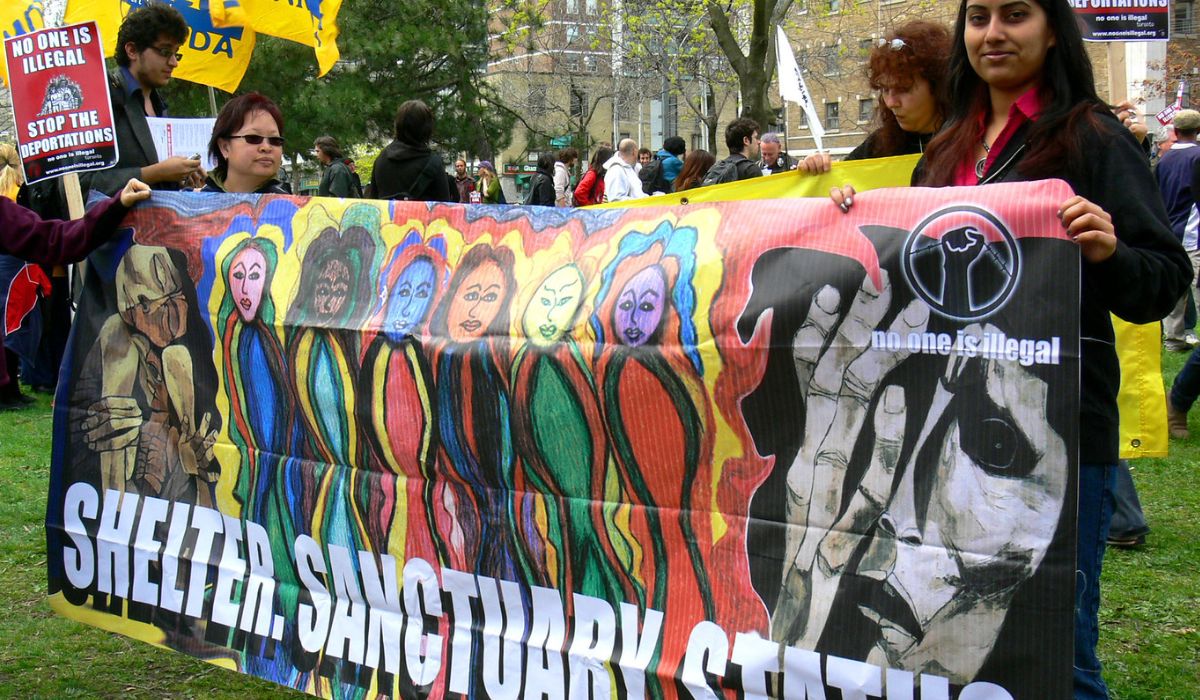
 Shelter, santuary, status. poster at the May Day rally 2009 in Toronto. Source: Tania Liu - Flickr / cropped from original / CC BY-ND 2.0
In the face of repression, movements must draw on their histories. Here, John Clarke offers his experience of how the Ontario Coalition Against Poverty responded to the state’s efforts
In a recent article I wrote for Counterfire, I looked at several countries where increased use of the repressive power of the state threatened rights of assembly and expression. Expressions of dissent and forms of protest that might have been tolerated previously are now subject to heavy-handed policing and legal persecution.
The UK hasn’t been exempt from this disturbing trend, as the recent guilty verdicts against Chris Nineham and Ben Jamal demonstrate. Their prosecution can be seen as part of a systematic effort to criminalise Palestine solidarity and curtail fundamental democratic rights in the process. Moreover, as in the case of the attacks on Palestine Action and those acting to demand climate justice, we see an alarming attempt to treat non-violent disobedience as serious crimes, if not acts of terrorism.
Strikingly, this authoritarian assault on protests and social mobilisation in the UK is taking place under a Labour government, with Reform still waiting in the wings. The state’s effort to crush dissent doesn’t require Trump-like regimes. Liberal and social-democratic governments are increasingly ready to pursue repressive options in the face of social resistance.
Very obviously, this resort to a more naked deployment of state power is taking place under conditions of mounting economic, social and political crisis. As Trump’s reckless and erratic pursuit of ‘America First’ objectives reaches new, dangerous levels with his ‘war of choice’ against Iran, conditions of political volatility and economic uncertainty intensify. The capacity to maintain previous levels of social compromise is diminished and a rising wave of authoritarianism gathers momentum.
Facing repression
In Toronto, where I live, we have seen an extraordinary effort by the security state to contain and undermine the movement of Palestine solidarity. This has involved a highly coordinated effort in political policing at its most blatant.
The issue has not been to ensure adherence to laws or to prosecute violations of those laws in any even-handed manner. Rather, as The Breach has accurately put it, the intention has been to ‘strategically incapacitate’ organised opposition to Israel’s crimes and the complicity of Canada’s ruling establishment.
The police involved in this attack have close links to leading politicians, the major Zionist organisations, federal intelligence services and state prosecutors. At the heart of the whole initiative has been a well-resourced and hideously misnamed ‘Hate Crimes Unit’ that has planned and executed this effort to disrupt the Palestine solidarity movement.
This sinister unit operates as part of the Toronto Police Intelligence Services, a body that I had extensive dealings with in the late 1990s and early 2000s, when I was an organiser with the Ontario Coalition Against Poverty (OCAP). Police Intelligence approached our organisation with precisely the objective of strategic incapacitation.
OCAP had the perspective of mobilising on the largest possible scale within poor working-class communities. We carried out actions and campaigns that were calculatedly disruptive in order to develop a counterpower in the face of austerity and social abandonment. When, for example, Toronto’s Police Chief responded to pressure from major retail companies by announcing an operation to drive away unhoused people asking passers-by for money on the streets, we responded with a ‘mass panhandle’ in the city’s most prestigious shopping mall that proved to be very effective.
The use of such methods obviously created a level of animosity in high places and various efforts were made to contain us and undermine our organising. The use of aggressive police tactics was part of this and we soon found that Police Intelligence was central to these efforts.
On the night before a major OCAP protest, a group of Intelligence cops came to our office unannounced. They described themselves as members of the ‘Red Squad’ and threatened us with the severest consequences if we caused any problems the next day. They told a visiting comrade from Quebec that his body would be fished out of Lake Ontario if there was any trouble. This was obviously a crude attempt to intimidate us, but it spoke to the function they were discharging as a specialised political unit.
Some time prior to this, a group of fascists held a demonstration outside a motel where Roma refugees were being accommodated. The signs they displayed included ‘Canada is not a garbage can’ and ‘honk if you hate Gypsies.’ As soon as we learned of this, we held an event of our own at the same location. We organised a barbecue for the families with games for the children and we displayed a banner reading ‘honk if you hate racists’.
Intelligence officers showed up at the event and engaged the Roma families in conversation. We soon discovered that they had warned them that we were dangerous extremists who would put them in danger. We were able to reassure the families and the event was a smashing success. What leapt out at us, however, was the strategic role that these cops played. We were doing nothing remotely illegal but they were working to try to disrupt our activities and neutralise the risk that we might build an alliance with a refugee community.
In June of 2000, OCAP responded to a huge increase in homelessness by bringing a mass delegation of 1,500 people to the Ontario Legislature to demand that a small group of unhoused people be allowed to address the assembled representatives. The police used horses and the ‘public order unit’ to drive the crowd from the grounds and a major confrontation ensued that became known as the ‘Queen’s Park Riot.’
Dozens of people were arrested and charged at the time and in the days that followed, but three of us were deemed the leaders of the action and faced draconian charges and a jury trial, with the possibility of major prison sentences.
Prior to the trial, the lead prosecutor informed my lawyer that they would offer me a non-custodial sentence if I pleaded guilty and agreed to probation conditions that included a three-year ban on participating in OCAP’s work. I rejected this, we advanced a politically principled defence and a divided jury failed to convict us.
What is so clear here is that, for both the Crown Attorney’s office and the Intelligence cops who worked closely with it, law enforcement was an entirely secondary matter. Though they greatly exaggerated the importance of my particular role, their key objective was to disrupt and disempower OCAP, a thoroughly political objective.
Responding to repression
When OCAP faced serious efforts to disrupt and undermine our organisation through state repression, we learned several lessons and applied them as we carried on our struggles.
Firstly, we understood that repression was the earliest response of power structures that wanted to avoid making concessions to movements of oppressed and exploited people. Unions were initially treated as criminal undertakings and the rights of assembly and expression were not automatically respected. The rights we have were won in struggle; they are always under some form of threat and they must be defended in the face of attack.
Secondly, it is wise to be prepared for state attacks and the ‘dirty tricks’ that are often employed against movements. OCAP encountered all manner of police surveillance, infiltration and provocations. We made sure that the actions we carried out were as spirited and effective as possible but we also took care that they were well co-ordinated and with effective decision-making systems in place.
The police often used a tactic against us that is referred to as ‘conspicuous surveillance,’ in which they want you to know they are watching you in the hopes you will be intimidated or can be provoked. On one occasion, a married couple who were part of OCAP and making their way to one of our protests were confronted by two men who proceeded to make filthy remarks about the woman. They guessed what was going on and didn’t respond. Sure enough, when they got to the protest, these two foul mouthed individuals were standing with other cops and monitoring the crowd. The provocation was overcome through experience and preparedness.
Thirdly, unity and active solidarity are the best defences against state repression. When OCAP faced legal persecution, support from the broader movement was vital and enormously effective. We will always have political disagreements and different views on strategies and tactics but the principle that ‘an injury to one is an injury to all’ should always be acted upon.
Our enemies need to know that we are united and leave no one behind in the face of attack.
Finally, the effort to contain us through repressive means created major challenges to which we had to adapt. We had trials to deal with, support to organise for people who were in jail and we had to function with some of our key members facing major bail restrictions that limited their activity severely. At every point, however, we put a premium on carrying on our struggles and continuing to mobilise community-based resistance. We avoided the danger of becoming a de facto legal-support organisation no matter what was thrown against us.
As I write this, the president of the United States has declared that Iran must meet his terms or ‘a whole civilisation will die tonight’. This is an open threat to commit genocidal war crimes that openly contravenes both US and international law. It speaks volumes about the nature of the ‘rule of law’ about which we are told. If such gangsterism now dominates international affairs, we can hardly be surprised if we face authoritarianism and an assault on democratic rights domestically in this enormously dangerous and volatile period.
The response to all efforts to intimidate us and contain us with the hard edge of state power must be a determined effort to mobilise even more powerfully and on a larger scale. We must prove in action that the rights our movements won in struggle will be defended in the same fashion.
Before you go
The ongoing genocide in Gaza, Starmer’s austerity and the danger of a resurgent far right demonstrate the urgent need for socialist organisation and ideas. Counterfire has been central to the Palestine revolt and we are committed to building mass, united movements of resistance. Become a member today and join the fightback.

John Clarke
John Clarke became an organiser with the Ontario Coalition Against Poverty when it was formed in 1990 and has been involved in mobilising poor communities under attack ever since.