
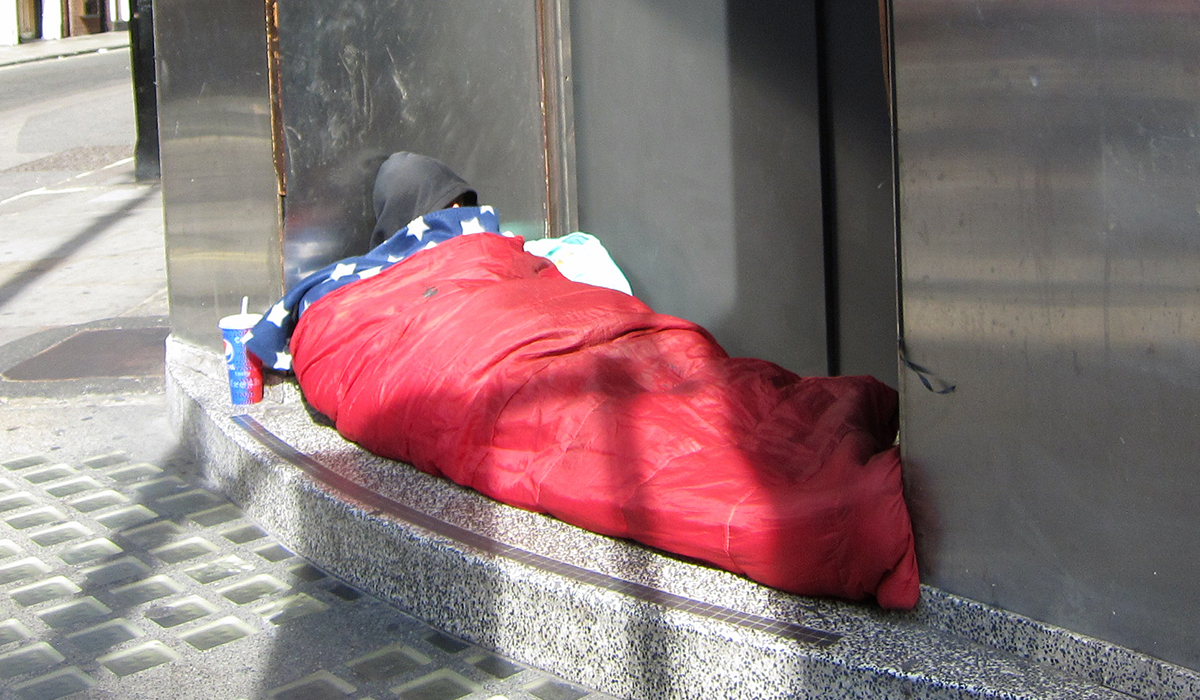
 Rough sleeper in London. Photo: Alan Light / CC BY 2.0
Ahead of Saturday’s national housing demonstration, Terina Hine assesses the deepening crisis
Councils across the country are dealing with an unprecedented homelessness crisis. For some, the answer has been long-distance relocations, leaving vulnerable families and deprived communities to deal with the consequences.
Many thousands of people across the country are made homeless though no fault of their own. Women leave abusive relationships, landlords raise rents, refugees granted asylum must leave temporary hotel accommodation. To find affordable private rentals in our big cities, especially in London, is not easy. Since the pandemic, there has been a 41% fall in private landlords, making it even harder. And it’s not just rent that is difficult to find, but also a guarantor, references and the substantial deposit.
For many, this is an impossible task and they are left with no choice but to make a homeless application to their local council. But submitting an application to your local council does not mean you will be housed locally. Increasing numbers are being housed ‘out of borough’ and more and more sent many miles away to unfamiliar towns and villages.
Last year, 360,000 households across England made a homeless application, around a quarter were in London; 120,000 people are currently living in temporary accommodation, almost half are in London. London councils have been looking at ways to deal with this crisis. One solution they have found is to offer private accommodation in cheaper areas: Stoke-on-Trent, Halifax, County Durham, Southend-on-Sea.
It appears that a disproportionate number of those relocated long distances are recent refugee families, most likely because they do not have the resources or know-how to appeal council decisions and because many councils require evidence of connection to a local area when considering housing applications. This is something that is clearly more difficult for recent arrivals to prove.
Recently, BBC Radio 4 produced a documentary on the impact of rehousing to County Durham. It didn’t make for happy listening. Miners’ houses, often cheap terraces in ex-pit villages, sitting empty and dilapidated for years, are being used to house some of London’s homeless. Once families have moved, the London councils hand over responsibility for resettlement to privatised relocation agencies who are supposed to assist with furniture, GP registrations and school places, but in reality provide little help.
Many of those relocated speak no English. Some had jobs which they lost when they moved, and, in the new localities, face little prospect of employment. With no private transport, living isolated in rural communities without family or friends, things are not easy for new arrivals.
Families often turn to churches and the voluntary sector for help, or rely on the kindness of strangers to explain how to get a GP, apply for a school place, or simply to drive them to supermarkets located miles away from their new home. Schools find they need to step in when teachers notice that children are living without furniture and are not registered with a doctor.
New arrivals also face a culture shock, often leaving multi-ethnic areas of cities to move to small, predominantly white, close-knit communities. They report difficulties assimilating and feeling lost and out of place. Some experience hostility from local residents who face their own challenges with high levels of unemployment following decades of deprivation and underinvestment. All of this allows Reform and their racist, anti-immigrant propaganda to thrive.
With limited affordable housing being built and dwindling council-house stock as a result of right-to-buy legislation, this crisis will only get worse. In London, one in fifty residents are currently living in temporary accommodation, and one in 21 are children. That’s one child in every class living in temporary accommodation in our capital city. Central government has frozen the amount it provides to local authorities to pay for this temporary accommodation since 2011, although housing costs have spiralled. In the past eighteen months, the amount local authorities in London have spent on temporary accommodation each day has risen from £4m to £5m: this is the financial reason for exporting families to cheaper locations.
Out of area placements are the result of a severely broken housing system, resulting in dislocation and isolation for some of the most vulnerable in our society while at the same time helping fuel the rise of Reform.
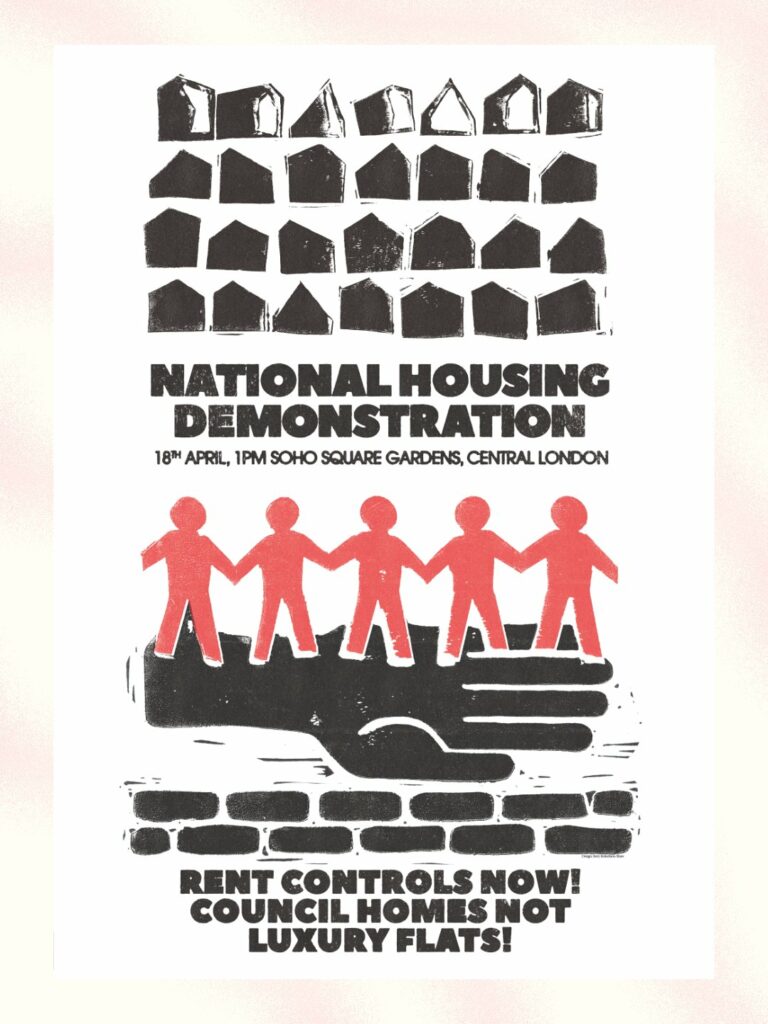
Join the National Housing Demonstration on Saturday 18 April, assembling 1pm at Soho Square Gardens
Before you go
The ongoing genocide in Gaza, Starmer’s austerity and the danger of a resurgent far right demonstrate the urgent need for socialist organisation and ideas. Counterfire has been central to the Palestine revolt and we are committed to building mass, united movements of resistance. Become a member today and join the fightback.
