
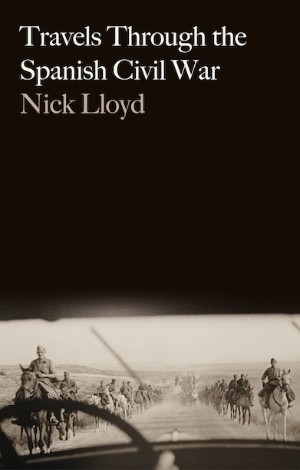
 Nick Lloyd, Travels Through the Spanish Civil War (Hurst 2025), 352pp.
Chris Bambery enjoys a fascinating travelogue through sites of the Spanish Civil War, but advances a different interpretation of how fascism could have been stopped.
Nick Lloyd has for many years been running popular Spanish Civil War walking tours in Barcelona. In his Travels Through the Spanish Civil War, he recounts meeting many relatives of International Brigaders, usually communist volunteers who came to fight for the embattled Spanish Republic. One was Richard Blair, son of George Orwell, author of Homage to Catalonia. He now runs tours through the Orwell Society of the battlefront in Aragon where his father fought and was wounded. Through his guided walks and his own reading, Nick Lloyd has written what is both a travel guide of the Spanish Civil War and a history, woven through with interviews with the many fascinating people he encountered on his travels.
One such is Victor Pardo, an expert on the war in Aragon who has restored and recreated the tranches and bunkers where Orwell fought as part of the Poum’s Lenin Division. The Poum (Partido Obrero de Unificación Marxista, Workers Party of Marxist Unification) had a popular base in Catalonia but little beyond that. It was a party which rejected Stalinism and was therefore labelled as ‘Trotskyist’ by the Spanish Communist Party, which was determined to eradicate it. In fact, its key leader, Andreu Nin, had broken with Trotsky, though he shared his belief that the revolution in Catalonia, which had followed the crushing of the fascist uprising in Barcelona, should be followed through across Spain as the only way to defeat fascism.
The visit Nick Lloyd made with Richard Blair and the Orwell Society to Aragon was my favourite chapter because it combines history, interviews with participants with a wonderful description of the countryside, the villages and the natural world. He is obviously an expert on birds as he describes them throughout the book. It left me keen to follow his footpaths, and Orwell’s, from Barcelona to Aragon.
Obviously, the July 1936 uprising in Barcelona, in response to the fascist coup, is the starting point of this book. A mass working-class response was in the main organised by the anarch-syndicalist CNT (Confederación Nacional del Trabajo, National Confederation of Labour). The CNT had mass support among the working class of Catalonia, which, along with the Basque Country, was the most industrialised part of Spain, and among the desperately poor agricultural labourers of Andalusia and Extremadura.
Nick Lloyd’s sympathies are clearly with the CNT, which is no bad thing, but he does not really explain its decision to end resistance in the May Days of 1937 when Communist units of the new Republican government restored ‘order’ in Barcelona, suppressing the collectives running the factories and much else and banning the Poum whose leader, Nin, was arrested, tortured and executed by the Russian NKVD. The CNT ministers in the Republican government decided the war against fascism should be prioritised over revolution and ordered the barricades across Barcelona to be taken down. Demoralisation set in and, in January 1939, Barcelona fell without a fight.
How the Republic could have won
In the book, Lloyd also visits three of the sites of Republican offensives, Huesca, Teruel and the Ebro River. His admiration for the Republicans, particularly of the International Brigades, shines out. However, there is a problem with his political perspective. Discussing Ken Loach’s film Land and Freedom, he argues against the line of Loach, Orwell and Poum, ‘that the only way those on the Republican side could have defeated Franco would have been by fighting a revolutionary war’ (p.55). Nick argues that the massive amount of arms and men dispatched by Hitler and Mussolini were to blame for the Republic’s defeat, along with the refusal of the Western democracies to sell arms to the lawful government of Spain.
The line of the Republican government, after the May Days, and the Communist Party, was that a professional army had to be built to wage a conventional war. The only significant arms the Republicans received came from Stalin’s Russia and Lloyd rightly points out it was ‘half-hearted, overpriced and politically poisoned aid’ (p.55). Russian weapons ceased after the September 1938 Munich Agreement between Britain, France, Germany and Italy over dividing Czechoslovakia, when Stalin began to contemplate his eventual Pact with Nazi Germany.
The Republic never was able to build a regular army to oppose Franco, who had the vast bulk of the old professional army. The Republican offensives at Brunete, Huesca, Teruel and the Ebro River all followed a similar pattern. In the case of Huesca and Teruel, the objectives were of little strategic importance. All four offensives were tactically a success initially, but they were then stopped and Franco, unwilling to concede defeat, poured in troops and artillery to drive the Republicans back. At Teruel, that meant the collapse of the Aragon front and the isolation of Catalonia from the rest of Republican territory. The Ebro offensive ended with Republican forces unable to resist a fascist advance into Catalonia. Anthony Beevor has argued the Republicans would have been better to remain on the defensive and to let Franco come at them in prepared positions.
However, when Lloyd writes about the 1936 summer offensive into Aragon by the CNT, he describes a revolutionary war when the CNT gave the land to the peasantry and organised collectives. With popular support this was the biggest military success for the Republic. If it had been repeated in Andalusia and Extremadura it would have undermined the fascist control of parts of those regions, showing how a revolutionary conduct of the war could have resulted in Republican victory.
Spain was the country which invented guerilla war in response to Napoleon’s occupation, but it was never attempted to repeat this on any scale in the Civil War, partly because the Communist Party feared it would escape its control.
Franco’s uprising began in Spanish Morocco, from where his crack troops came. However, the Republican government refused to declare independence for this colony because it would antagonise Britain and France. As it was trying to fight a regular way, launching large-scale offensives was a failure because the Republic did not have the weapons, and by the time of the Ebro offensive, the men.
Nevertheless, this book is an excellent description of Lloyd’s road trip through some of the key battlefields of the Civil War. Read it and then try to escape the infestation of mass tourism in today’s Barcelona by taking one of his tours.
Before you go
The ongoing genocide in Gaza, Starmer’s austerity and the danger of a resurgent far right demonstrate the urgent need for socialist organisation and ideas. Counterfire has been central to the Palestine revolt and we are committed to building mass, united movements of resistance. Become a member today and join the fightback.

Chris Bambery
Chris Bambery is an author, political activist and commentator, and a supporter of Rise, the radical left wing coalition in Scotland. His books include A People's History of Scotland and The Second World War: A Marxist Analysis.