
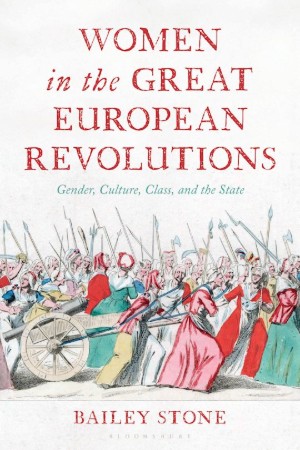
 Bailey Stone, Women in the Great European Revolutions: Gender, Culture, Class and the State, (London: Bloomsbury, 2025), xiii, 314pp.
A history of women in revolution that fails to see how the Great Revolutions have involved women and furthered the cause of their liberation fails to convince Elaine Graham-Leigh
Women are often not well served by historians of the great European revolutions. In the case of the Russian Revolution, for example, as Judy Cox notes, ‘women have been written out of all aspects … by historians of left and right.’i This view of women in the revolution allows them involvement in spontaneous riots for ‘bread and herrings’, but when it comes to organised activity, sees them as simply absent. It’s an attitude to women’s revolutionary activity summed up by historian Richard Stites, who argued that ‘there is no sense trying to magnify the role played by the female half of the population during 1917’ because it was so insignificant.ii
Stone explains that this work on women in the great European revolutions came from a sense that he had been guilty of a similar, if perhaps not so egregious omission in his previous work. ‘What I failed to emphasize at that point in the bookiii … was the fact that women, who were among the “disillusioned citizens” conjured up on those pages in 2014, had played a variety of key roles in all three European revolutions, and – very notably – had done so both on the left and on the right sides of the political spectrum’ (p.viii). This work is therefore an exercise in setting the record straight, but not one that proceeds in the way that the title might lead us to expect.
Historiographical disdain notwithstanding, that women played significant roles in the English, French and Russian revolutions is not in doubt. From the London women who wore sea-green in support of the Levellers, to the women of Paris who dragged cannon to Versailles in October 1789 and the International Women’s Day demonstrators of February 1917, women were central to some of the most important revolutionary actions. Belying the idea that women were only capable of disorganised, spontaneous actions, women could also be major figures in the revolutions, as shown by women from Katherine Chidley in the English Revolution to figures like Alexandra Kollontai and Inessa Armand in Russia.
With all of this evidence to be discussed, it seems surprising that we are more than a hundred pages in here before we get any sustained discussion of ordinary women’s involvement in these revolutionary events. It becomes clear, however, that there is a distinction between looking at the history of women as participants in the great revolutions and Stone’s project, which is, he says, to examine ‘women’s experiences in the three historic revolutions’ (p.36). This is not a mere semantic difference. Focusing on all women in revolutionary periods, not just on revolutionary women, means that Stone can examine active counterrevolutionary women, those simply caught up in events, and female members of the elite. Thus, he includes a chapter on the three female monarchs dethroned by the revolutions, Henrietta Maria of England, Marie-Antoinette of France and Empress Alexandra of Russia, before getting to the chapter on women’s revolutionary activity.
Revolution and emancipation
The obvious question about women and the great European revolutions is to what extent the revolutions helped the cause of female emancipation. Since this is an academic book, this can’t be addressed without a good deal of preliminary throat-clearing on ‘theorizing gender in revolutionary situations’ and the argument is then largely conducted through summaries of other historians’ arguments, leaving us to read between the lines to work out whether we are supposed to accept their analysis. Thus, for example, on the English revolution, Stone states that historians like Christopher Hill and Lawrence Stone ‘always tended to stress the benefits that middle-class Puritan women, at least, gained from the revolutionary era’, with the comment that these are ‘scholars writing in the Whiggish tradition’ (p.117) doing the work of signalling that we’re expected to disagree with said stress.
This style makes disinterring the actual argument something of a challenge. However, Stone’s contention appears to be that the three revolutions under consideration did initially advance women’s rights, but that these were temporary gains which quickly collapsed back into new forms of oppression. As George Lawson summed it up on the back cover, Stone ‘show[s] how, despite the centrality of women’s agency to revolutionary movements and for all the hopes of gender emancipation via these movements, post-revolutionary states confined women within new patriarchal state structures. This is a powerful, if depressing, insight.’
Stone sees the fight for female emancipation as following the same pattern that he argues for the revolutions as a whole. In each of the three revolutions, he sees a honeymoon period of ‘early, moderate revolutionaries’ reformist efforts’ (p.47), after which ‘polarization and radicalization’ led to catastrophe: ‘a visceral sense of impending tragedy in all three of these upheavals – the tragedy of popular aspirations about to be (at best) very fleetingly acknowledged, but then shattered irrevocably upon the jagged rocks of harsh new Terrorist (and post-Terrorist) realities’ (p.57).
This is explicitly (or as explicit as Stone ever allows himself to be) not a Marxist position. Stone argues that Marxist analysis of the great revolutions has fallen into disfavour because of ‘the archival research of a younger generation of historians’ (p.14), which seems a clear signal that we are supposed to join him in dismissing it, and he characterises understanding the difference between a bourgeois and a socialist revolution as making ‘reductionist Marxian distinctions’ (p.35). The effect is that Stone denies himself a way of understanding the dynamics of the class forces driving the great revolutions, as the radicalism of the lower classes first drives the bourgeois revolution and is then a threat to the bourgeoisie’s capture of state power.
The conclusion is a resoundingly reformist one. If only the revolutions could have stopped in their early, moderate periods, in which ‘politicians had been able to achieve or at least work toward useful reforms’ (p.51) then everything would have been fine. The lesson for budding revolutionaries appears to be to always keep hold of your moderate politicians and eschew ‘radicalization’. In terms that Stone would not accept, it’s an argument for a bourgeois revolution in which the lower classes are kept carefully in their place.
If the analysis here of how the great revolutions failed to emancipate ordinary people is less than compelling, the same could be said of the argument for how they came about in the first place. Stone notes how revisionist historians have ‘rejected long-term revolutionary causation’ in favour of seeing the great revolutions ‘unfolding on the basis of unpredictable contingencies’ (p.14). This is really little more than an academic way of saying ‘stuff happens’. Certainly, Stone’s narrative account of the beginnings of the English, French and Russian revolutions brings short-term political decisions to the fore over any understanding of the class forces that underlay them.
The same lack of any satisfying argument for why events fell out as they did affects Stone’s consideration of women in the revolutions. Stone is clear that the great revolutions had profound effects on women’s lives, ‘regardless of whether they were playing “emancipatory” or traditionalist roles in these situations’ (p.217). This can though become the unremarkable conclusion that serious social upheavals will affect everyone living in those societies, and can compel women in particular to step outside their households to take more of a public role. In the English revolution, for example, Stone quotes historian Diane Purkiss pointing out that ‘women did do war work on occasion: in Coventry they filled in quarries “that they might not shelter the enemy”… Others nursed the wounded, or were camp followers, cooking and washing for their men. Even more dramatically, women like Brilliana Harley commanded siege defenses’ (p.119).
Women, revolution and class
Stone’s description of this sort of women’s involvement in the revolutions does not draw out what made the revolutions different from other wars. There is of course an argument around women’s participation in war work in World War One and World War Two that it did have a positive effect for women’s liberation, but it does not follow that this was also true for early modern warfare. Women’s involvement, voluntary or involuntary, in the Thirty Years’ War or the Napoleonic Wars is not usually seen as a driver of female emancipation, so we don’t only see the English or French revolutions as such a driver simply because they embroiled women in wars. The key difference for women was that the radical democratic ideas that were behind and developed in the English, French and Russian revolutions all included ideas about equality for women.
Stone does acknowledge this, but the bulk of discussion here is about how far the revolutions failed to bring about women’s equality, rather than on the extent to which they were both produced by and were instrumental in carrying forward a radical tradition for emancipation. For Stone, the revolutions were a mistake which negated the reformist gains that women could have had, such as the right to vote granted to Russian women by the Provisional Government in July 1917. For Stone, the missed opportunity was that if the Provisional Government had stayed in power, it would have given women even more rights. This is an oversimplification of the complex political situation in the July Days, and certainly underestimates the role of pressure from the streets in winning a reform programme from Kerensky’s government (which, incidentally, Kerensky had rejected by the end of the month).iv
The minimisation of the importance of radical ideas is accompanied here by some emphasis on women themselves as opponents of measures for women’s emancipation. Stone’s chapter on ‘disillusioned and traditionalist women’ discusses not just aristocratic women who fought against the revolutions but also peasant dissent from laws meant to liberate women, particularly in Russia. ‘The Russian baba’, Stone comments, ‘remained stubbornly conservative’ on religion and education (p.203). They also rejected the 1918 and 1926 Family Codes which, among other measures, liberalised divorce, seeing this as a way for men to evade their responsibilities. As one peasant woman in Kursk province summed it up: ‘I can’t forgive a man who lives with a woman for 20 years, has five kids, and then he decides his wife no longer pleases him. Why did she please him before, but now she doesn’t? Shame on you, comrade men’ (p.205).
It is important to recognise this viewpoint, but in concentrating on opposition to these laws, Stone’s discussion minimises the important ways in which the Russian revolution did transform women’s rights in Russia. Before the revolution, as one woman told Clara Zetkin, ‘we were silent slaves. We had to hide in our rooms and cringe before our husbands who were also our lords. Our fathers sold us at the age of ten, even younger. Our husbands would beat us with a stick and whip us when they felt like it. If they wanted to freeze us, we froze.’v The change from this to a situation where women had rights to their own property in marriage, had access to divorce, equal pay and maternity leave was significant and should not be handwaved away.
In segueing from the discussion of Russian peasant opponents to the Bolsheviks’ family laws to Stalin’s statute discouraging divorce and banning abortion, Stone implies that the latter was a victory for at least some Russian women. It would be more reasonable to see this as a rolling back of some of the gains won for women by the revolution. In this way, the Stalinist regime followed the path set by the Napoleonic regime in France, when the 1804 Civil Code banned divorce by mutual consent, which had been legalised in 1792, and made a woman once again the legal property of her husband. The French measures are a demonstration of the bourgeois revolution’s need to shut down the more radical revolutionary aims, including those for women’s liberation, while Stalin’s similar measures show the conservatism of the state-capitalist regime.
In keeping with his rejection of Marxist ideas, Stone avoids seeing women’s oppression as anything to do with class. While he is insistent on recognising that not all women in the great revolutions supported those revolutions, that what he is seeing here is the result at least in part of class differences is not made clear. Class is an interloper into women’s issues, a factor which ‘ominously’ (p.151) divided the women’s movement in Russia, for example, from 1905 on. Against this, understanding women’s oppression as produced by class and existing to perpetuate exploitation immediately makes clear why the great revolutions were so marked for their radical ideas around women’s emancipation as well as for freedom for men. Stone quotes Diane Purkiss in noting that at the Putney Debates, Colonel Rainsborough spoke for ‘the poorest hee’, ‘but no one had a word to say for “the poorest she”’ (p.125). This is an underestimation of the importance of the radical democratic tradition in which all these revolutions stand. There is much still to be said about women’s roles within that tradition, but sadly, not much of that was said here.
i Judy Cox, The Women’s Revolution: Russia 1905-1917, (London: Counterfire, 2017), p.13.
ii Richard Stites, The Women’s Liberation Movement in Russia: Feminism, Nihilism and Bolshevism 1860-1930, (Princeton: Princeton University Press, 1978), p.289, quoted in Cox, The Women’s Revolution, p.13.
iii Bailey Stone, The Anatomy of Revolution Revisited: A Comparative Analysis of England, France and Russia, (Cambridge: Cambridge University Press, 2014).
iv See Dominic Alexander, The Making of the Great Revolutions: Mass Action 1640-1917 (London: Counterfire, 2026), pp.187-190.
v Cox, The Women’s Revolution, p.79.
Before you go
The ongoing genocide in Gaza, Starmer’s austerity and the danger of a resurgent far right demonstrate the urgent need for socialist organisation and ideas. Counterfire has been central to the Palestine revolt and we are committed to building mass, united movements of resistance. Become a member today and join the fightback.

Elaine Graham-Leigh
Elaine Graham-Leigh is an activist and writer of history, politics and fiction. She is the author of The Southern French Nobility and the Albigensian Crusade, (Woodbridge: The Boydell Press, 2005), A Diet of Austerity: Class, Food and Climate Change, (London: Zero Books, 2015), Marx and the Climate Crisis, (London: Counterfire, 2020), The Caduca, (Canterbury: The Conrad Press, 2021) and Revolution in Carcassonne: The Story of a Fourteenth-Century Rebellion, (London: Whalebone Press, 2025). She is a founding member of Counterfire.