
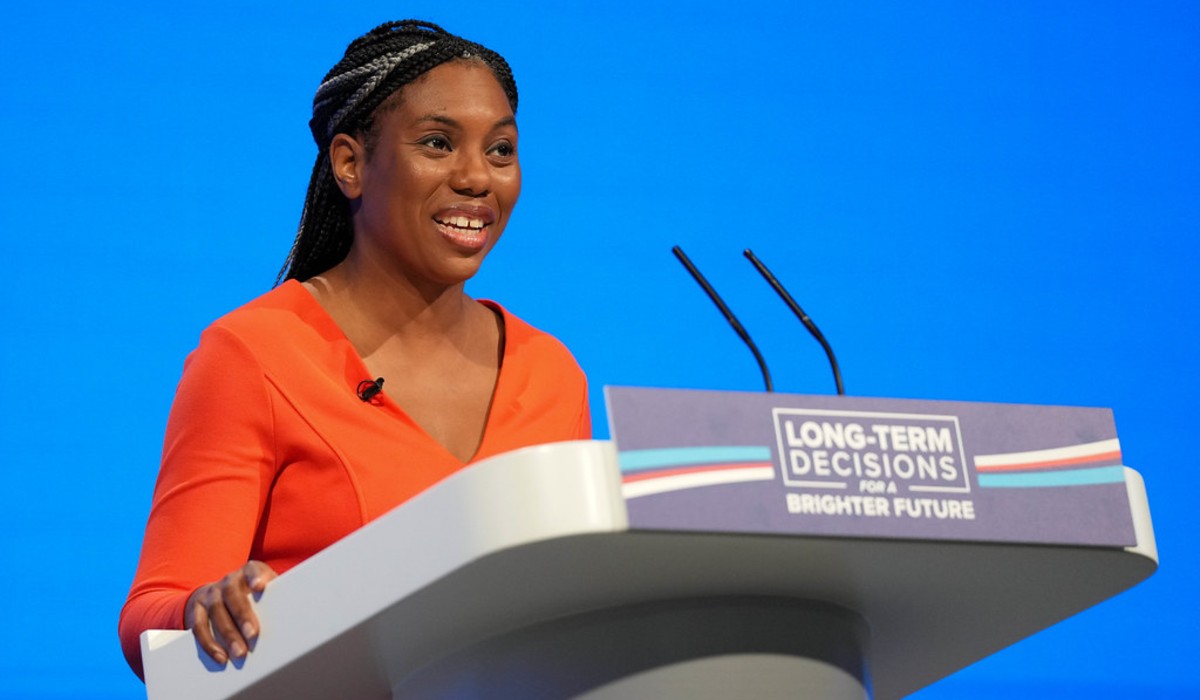
 Kemi Badenoch at Conservative Party Conference in 2023. Photo: The Conservative Party / Flickr / CC BY 2.0
In the wake of the Tories’ latest disaster, Kevin Crane analyses the historically adaptive nature of the party, and why now it’s run out of tricks to get people to vote for their rulers’ interests
Before the English local elections in May, the already desperate-looking Conservative leader Kemi Badenoch told her party to brace for a seriously bad result. This didn’t do a lot to cushion the blow, as the Tories trailed in third behind Reform and the Lib Dems. Those same results will have been a warning to Tories that they were looking at an extremely bleak annual conference, but you can tell the impact of this event will have been no easier for them to brace themselves against.
The defining image of Tory conference is of empty auditoriums, with the biggest humiliation probably being that of the Shadow Chancellor, Mel Stride, unveiling party’s new post-defeat economic strategy to almost no one at all. Badenoch has been on the media making a few squirmy attempts to claim that the apparent emptiness of the event is just fewer business lobbyists attending this year due the party being out of office, but this is fooling no one. The Tory Party is having a crisis of membership and morale, and it is worse than literally any they have ever had before.
It’s really no surprise that the party’s membership can’t get excited about new policy announcements, when the obvious response the majority of Brits are going to give to proposals about slashing stamp duty or doing even-deeper benefit cuts is simply going to be. ‘If that’s such a good idea, why didn’t you just do it when you were government?’ The problem of burn out among membership is made many, many times worse than it would have been in previous decades, by the sharp decline in the membership numbers. In past decades, local Conservative Associations were among the largest voluntary organisations in Britain, so even in the wake of a heavy defeat like 1997, there would still be members willing to turn up and participate. Today, there are just 123,000 card-carrying Tories, probably the lowest number since mass party membership began in the later nineteenth century.
From civil-war losers to natural party of government
The historic nature of the Tory crisis is difficult to overstate. This is a political party that is almost the same age as the British state itself, and it was one of the most effective electoral machines of all time. Toryism goes right back to the seventeenth century and represented the efforts of the most counter-revolutionary, backward elements of the ruling class to try to restrain changes in society that were being brought about by the rise of capitalism and the growth of modern politics. The project’s aims have not remained the same, but the organisation proved to be very adaptable and innovative, hence it’s long-term success.
Despite its origins as a Royalist ruling-class faction, the Tories were able, at several points, to reinvent themselves and reorientate how they related to ruling-class interests, remarkably surviving intact through the arrival of mass politics, unlike most of their European equivalents, into the twentieth century. They adopted the formal name ‘Conservatives’ in the 1830s and, after the Second Reform Act in 1867, which widened the franchise beyond the middle class, were able to establish a mass base amongst the middle and even working classes by selling conservatism as a popular ideology. This relied on appealing to a British nationalism built around support for monarchy, the old aristocracy and Empire, as well as an established-Church identity that was hostile to Catholics and non-conformist Protestants.
The specifics of Toryism were always less important than the core aims, though, and the party was willing to adopt changes if it couldn’t beat them. It was originally, for example, solidly against free trade, but ultimately grew accustomed to it when it was clear that the ruling class would benefit as a whole. As time wore on, it adjusted much further, ultimately accepting ideas about welfarism as Labour took over from the Liberals as their main rival, as well as replacing religious sectarianism with anti-white racism as it’s favoured means of keeping the working class divided.
It can be quite difficult for us today to imagine how fundamentally normal it was for people to be in the Tory Party. By the 1950s, they had over three million members and had completely seen off their historic rivals in the Liberal Party (which survives today, much diminished, as the Lib Dems) as the ‘natural party of government’. Never at any time did Labour have this many individual members: it could only be considered comparable in size by counting the numbers of people in its trade-union affiliates (which, to be fair, did strongly favour Labour in the twentieth century).
The ‘property owning democracy’
Margaret Thatcher’s radical changes to the Tory Party from 1979 onward are best understood as another example of the party successfully reinventing itself to better perform it’s pro-upper-class agenda. Obviously, a huge component of Thatcherism was its aggression towards class enemies – particularly the trade unions – but another crucial plank was to shift away from the welfarism that the British state had been forced to incorporate to contain the working-class movement. As part of her mission to ‘change people’s souls’, as she put it, was to encourage as many Britons as possible to see themselves as little capitalists with wealth-accumulating assets. The vehicle for this was housing, and it was successful at what it set out to do.
Through measures like giving ‘right to buy’ to social-housing residents and the freeing up of credit for mortgages, the Tories substantially increased homeownership in Britain. This encouraged significant numbers of people to turn away from fundamentally quite collective notions of citizenship and economic security and be substantially more invested in the individual matter of the value of their properties. Since many of the cultural attachments that people had to Toryism were in hard decline by the late twentieth century – Britons were much less religious, less socially conservative, less deferential to old elites and also less racist – the idea of ‘homeowners party’ was vital to reconstructing the party’s mass base.
The project was so effective that not only did Labour not attempt to reverse these policies during the Tory wilderness years of the late 1990s to the 2000s, but that even during this bad time for the party, their total number of voters rose steadily as more and more of the (mostly white) population eased into seeing themselves first and foremost as owner-occupiers. This gradually growing base eventually enabled them to oust Labour marginally in 2010 and then deliver a shockingly successful re-election half a decade later, despite the deep unpopularity of the party outside of its core demographic.
In 2015, the leftwing social geographer Danny Dorling went so far as to say that the Conservatives had taken on the features of a single-issue party, it being so narrowly focused on promising to keep house prices rising, come what may. The following year, however, an issue that the party had been trying to suppress suddenly jumped up the priority list: Europe.
The Brexit debacle
David Cameron’s changes to the Conservatives, once he became leader, were less shocking than Thatcher’s had been. He was lucky enough that the credit crunch hit at the perfect time for him to use it to justify bringing in austerity economics, which was what the British business and financial elites were calling for at the time. He just needed to soften the party’s cultural image. So, he made some liberal-ish moves such as legalising gay marriage and promising to take climate change seriously. Those measures did push a certain layer of deep Tory reactionary out into the arms of Nigel Farage’s Ukip, even amidst the victory of 2015, it was clear that the Tories needed to be a little concerned about their right flank.
Cameron thought he had the perfect solution for this: he’d crushed the Lib Dems with a referendum on voting reform in 2011 and defeated the Scottish Nationalists on a (significantly more contested) referendum in 2014. So, it made sense to Cameron to try to head Ukip off by calling the Brexit referendum … and as we know, it ended his prime-ministerial career.
Europe had been divisive issue in the British ruling class, and therefore the Tory Party, for at least thirty years by the point that Brexit actually rolled round, and it was one of the factors which led to them becoming so dysfunctional in the 1990s. The leadership of the Tories, firmly tied as they were to the dominant forces in the City of London, were actually opposed to leaving the European Union, but there were big-money interests like hedge funds that did not agree. The bigger problem for the party, though, was that its mass bass was also very anti-EU, and they made heroes out of oddball MPs like Jacob Rees-Mogg who agreed with them. A serious breakdown of their cross-class coalition loomed, and the Tories lost their parliamentary majority in an unforced snap election.
After Theresa May, an establishment Remainer now insisting she was on the Leave train, made an absolute hash of trying just to carry on with the austerity agenda and an unclear Brexit plan, in the face of a left-led Labour that the ruling class was horrified by, it was clear that the Tories needed another big reset. Enter Boris Johnson.
Making a winning coalition…
Ever since he’d become a national political figure, Johnson had always been clear that he was a ruthless pragmatist who would do whatever it took to be prime minister. He, infamously, converted to the cause of Brexit purely because he realised it was a way to build his own power. In 2019, he managed to snatch the office without public election by taking over from an exhausted Theresa May and instantly set about restructuring the Tory Party in ways that were comparable to the determination of Thatcher, but with very different programmatic intent. He expelled an unprecedentedly large number of MPs from the party – including high-profile grandees – and shut down parliament via a ‘prorogation’ that was legally dubious, but very popular with a lot of the public because it seemed to demonstrate his slogan of ‘Get Brexit Done’.
Labour by this point, of course, was plagued by self-sabotage coming from its own deep establishment, as they were viciously trying to get rid of Jeremy Corbyn’s leadership. We really didn’t have any right to act surprised that Labour lost the 2019 general election: given that on one side you had Labour divided against itself and with an intentionally incomprehensible Brexit policy (curtesy of Keir Starmer, of course), while on the other, the Tories looked to have reinvented themselves, yet again.
Johnson won a resounding victory on a Brexit-focused populism that converted large numbers of former Labour voters to Conservative and, in a major upset, given traditional voting patterns, winning the largest number of previous non-voters. In some respects, this was the election that finally broke Labour’s claim to traditional social-democratic voting, since it saw party preference massively divert from social class. The scale of Johnson’s victory was absolutely remarkable … but so was the short period of time he got to enjoy it.
Johnson had a good pandemic in the immediate aftermath of the election, even though his actual judgement throughout was very poor, it’s notable that the public largely didn’t blame him for it, and government approval ratings were shockingly high throughout. At the Tory conference 2021, as we all were moving back into a lockdown-free life, he seemed so utterly dominant in both his party and the country that the pundits were speculating that he might be running the country for many years. I don’t think any of us realised he wouldn’t lead either for another ten months.
…and then unmaking it
The Conservatives turned their great victory to ashes in a series of moves that were basically all unforced errors. Johnson burned significant goodwill via a series of unpopular manoeuvres to defend politicians that were personally loyal to him, even after they’d been caught committing serious breaches of parliamentary codes or just sleazy behaviour. On past performance, Johnson should have found such things survivable: his career had prevailed despite numerous scandals before. But something had very much changed. Tory staffers and senior civil servants started taking much more critical lines on him. A torrent of revelations about him and his breaking Covid-19 social distancing at Number 10 were made public, and embarrassing stories about him lying were given to the BBC.
Now, it could be the case that all these Whitehall bigwigs had suddenly realised that this man was a bit dodgy. It’s unlikely, given that his political career had basically been launched by a past scandal involving a friend of his in prison, who wanted him to hire a hitman, as revealed on Have I Got News for You in 1998. It is more likely that powerful, if incoherent, factions of people from the Tory elite had decided to stop tolerating him.
The Johnsonite coalition had been tolerated by Tory grandees as a way to head off a radicalised Labour Party, but they did not wish to tolerate him for long. Critically, Johnson just wasn’t committed to continued austerity, because he knew perfectly well that the public was pig sick of it, and favoured big state spending on lavish projects (his ‘levelling up’ agenda) in the glory of which he could bask. Gradually, over the spring and summer of 2022, Johnson and his allies tired of the internal war of attrition, and he conceded to step down and be replaced.
If Conservative grandees had assumed that getting rid of Bojo the Clown was going to be as smooth as sweeping away Cameron and May when they were spent forces, however, they rapidly got a nasty shock. The favoured candidate to replace the man who’d won the election was Rishi Sunak, a quintessential continuity austerity candidate, but the membership just wasn’t having it, which is what gave us the combination of tragedy and comedy that was Liz Truss’ month-and-a-bit in Number 10. She famously was given enough rope to hang herself: making the stupidest economic move she could think of and then binning her off once the international financial markets gave the pound the big thumbs down.
It’s easy to forget that the political-media establishment were thrilled once Sunak was firmly installed in Truss’ place (I remember the presenters of Radio 4’s PM were giddy with joy), because reality hit his administration so hard and so fast. Johnson was proved right about austerity: it just wasn’t popular. To make matters worse, thanks to the economic shocks that had now been caused by letting Liz Truss run wild with fantasy libertarian tax cuts, the backstop of support the Conservatives had relied on up from their supposed guardianship of a sound, reliable property market was also gone. Sunak’s main innovation to try to shore up his support was to lean in on anti-migrant racism by propagating social panic about ‘stopping the small boats’, which has been shifting attitudes to the right, but not getting the Tories more votes.
The Farage factor in 2024 was the biggest single reason why the Tories lost so, so many seats, but this too was the result of the Tories’ own mistakes. In 2019, Nigel Farage realised that Boris Johnson’s capacity to assemble a populist right-wing coalition far outstripped his own, so he took a pragmatic decision not to run against sitting Tories and thus fight the election in a sort of undeclared alliance with Johnson. Once Johnson was binned and his voter coalition was fracturing, Farage realised his smarter move was to go completely the other way and hammer the Tories, which has very obviously paid off.
Ultimately, the Conservative Party is on the floor because it does not have a clear way to serve its fundamental purpose of persuading a mass base to support bourgeois goals. It lacks any obvious path to get back to doing that, even in the long term. Since they have rejected breaking with austerity, they present no attractive economic alternative to Labour. Kemi Badenoch proposes measures like removing stamp duty and giving first-time home-buyers cash handouts, in an obvious bid to regenerate the ‘property-owning-democracy’ strategy, but the housing scheme is likely too close to decomposition for that make much impact.
The only thing anyone is likely to remember from this year’s conference is Badenoch’s leadership rival, the somehow even less charismatic Robert Jenrick, making astonishing racist remarks about there being ‘no white faces’ in parts of Birmingham. Remarks which, of course, the Nigerian-descended Badenoch felt compelled to defend. All the Tories currently do is provide legitimacy to the hard-right shift that is going on in British politics, and this makes them very much part of the problem in a society in which the threat of fascism is rising.
Before you go
The ongoing genocide in Gaza, Starmer’s austerity and the danger of a resurgent far right demonstrate the urgent need for socialist organisation and ideas. Counterfire has been central to the Palestine revolt and we are committed to building mass, united movements of resistance. Become a member today and join the fightback.
