
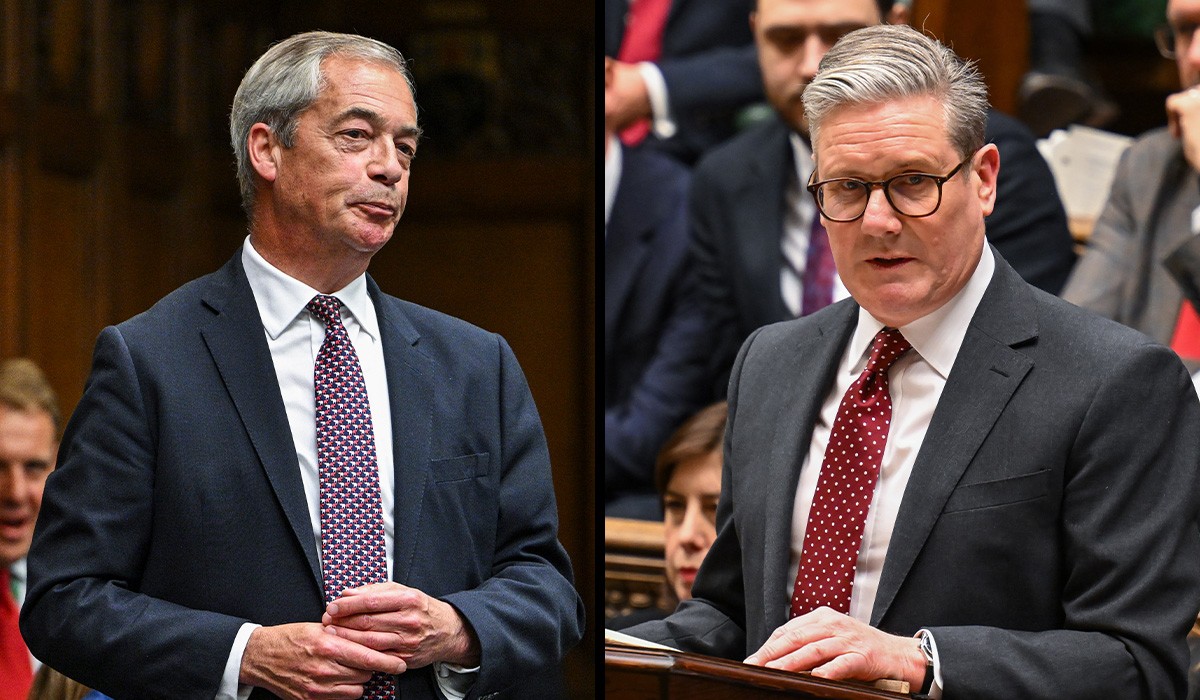
 Nigel Farage, Keir Starmer. Photos: House of Commons / CC BY-NC-ND 2.0
There were two significant elections results this week, in Caerphilly and for the position of Deputy Leader of Labour, that exposes the pressure on both Starmer and Farage. Kevin Crane explores the dynamics
The Caerphilly by-election has shattered a consensus shared across virtually the whole of the British political and media establishment received some serious blows. Since the general election last year (yes, it feels longer, doesn’t it?) the narrative is that the Labour Party is the only political force that has hope of standing against a coming Reform UK juggernaut. This vision has been talked up endlessly by both of the sides concerned. Nigel Farage’s camp pushes this narrative because they want everyone who is looking for a protest against the establishment to vote for his far-right challenge, while Keir Starmer’s camp pushes it because they want literally everyone who is opposed to the far right to vote for him as the champion of the establishment.
The corporate and state media’s preference for ideology over facts was on clear display on election night. The only reason why they’d been giving the race much attention at all was because they had assumed that Reform’s polling meant that the party was poised a surefire win, which would reinforce the narrative that Farage’s upstarts are sweeping the nations and can now win anywhere. The seat being contested was in the Senedd, the devolved parliament of Wales, so it would normally be regarded as a trivial issue by London-centric elite journalists. Their fixation on Reform is such that even once the result was in and it was clear that Plaid Cymru had won a clear victory, they swarmed straight past the newly elected member and descended upon their preferred candidate anyway.
The warm goodwill was still cold comfort for the Reform candidate, though, as he too had clearly believed that his victory was utterly assured. You would have to have a heart of stone not to laugh at the photograph of him staring in stunned disbelief, and the fact that he flounced away from the count – Liz Truss style – without giving his customary post-result speech.
This was breathtaking entitlement from a man who was ultimately running for a new party in a seat that had never previously returned non-Labour candidates. He assumed he was just going to stroll into an easy victory and had already invited both Farage and Lee Anderson to a soon-to-cancelled victory rally. It shows how confident the far-right party had been feeling, and their disappointment might just indicate that this confidence has become excessive.
Has Reform peaked too soon?
Since Farage finally made his big comeback just before the 2024 election, Reform has been making gains with virtually zero setbacks. Although they ‘only’ won five MPs (still a breakthrough in British politics), the absolute carnage they wrought on the Tories was undeniable. They essentially stole the base of the old party right from under its feet. The May elections this year enabled them to land a second catastrophic blow on the Conservatives, snatching away local authorities from them that the Tories had simply never lost before. That time, however, Reform also inflicted humiliating defeats on Labour, particularly overturning a large and historic majority in the Runcorn by-election.
From the summer onwards, Reform’s polling has reached levels that no party outside the Labour-Tory duopoly has had for a century. The media has consistently reinforced the appearance of a new, dynamic government-in-waiting as if it’s just destiny. Farage, and to a lesser extent his other MPs, are invited to give opinions on every topic of the day as if they were already the official opposition, despite that role still being held by the Tories and the Lib Dems having fifteen times as many MPs. This is the context in which Reform people have started to view untested propositions like winning the Welsh valleys as done deals.
The uniformity of media opinion obscures an important fact about both Farage and his party: they are hugely divisive, and a large proportion of the country absolutely hate them. The base of Faragism is large in British society: significant numbers of overwhelmingly white people, across social classes but mostly older, are open to racist arguments and apparent opposition to political conformity, wrapped in a vaguely libertarian standpoint. Something the party may now be struggling with, however, is its distinct lack of crossover appeal.
Nigel Farage has always tapped into a populist racism, which for most of the past couple of decades has seen him coyly being the guy who said (or at least strongly implied) bigoted things mainstream politicians wouldn’t dare to. The changed conditions of the past few years have caused that to shift. As society has descended deeper and deeper into crisis in the wake of the Covid-19 pandemic, the establishment has leant harder and harder on the politics of racial division in order to divert popular discontent against itself. That has, in turn, meant that politicians who appeal to racism have both opportunity and cause to crank things up a notch.
The result has been a major toxification of discussion of race in the country, typified by the Tory leadership wannabe Robert Jenrick complaining about too many non-white people in Birmingham, or Reform’s Sarah Pochin complaining about too many non-white people on TV. Statements like this would have been career-ending gaffes in the recent past, and the fact they aren’t now is the public signal that we have entered a new period of racist threat in society. It is one in which racial prejudice, abuse and violence are rising.
Racism is not rising without opposition, however, because not everyone in Britain is a racist, or even tolerant of racism. Millions of Britons were horrified by the anti-immigrant and anti-Muslim pogroms that broke out last Summer (as was widely noted mostly in areas that had just registered big Reform votes). Mass demonstrations against racism followed those riots, and these were evidence that plenty of people are totally opposed to Reform on the basis of its hate-filled politics. Plaid Cymru’s leader, Rhun ap Iorwerth, explicitly and proudly cited his party’s open rejection of Faragism as crucial to their success in Caerphilly.
Someone else who realises that Reform most likely can’t form a government on the basis of racial prejudice alone is Farage himself. He has always had to do something of balancing act between giving his core vote the “red meat” they crave, while maintaining distance between himself and fascist forces he knows he wouldn’t be able to control. He consequently finds race riots and street mobilisations like Tommy Robinson’s “Unite the Kingdom” march tricky to remain aloof from while he tries to win the votes of the people involved in them. He also tries to reach beyond that thuggish hardcore by floating populist policies on other issues – such as proposing to nationalise steel manufacturing and the water utilities – but that’s not straightforward either, because committing to full anti-austerity policies would put him on a collision-course with elite financial interests that he personally identifies with. This slipperiness does annoy some people, such as the right-wing TV host Jeremy Clarkson, who has grumbled on social media that Farage’s economic policies amount to saying “I want lower taxes and higher spending” and changing the subject back to immigration before anyone points out this makes no sense.
Farage’s superficially smooth rise to power has, on closer inspection, been a complex process of managing conflicting elements, much of which might have been impossible without the significant institutional support Farage relies upon from the media. The Reform leader has to be the most aggressive mouthpiece for anti-immigration policies, while also appearing to be outside the political system by also saying he addresses other concerns people have, that – like steel and water – have very obviously nothing to do with immigration. Racism and xenophobia are crucial to the unity of the project, but Farage can’t allow the party to give into the full fascist tendencies of much of the base, causing him to awkwardly fudge his position on whether he agrees with his own MPs that only white people ought to be on the telly.
Holding a set of difficult contradictions together is one thing when you are experiencing rapid success, as Reform has done expanding its base of support this past year and a half. The problem that Caerphilly may indicate, however, is that this period of growth may have reached its end. Statistical evidence is that Reform’s polling of around 35% may be a saturation point, which is to say anyone else who hasn’t been persuaded to vote for them may never be persuaded. Since no one knows if the next general election is going to come any sooner than 2029, that puts Reform in the difficult position of trying to hold its voting coalition together over a significant length of time. A lot of things are going to happen both in Britain and worldwide in the next four years, and the landscape might look very different by then, particularly if Reform are faced by an enemy that isn’t simply the expression of establishment power.
Could Labour turn things round?
Making fewer headlines than the Senedd by-election last week was the outcome of Labour’s widely ignored deputy leadership election. The sheer apathy that met this contest was telling in itself: in 2020 Angela Rayner was elected to the post with 192,168 votes, which is thirty thousand more than were cast for either candidate combined at this election. Although we do not have up-to-date Labour membership figures and it isn’t clear what portion of votes came from trade union affiliates, we’ve been told it was a 16% turnout, so the decline of activist engagement in the party is on full display.
Despite the fact that the two candidates – near identical both in appearance and political orientation – are very much both losers, the formal winner was Lucy Powell. This is bad for Keir Starmer as she was one of the sacrificial lambs he got rid at the end of the summer as part of the launch of “phase 2” of his government, and now he’s stuck with someone who’s looking to settle scores against him on the party’s national executive committee. And she may get a chance to settle those soon, because it is possible that he will be finished in politics in just a few months.
The collapse of the Tories – as mentioned, partially as a result of the Reform offensive against them – gifted Starmer a huge parliamentary majority. He has accomplished absolutely nothing with this, unless you count the acquisition of personal gifts and freebees from super-rich donors. His pre-election promises of an ‘economic focus’ translated into instant and relentless commitment to austerity, which makes most people poorer while doing nothing to improve the day-to-day economy or infrastructure of the country. This has been combined with a wider agenda of utterly reactionary policies – most dramatically his support for Israel throughout the Gaza genocide and his absurd over-extension of the anti-terror laws – which have alienated voters in basically every demographic you can name. His sudden proclamation of mandatory digital ID cards, a murderously unpopular move that will cost millions in taxpayer’s money, has only deepened public opposition.
Starmer has become, by all measures, the most disapproved of prime minister since records began. Under the guidance of shadowy advisors like the widely despised Morgan McSweeney, Starmer is incapable of giving any response to anything that is not a further shift to right. He positions himself as the only possible alternative to Nigel Farage, but also as the more competent and efficient implementor of Farage’s policies.
If the man’s slowed down on this front, it’s in part because he hasn’t really got any further to go in that direction. His response to the successes of Reform at the May elections was to give the single most xenophobic anti-immigration speech ever given by a British leader – the infamous Island of Strangers address – which he later had to give a rather pathetic apology for. The ‘deep regret’ he claimed to feel was less likely to have anything to do with the genuine hurt and fear he’d caused to members of ethnic minorities, than it was because his advisors had realised that resorting to Nigel Farage-style rhetoric doesn’t win Labour voters over from Reform, it just turns off supposed Labour voters.
Labour’s polling has collapsed along with Starmer’s approval ratings and is currently below 20% according to many of the major analysists, with further problems looming as Starmer’s hapless chancellor Rachel Reeves looks set to drop an absolute stinker of a budget in November. Her now-signature combination of tax increases and spending cuts is the inevitable result of this party making an ideological commitment to never redistributing wealth and pretending to believe that trickle-down economics has ever worked.
Even the most die-hard centrist media figures who had until very recently been devoted supporters of the prime minister have begun publicly accepting that his premiership is a disaster, with people like Andrew Marr making that rarest of admissions “I was wrong to support him”. A leadership challenge is as good as certain at this point, because they can’t carry on like this.
Who’s next?
There are, however, several major problems with replacing Starmer, the most basic of which is: who can actually lead? Almost all members of the current cabinet are as disliked by the public as the current leader is, and previous leadership hopefuls like Lisa Nandy and Jess Phillips have wrecked their images with shocking behaviour, such as Nandy lying to parliament that Israeli football hooligans were being banned from entering Birmingham because of antisemitism, and Phillips completely alienating sexual abuse victims in a botched enquiry. Angela Rayner had been a partial exception, with subtly better opinion polls, but the tax avoidance scandal that caused her to resign from the cabinet appears to have knocked her out for the foreseeable future.
One cabinet member who’s clearly got his eye on doing a coup on Starmer is health secretary Wes Streeting, who has been making very specific interventions to distance himself from Starmer for the past few months. He broke the official omerta on the forced starvation of Gazans before the government had officially denounced it, and this past week has been willing to call out Reform’s Sarah Pochin as racist, despite the Starmerite line still being not to do that because it will supposedly prevent Labour from taking back Reform votes.
It’s not impossible for Streeting to succeed, but two huge factors work against him. The first is that he’s massively electorally vulnerable, having held on to his East London seat by a majority of just 528 votes against a charismatic pro-Gaza independent. The second is that you really don’t have to look very far to see that his actual politics represent no fundamental deviation from Starmerism. Streeting is a rabidly pro-privatisation politician, heavily funded and influenced by American business interests. His leadership would be a lot more of the same.
The pretty-popular mayor of Manchester, Andy Burnham, is currently the main hope for the Labour left… or what passes for a Labour left these days, anyway. He is also a longshot though, for the simple reason that he’s not currently an MP. It’s no secret that he is currently seeking to do a deal with an older politician, who’d be willing to step down from their seat to trigger a by-election for Burnham to stand in. Time was that this would have been breathtakingly easy in the Northwest of England, but the extreme decline of mainstream politics has turned this into a somewhat dicey gambit. Burnham might struggle to win the seat that’s been cleared for him. Even winning that battle, though, would only be the start of a very big war.
A challenger who seeks to overthrow Starmer will trigger weeks, if not months, of political chaos, potentially even worse than when the Tories ousted Boris Johnson in 2022. While Starmer himself would almost certainly decline to re-contest the leadership election: even if he doesn’t accept his career in politics is over, his advisors will be forced to tell him. That wouldn’t, however, change the fact that the majority of the 401 current Labour MPs don’t really differ from Starmer’s political views on much of anything, having been promoted and selected via a ruthlessly factional party machine controlled by the right.
If Burnham or some other leftish figure did become leader, forming a functioning government would itself be a challenge. The total number of MPs affiliated with leftwing or centre-left parliamentary groupings is only around thirty individuals, in contrast to the hard-right “Labour Growth Group” which has more than fifty MPs and will fight hard to prevent any change in the party’s course. All this is before the even more difficult clash with very powerful forces within the British state, like the Treasury and the Bank of England, that are dead set against lifting austerity.
So, a leftwing turn in a post-Starmer Labour Party is not impossible, but it is both uncertain to happen and uncertain to deliver much actual improvement. What it most likely can’t do is fully reverse the decay of the party, which is basically now Labour-in-name-only. Working class people, and even trade unionists, have not been significantly more inclined to vote Labour than any other social class since 2019. The job of work the party would need to do to restore its historic roots is colossal, and potentially impossible, particularly while running a government that is presiding over massive economic and social crisis.
As I say, it is not even guaranteed to happen, with right-wingers in the party, led by Rachel Reeves, floating an alternative in the form of rekindling the Brexit debate. This is a move that simply takes Starmer’s framing of “it’s us or Reform” and reframes the premise away from a contest over who’s the most radically anti-immigration. It would replace that with a reenactment the period from 2016 to 2019, which similar coalitions of middle-class orientated forces. It’s desperate stuff, but then, they are desperate.
Learning better lessons – an independent left challenge can win
The left needs to completely reject the idea that there is anything inevitable about right-wing Labour and Reform UK being the sole, binary political choice ahead of us. If the shock win in Caerphilly wasn’t enough evidence, look at Ireland where the socialist presidential candidate Catherine Connolly won a resounding victory, despite the growth of the far right inside the country and against fierce condemnation from the political and media establishment. We need to look also at the way that the French left managed to score a surprise victory last year, when the centrist president Emanuel Macrom tried to perform the same “me or the fascists” manoeuvre as Starmer is currently doing here and they proved him hilariously wrong. There are even signs that the German Die Linke party is significantly rebuilding it’s support as a principled anti-systemic alternative that also opposes the far right.
Over the next few years, there will be various attempts to try and discipline leftwing forces in Britain into falling in behind Labour, particularly if a more serious reformist like Andy Burnham manages to get into to Number 10. We should be arguing that not only can we do better, but we have an active duty to do so. It is not sufficient to tell working class people that is their duty to continue to suffer and get poorer as a sacrifice to keep Nigel Farage out of power. To this end, we should continue to work with initiatives like Your Party to build an alternative, as well as working with less radical forces, be they Greens or the national parties in Scotland and Wales, where they are willing to stand up against racism and the far right.
Before you go
The ongoing genocide in Gaza, Starmer’s austerity and the danger of a resurgent far right demonstrate the urgent need for socialist organisation and ideas. Counterfire has been central to the Palestine revolt and we are committed to building mass, united movements of resistance. Become a member today and join the fightback.
