
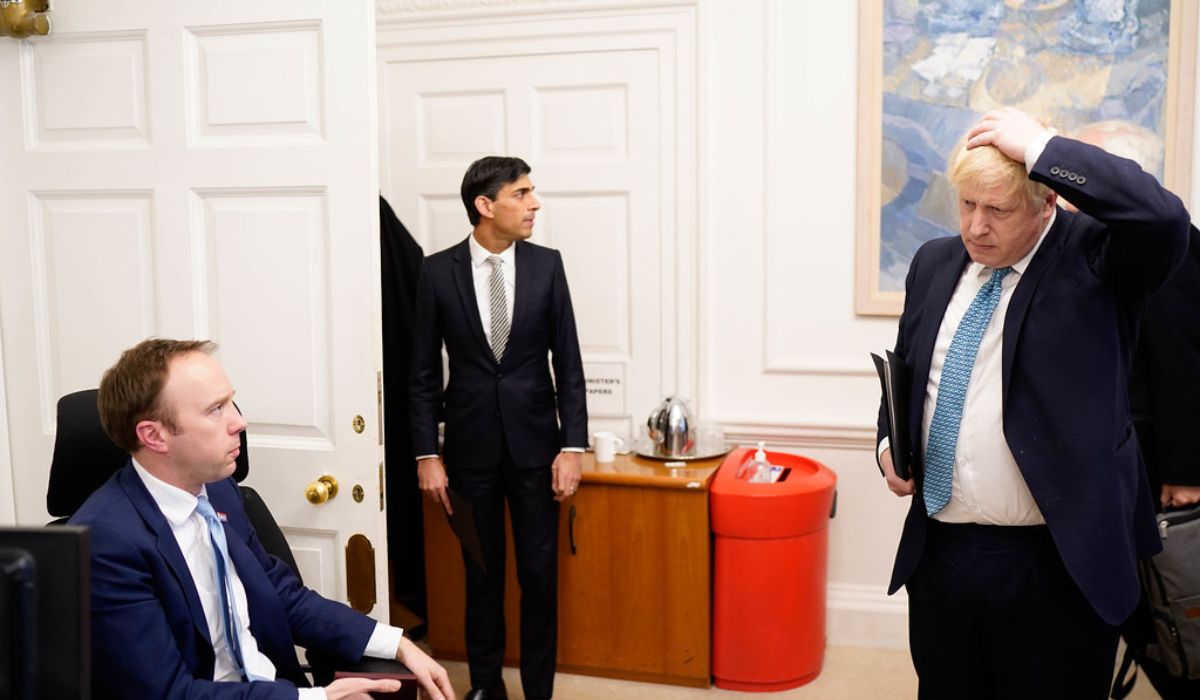
 Boris Johnson is joined by the Rishi Sunak (middle) and Matt Hancock after a Coronavirus press conference at No10 Downing Street.. Source: Andrew Parsons - No 10 Downing Street - Flickr / cropped from original / CC BY-NC-ND 2.0
The report from the Covid Inquiry that Johnson’s government was disastrous, as many of us knew, but we are in a no better position now, argues Terina Hine
It has taken almost six years to reach the official conclusion that Boris Johnson’s government did ‘too little too late’ during the first phase of the Covid pandemic. The Johnson government oversaw the worst public-health disaster in a century, with over 230,000 deaths, and as Heather Hallett’s report makes abundantly clear, many of those deaths could have been avoided.
Hallett’s damning report may highlight what many of us already knew: that Downing Street was toxic and chaotic, with decisions not backed by data and a prime minister recklessly complacent. We have known for some time that Johnson chose to spend the critical month of February at his country retreat, neither being briefed nor attending emergency Cobra meetings, and the scandal of the Downing Street parties only underlined his indifference and arrogance.
As the bereaved Covid families said, the ‘same arrogance that led those at the heart of government to hold parties while many of us died and grieved alone shaped the government’s approach to the pandemic, and led to loss of life at an unprecedented, avoidable scale.’
However, our being aware of the appallingly cavalier attitude and its consequences does not lessen the importance of an official report which clearly recognises government failure during a national emergency.
Johnson, his chief adviser Dominic Cummings and former health secretary Matt Hancock do not emerge well. Cummings, it says, ‘poisoned the atmosphere in 10 Downing Street’ and Johnson ‘did not seek to restrain or control Mr Cummings, nor did he exercise proper leadership’, instead Johnson was indecisive and failed to take heed of mistakes. The report does note that Cummings was responsible for the subsequent change in strategy, thus saving lives. As for Matt Hancock, the report raises concerns not just about his overpromising and underdelivering, but also about his reliability and trustworthiness.
Although the chances of Johnson, Hancock or Cummings reviving their political careers remain at near zero, one senior official implicated in the government’s deadly handling of the pandemic not only remains in government but has since been promoted by current PM Keir Starmer. Chris Wormald is now the cabinet secretary, the UK’s most senior civil servant. Wormald, who in 2020 was permanent secretary at the Department of Health, is accused of failing to ‘rectify’ Hancock’s overconfidence. The report questions the effectiveness of Wormald’s leadership. It appears this is yet another inappropriate Starmer appointment.
The usual suspects have, of course, come out of the woodwork to say lockdowns should never have happened. Hallett herself suggests lockdowns may indeed have been avoided, or at the very least been considerably shorter, had the government acted earlier and faster, a point not lost on many of us campaigning at the time. But it is clear that, having failed to implement crucial measures such as social distancing and quarantine measures earlier, there was no choice but to lock down if many more thousands of deaths were to be avoided.
Had the lockdown been brought in just one week earlier, on 16 March, deaths in the first wave would have been reduced ‘by 48% – equating to approximately 23,000 fewer deaths’ in England, Hallett concludes.
The lack of testing capacity was also heavily criticised, leading to officials having no real knowledge as to how far and wide the virus was spreading. They also failed to develop an exit strategy after the first lockdown. Instead, we had Rishi Sunak’s disastrous ‘Eat Out to Help Out’ scheme, and very little attention was given to the dangers of a second wave.
As I said in my book, A People’s History of Covid: ‘The extraordinary decisions taken in the early days of the pandemic, and the dial set to repeat in the second wave, reveal a failure of state that is difficult to comprehend. Government action and inaction, from the discharging of untested patients into care homes to the delayed lockdowns, resulted in thousands upon thousands of unnecessary deaths that is nothing short of criminal.’
All of this was compounded by a lack of pandemic preparedness, decades of cuts and increasing rates of poverty and marginalisation. It is important that individuals are held to account and that lessons are learned, but if we want a different outcome in the next pandemic, we need more than just a change in leadership.
Hallett’s report may help going forward; let’s hope so. But so far, almost six years on from those dark days of February 2020, we are still unprepared, not just for the next pandemic but for the winter that is now upon us.
Before you go
The ongoing genocide in Gaza, Starmer’s austerity and the danger of a resurgent far right demonstrate the urgent need for socialist organisation and ideas. Counterfire has been central to the Palestine revolt and we are committed to building mass, united movements of resistance. Become a member today and join the fightback.
