
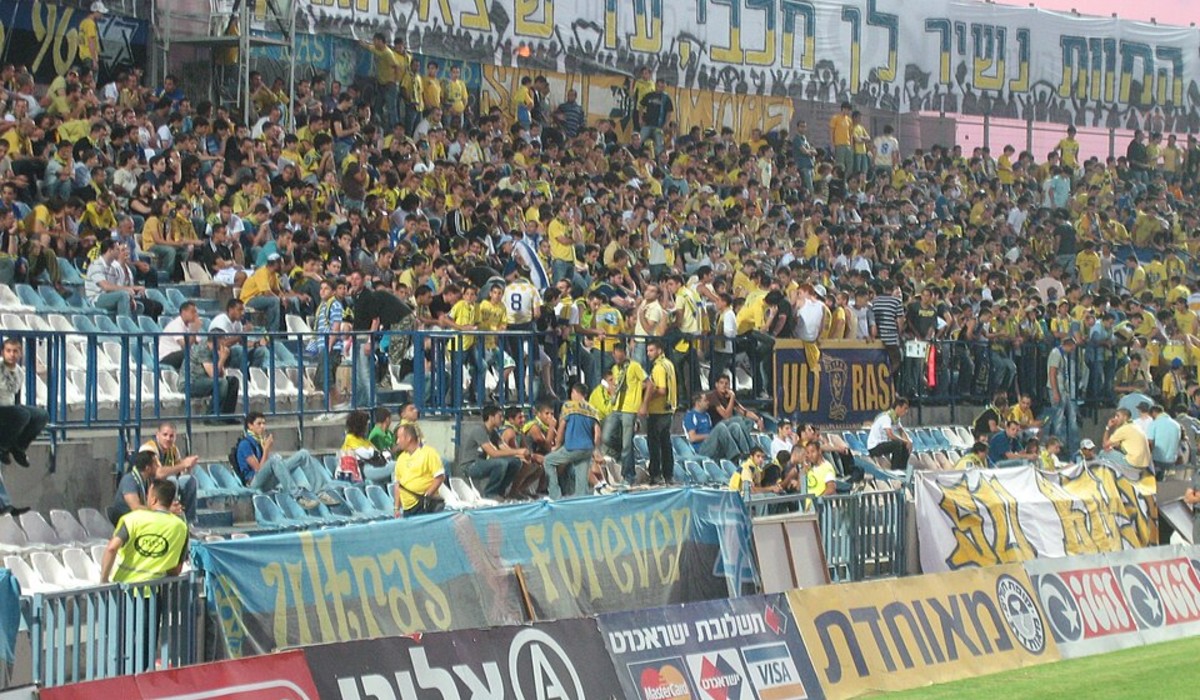
 Maccabi Tel Aviv fans. Photo: Yellow up / Wiki commons / CC3.0
The government has turned on the West Midlands police force to reboot its narrative of anti-semitism, argues Zahid Rahman
In the last few days, West Midlands Police has come under attack from politicians and large sections of the media establishment over its decision to ban Maccabi Tel Aviv supporters from attending a football match in Birmingham last November. Under massive pressure, the West Midlands chief constable Craig Guildford has resigned.
A report ordered by the Home Secretary, Shabana Mahmood, alleges that West Midlands Police failed to consult the Jewish community despite claiming that it had done so; that it “over-exaggerated” the threat posed by Maccabi’s supporters; and that it relied on artificial intelligence that created a non-existent precedent match between Maccabi Tel Aviv and West Ham United.
Health secretary Wes Streeting stated that he would be “horrified” if Guildford had not stepped down. More importantly home secretary Shabana Mahmood publicly announced that she had lost all confidence in him. This is the first time in twenty years that a home secretary has called for the resignation of a serving chief constable.
Yet the central decision under attack, the banning of Maccabi Tel Aviv supporters was not only defensible, but correct. There are two overriding reasons for this.
First, whatever the mistakes made, the reality is Maccabi Tel Aviv supporters have a well-documented reputation for far-right violence and racism. In Amsterdam in November 2024 hooligans were filmed tearing down Palestinian flags, attacking local residents, and chanting genocidal slogans such as “death to Arabs” and “there are no schools in Gaza because there are no children left in Gaza.” These actions provoked clashes with local residents in the days up before and after the games.
In the aftermath, large sections of the media and political establishment attempted to reframe the events as “antisemitic” violence, with some going so far as to describe them as “pogroms.” The framing was deeply cynical. Sky News, for example, quietly removed an initial video report that documented the violence carried out by Maccabi supporters, replacing it with footage that recast them as passive football fans under unprovoked attack.
Against this history, the decision to prevent Maccabi Tel Aviv supporters from entering Birmingham was a matter of public safety. Birmingham has one of the most diverse communities in the country with huge numbers of people from ethnic minorities, including Muslims. Having thousands of hooligans, known for their anti-Arab and Islamophobic bigotry, converging on Birmingham would mean putting British residents at real risk.
There is also the more general point that Israel is currently committing a genocide in Gaza, despite the sham ceasefire. Tens of thousands have been killed with images of civilian suffering dominating our screens for over two years. Israel is an apartheid state, a conclusion reached by respected human rights organisations including Amnesty International and Human Rights Watch. Allowing Israeli teams or their supporters to participate in international sporting events helps to normalise these crimes, crimes that the Israeli public has consistently shown either outright support for or indifference to in polling.
Sport has never been politically neutral. The rapid exclusion of Russian and Belarusian teams from international competitions following the invasion of Ukraine in 2022 demonstrates this clearly. Israel should be treated no differently. Banning the team itself rather than merely its fans would have been the more principled position.
However the political and media class went on to launch a campaign absurdly depicting the ban as an attack on Jewish people as a group and motivated by antisemitism. The attention given to the barring of fans was highly disproportionate; the BBC even went as far as to provide live updates on the political situation regarding what would usually be seen as a minor issue. Ministers spoke against the ban in interviews and within parliament. Following the ban’s announcement, Starmer promised to do “everything” possible to get it reversed. Ironically, a day or two after that statement, authorities in Israel had cancelled a match involving Maccabi Tel Aviv following the behaviour of those same supporters. The ban remained in place on 6 November when Aston Villa played Maccabi Tel Aviv in Birmingham.
The misuse of AI and the allegations of exaggerating threats found in the report are worrying. They point to systematic problems with the police in general. But the main driver of this whole cynical affair is the government’s support for Israel. After two years of genocide the impact of using antisemitism to supress criticism of Israel was declining. The government decided to seize on events around the Maccabi game to reboot the antisemitism narrative.
Birmingham, with its large Muslim population, was the perfect setting. The Muslim community has been an important bastion of anti-imperialist organisation, and reporting of this incident has been deeply islamophobic. The community has been portrayed as an extremist, anti-semitic monolith. The use of words such as “islamism” and “integration” by pundits and politicians has been common. The British far-right came out against the Maccabi ban and some even attended the game in Birmingham to demonstrate this.
The forced retirement of the West Midlands chief constable was the result of a campaign by the government to tighten its control over Britain’s police forces. Government ministers cannot sack police chiefs directly, for now that power remains solely in the hands of the Police and Crime Commissioners across England and Wales. The government has announced plans to give the home secretary powers to enact sackings. This is one more example of the government’s increasingly sharp authoritarian turn and will mean police forces will become even more repressive.
The controversy over the Maccabi Tel Aviv ban is less about public safety than about the state’s support of Israel. The banning of Maccabi fans was necessary to protect Birmingham’s residents. The attack on the chief constable is a warning of the government’s growing desire to centralise power over the police, to criminalise dissent, and to weaponise culture-war narratives against communities and movements critical of Israeli policies. This episode shows an ambition to increase the politicisation of policing and the continued efforts to conflate palestinian solidarity with antisemitism.
