
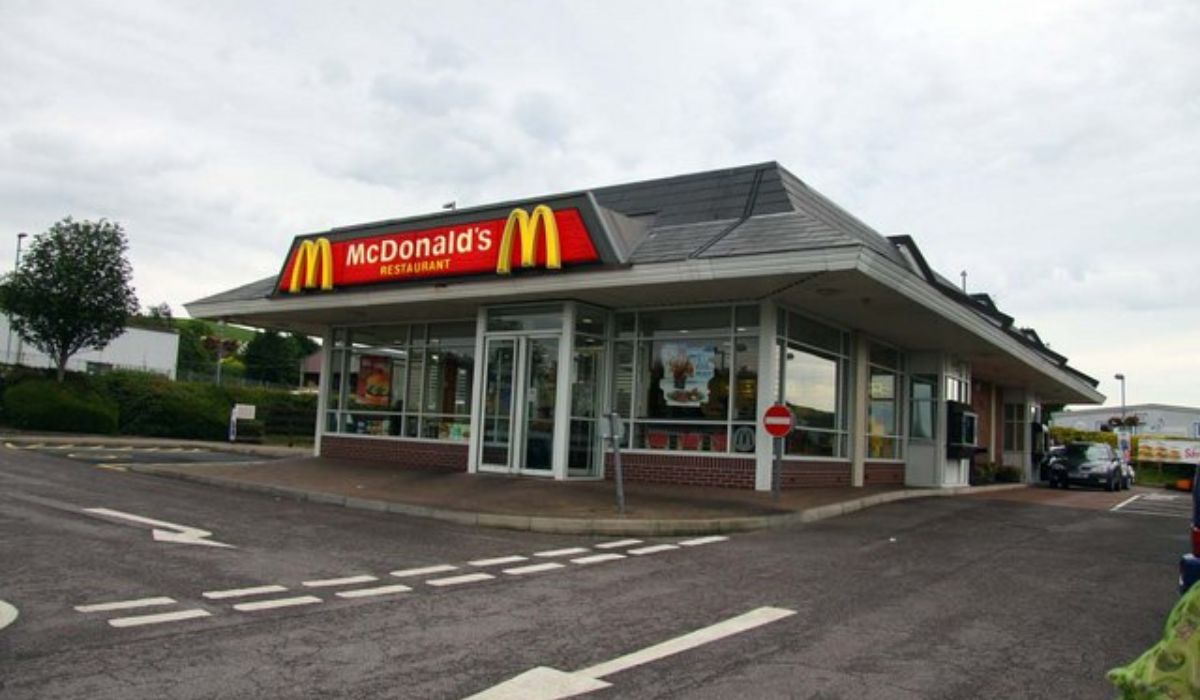
 McDonald's restaurant in Barnstaple. Source:
Mark Steel’s radio series exploring the ten-year-long McLibel case, in the context of historic campaigns and protests, is inspiring, finds Judy Seymour
This is a series of six 25-minute programmes in which the key figures, Helen and Dave (Greenpeace volunteer activists), single-dad Dave’s little boy, Charlie, plus a young aspiring film maker who borrows her dad’s posh camera to record it all, head to court 35 of the Royal Courts of Justice where Helen and Dave go head-to-head with the global McDonald’s corporation over libel claims. About what? About distributing leaflets or ‘the joy of having conversations with people you don’t know and won’t necessarily share opinions with – which is why it’s good’ as Helen says.
On we go into a nightmare world where corporate security personnel are ex-police officers still very much in contact with their former colleagues. A police informer is outed on camera years after the event. McDonald’s spends somewhere in the region of $10,000,000 on the libel case, and Helen and Dave get pro-bono help from Keir Starmer. It was a gruelling experience: at one point, Helen and Dave describe life as ‘the disappearing light at the end of the tunnel’. It is a true story of two Davids and a Goliath.
It all begins when five Greenpeace members are issued with a writ by McDonald’s for distributing a leaflet that fulsomely criticises McDonald’s credentials. Rescind or be taken to court! Three submit, but Helen and Dave refuse to bow to bullying.
Actually, this series doesn’t start here. It starts with a sweep that covers activism from the 1960s and through to the present day, establishing its intention of situating this story in the recent history of opposition to injustice. I like to be reminded of acts of resistance – especially those that triumphed, like Greenham Common, which is mentioned. The first Glastonbury where Bowie played for free is also mentioned, anti-Vietnam war protests, and Can’t Pay, Won’t Pay The Fight To Stop The Poll tax, are all also part of the story.
Inevitably, one thing can lead to another, and MI5 responds to the Grosvenor Square protest against the Vietnam War by requiring Special Branch to set up the Special Demonstration Squad (top secret even to other police forces) to infiltrate mainly progressive left groups. This becomes a core and horrible element of Helen and Dave’s story. In fact, the SDS investigated over 1,000 groups between 1968 and 2008: peace groups, animal-rights groups, anarchists, anti-apartheid groups, trade unions, hunt saboteurs, even the family of Stephen Lawrence. Especially given recent events, the story is a barely concealed warning about things that are almost certainly happening now.
The case
Back to the radio series. Five Greenpeace activists decide to mount an information campaign, using McDonald’s as an example of what’s going on in the corporate world. They produce and distribute leaflets citing sixteen issues of concern. For example, McDonald’s, they allege, is, amongst other things, a key player in animal cruelty in the beef industry. It contributes to the destruction of the rainforest. It trades on disinformation regarding the nutritional value of their products, mistreats its workforce through exploiting zero-hour contracts, and targets small children with its advertising. At first, a few hundred of the leaflets are photocopied and distributed, making this information public. Then, impressively committed volunteers organise an international day of action and succeed in getting the leaflets distributed worldwide.
In the meantime, Margaret Thatcher has her picture taken with Big Mac in her constituency of Finchley. From here, we are led through revolving doors, and hey, her constituency manager becomes head of communications for McDonald’s.
Next, a man from the golden arches delivers writs to five of the Greenpeace activists – the writs tied up with a pink ribbon. Withdraw the anti-McDonald’s leaflet and apologise, or otherwise be taken to court!
Two activists refuse to bow down, and so to a legal battle that lasted from 1991 to 2005. As many as 40,000 documents, 20,000 pages of testimony, closing speeches that lasted for almost the whole of autumn 1996, and 292 days in court: the longest trial by one day in English history since 1874. A final judgement that ran to 900 pages. And throughout, Helen and Dave represent themselves in court, interrogating 71 witnesses who stand for McDonald’s and finding and briefing 59 who testify for them.
This is only a small part of the story. We also meet a 28-year-old Keir Starmer, who gave the Greenpeace activists pro-bono support. Helen reflects that yes, ‘he seemed to care passionately about justice and fighting injustice and perhaps more fundamentally about freedom of speech.’ He seemed also to care that legal aid wasn’t available for libel cases because, he said, it ‘creates a real risk that criticism will be stifled’. He went on to help them again in 2000 when they launched an action against Her Majesty’s Government in the European Court of Human Rights, calling for greater protections for freedom of speech on issues of public interest, and for legal aid when defending libel cases, including those taken by multi-national corporations.
As Mark Steel says of the case brought by McDonald’s: ‘It all seems so surreal and utterly pointless.’ Exactly. And still, an important listen. Not least so that you’re extra careful about what you write in your leaflets and are willing and able to stand up for them if confronted.
I can’t complete this review without expressing my deepest respect for Helen and Dave, who took the fight on despite the threat of personal bankruptcy and the anguish of fourteen years confronting the full force of McDonald’s infinite power to purchase any amount of help they wanted. During this period of time, forty organisations had been sued and all had backed down. Helen and Dave didn’t. They will be forever lodestars in the struggle for justice, and Mark Steel goes down in broadcasting as a teller of stories with soul.
Before you go
The ongoing genocide in Gaza, Starmer’s austerity and the danger of a resurgent far right demonstrate the urgent need for socialist organisation and ideas. Counterfire has been central to the Palestine revolt and we are committed to building mass, united movements of resistance. Become a member today and join the fightback.
