
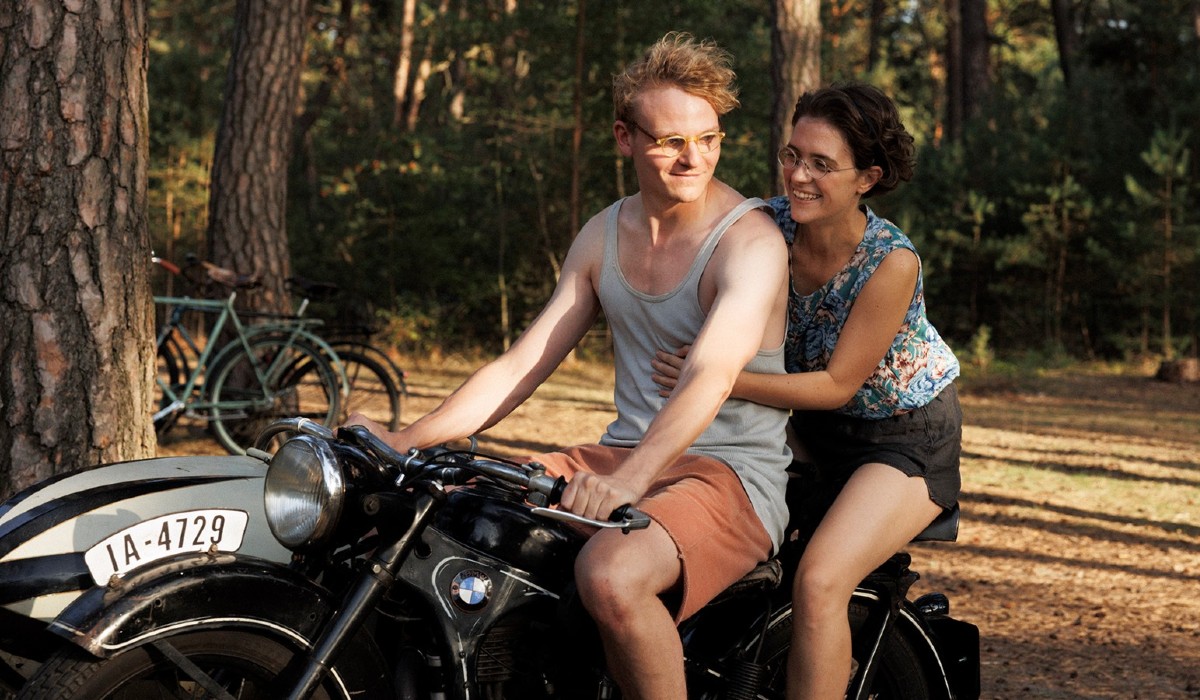
 Scene from From Hilde With Love
A moving and personal story of brave anti-fascist resistance in 1940s Berlin, recommended by Des Freedman
From Hilde, with Love is an understated and incredibly moving account of a group of resistance fighters in Berlin during World War Two. It focuses on the trial of Hilde, one member of a small group of activists, the Red Orchestra cell, who put up anti-Nazi stickers, printed anti-war leaflets to leave on public transport and tried to communicate with Moscow using coded messages.
This is an anti-fascist film without jackboots, swastikas or dramatic displays of violence. Instead, there’s an eery quiet on the streets and a calm on the trains where they carry out their work. The group meet in a lovely lakeside campsite that suggests bucolic summer holidays more than feverish plotting against the Nazis.
Hilde is one of the more recent members of the cell, recruited because of her touch-typing skills. She falls in love with Hans, who is desperately trying to communicate with the families of Russian-held POWs using shortwave radio.
There’s an uncanny, and at times simply unrealistic, ordinariness to the lives of the protagonists even as they carry out acts of immense bravery. The Gestapo officials and jailors who populate the film are seen as meticulously bureaucratic rather than overtly violent, yet still punishing the cell members in the harshest possible ways.
Liv Lisa Fries puts in a remarkable performance as Hilde who is transformed through her resistance work from a shy office worker into a resilient and confident activist. She bears her responsibility as a new mother in jail with the same determination as her commitment to learning Morse Code.
Politics in the grand sense is oddly missing from the film. There’s the occasional comment about property being a ‘bourgeois category’ and a critique of monogamy but mostly the cell members get on with their duties without fuss or drama.
At times this makes for a frustrating journey despite the utter horror of the circumstances and yet Hilde’s resilience in the face of such bureaucratic torture is immensely impressive and utterly unthinkable.
In many ways, this resonates with Hans Fallada’s equally understated 1947 novel Alone in Berlin which tells the story of a working-class Berlin couple who leave anti-Nazi postcards in staircases, alleyways and offices across the capital. These are the small and seemingly fruitless acts of civil disobedience that took place even at the height of Nazi power and for which the perpetrators received the cruellest treatment.
Hilde, and her fellow youthful activists in From Hilde, with Love seem to see no alternative than to stand up to the regime even if its horrors are not on show in the film itself.
This might, for some, be a film that lacks drama and context; others will appreciate the more individualized traits of absolute commitment, determination and bravery that underscore director Andreas Dresen’s portrayal of resistance heroes who were major figures in the East Germany in which he grew up.
It’s a hard watch in every sense but stories like this – performed without pizzazz and fuss – are rare and worth commemorating.
From Hilde, with Love is in cinemas now.
Before you go
The ongoing genocide in Gaza, Starmer’s austerity and the danger of a resurgent far right demonstrate the urgent need for socialist organisation and ideas. Counterfire has been central to the Palestine revolt and we are committed to building mass, united movements of resistance. Become a member today and join the fightback.

Des Freedman
Des Freedman is Professor of Media and Communications in the Department of Media and Communications at Goldsmiths, University of London. He is the co-author of 'The Media Manifesto' (Polity 2020, author of 'The Contradictions of Media Power' (Bloomsbury 2014), co-editor of 'The Assault on Universities: A Manifesto for Resistance' (Pluto 2011), and former Chair of the Media Reform Coalition.