
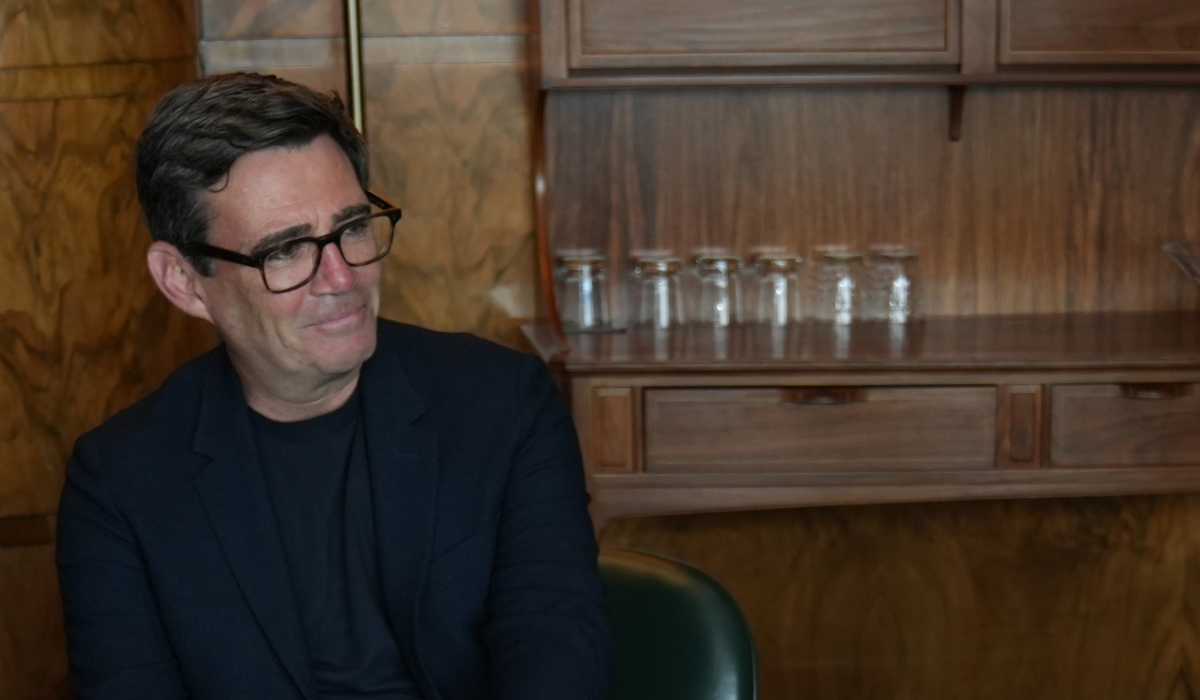
 Andy Burnham at Holyrood, August 2023. Photo: Flickr/Scottish Government
Lindsey German on the government’s latest leadership phase and a breakthrough in anti-imperial internationalism
So it looks like Keir Starmer is accepting it’s the end and walking away from Downing Street. Andy Burnham’s victory in the Makerfield by-election was just too strong and decisive for there to be any equivocation or backsliding from the true Starmerites. They could not claim that Reform came close to him, nor that the combined votes of Reform and the even more right-wing Restore Britain were more than his. He scored well ahead of the far-right candidates together. That has left Starmer no wriggle room.
The by-election itself was remarkable, not least because its avowed aim was to unseat the sitting prime minister and replace him with Burnham. The whole pitch of his campaign was to promote himself as the agent of change – with no reference to Labour or indeed to any policies – and presenting himself as an alternative to mainstream politics. In this, he was highly successful.
The election was also a remarkably poor night for Farage’s Reform. You can blame this on the candidate – a pretty obnoxious sexist even by far-right standards – or on Burnham’s unique appeal, but there is beginning to be a pattern here. Reform is ahead in the polls and did very well in the May local elections, but it is doing less well in by-elections. It lost in Caerphilly last October, it lost in Gorton and Denton to the Greens earlier this year and has now been trounced in Makerfield despite winning many council seats there only just over a month earlier.
Reform has a big general following but translating this into votes in any particular situation is harder, and there is a widespread opposition to the party and to Farage. The campaigning on the ground not to vote Reform by groups like Stand up to Racism is a part of this. Growing familiarity with Reform’s politics and its politicians also plays against them. And Farage is haunted by Restore Britain, which is taking votes from Reform from the right and may be sufficient to split the far-right vote in an election and save some Labour seats.
However all this pans out, Makerfield showed a very big far-right vote which has to be confronted politically. Obviously Burnham benefited from a very large tactical vote to keep Reform out. But as a strategy it fails. Tactical voting may work in one by-election but it cannot solve the problem of the far right growing. That’s because the main electoral parties help to pave the way for fascism and the far right, and adopt many of their policies, especially over immigration and racism, which only serve to legitimise them. In addition, those parties then demand that socialists who oppose those policies have to get behind them as the only alternative to fascism.
So while it is welcome that Reform was defeated, we all know that this is one small step on the road to routing them. This takes organisation to challenge and defeat racism and fascism, like we saw with the Together demo in March, the mass protest in Belfast following the pogrom there, and the many local demos against the fascists. Fundamentally we have to attack the roots of these ideas and the conditions that give rise to their popularity.
Here Burnham is talking about change, but what does he really mean by this? The truth is that already the ruling class and its faithful spokespeople in the media are stressing that Burnham must not frighten ‘the markets’, that if he wants to spend then he needs to cut pensions and benefits, and that he should not have Ed Miliband as chancellor because this would be seen as too much of a challenge to the status quo. So he may try some level of nationalisation – for example for the deeply unpopular and greedy water companies – but will be constrained by strict self-imposed borrowing rules dictated by the banks and finance industry.
We need to put as much pressure on Burnham to change course and deliver for working-class people in a way that Starmer did not. The overwhelming sense one gets in all these electoral contests is a profound distaste for establishment politics and politicians, who are seen as incompetent and corrupt; real misery for working-class people over housing, work, price rises and unemployment; and a sense that the whole of society is in crisis. To even list these issues is to demonstrate how inadequate Burnham’s response to them will be.
Therefore it will be essential that through trade unions and campaigns we put as much pressure as possible on a Burnham Labour government to deliver for workers. Unless this happens, the path to a Reform government lies open. And the paralysis that has characterised Starmer’s past two years will be there at least in part because Labour fears the capitalist class and therefore will not want to challenge its priorities. Not least over the attempt to shift from welfare to warfare.
Internationalism takes centre stage
The massive conference against war held in London on Saturday was a big step forward for the movement. Around 3,000 people attended in two packed halls to listen to speakers from the Middle East, Europe and North America. People were in attendance from dozens of countries and cheered to the echo the representatives of the Palestine movement who opened the conference.
Its importance is in the building of a mass movement against war and rearmament, especially across Europe whose rulers are demanding endless money for ‘defence’ and callously demanding cuts in living standards to working class people in return. Crucial to this will be the trade union movement, represented at the conference by over 100 local supporting branches in Britain, and many national unions, as well as delegations from unions in France, Spain, Germany, Greece, Italy and Canada.
The argument for this is the supposed Russian threat that is being used to militarise Europe on an ever-greater scale. Yet Russia is bogged down in Ukraine and is in no position to launch a war across Europe. The drive to war is coming from the western Nato powers determined to strengthen their positions and defeat Russia in the proxy war in Ukraine.
We are approaching a moment like 1914, when an arms race and imperialist rivalry led to millions dying for no purpose. Stopping that has to be the priority for everyone on the left and in the trade unions. Doing so would also be a blow to the racism which comes from war, and to the attacks on living standards we are all facing. The declining US empire is in a very dangerous place. Trump has been defeated in Iran, the Middle East is in turmoil following the Gaza genocide, and we face greater instability everywhere.
This week: We are having a steering committee to help build Stop the War following the conference. I am also looking forward to hearing Louise Raw talking about East End women on Tuesday as part of the Cable Street series. And on Friday I’m catching the wonderful Brecht play Mother Courage at the Globe theatre.
Before you go
The ongoing genocide in Gaza, Starmer’s austerity and the danger of a resurgent far right demonstrate the urgent need for socialist organisation and ideas. Counterfire has been central to the Palestine revolt and we are committed to building mass, united movements of resistance. Become a member today and join the fightback.

Lindsey German
As national convenor of the Stop the War Coalition, Lindsey was a key organiser of the largest demonstration, and one of the largest mass movements, in British history.
Her books include ‘Material Girls: Women, Men and Work’, ‘Sex, Class and Socialism’, ‘A People’s History of London’ (with John Rees) and ‘How a Century of War Changed the Lives of Women’.