
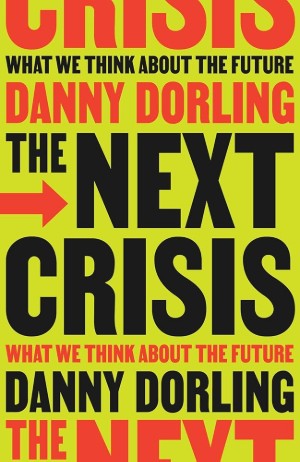
 Danny Dorling, The Next Crisis: What We Think about the Future (Verso 2025), 336pp.
The Next Crisis is an informative work well worth reading but it leaves to us to create solutions to capitalism’s crises, finds Stephen Carlill
This book is not an attempt to forecast the future. Its subject is current anxieties and their consequences. By analysing the results of opinion surveys covering much of the world’s population and official statistics, Professor Dorling provides numerous insights into reality and our often somewhat distorted perceptions of it.
Climate change is way down most people’s ranking of concerns, with the cost of living and inflation being at the top. The well-informed sort of people who read Counterfire are unlikely to be surprised by this. Equally, we are probably conscious that the repeated raising of the issue in very alarmist terms has led to some cynicism about the seriousness of the threat and how quickly action is needed. However, many of us will be surprised to read that one adult in eleven in the UK believes that climate change is a hoax (p.167). Also, as most of us lead busy lives, we might not have noticed that climate change is blamed for problems which would occur anyway. Climate change or no climate change, if we cover lots of land with buildings and hard surfaces, we can expect flooding in low-lying areas unless we install suitable drainage systems.
The author goes through the same process of setting the record straight for other concerns. He is especially interesting on poverty and inequality.
He takes to task economists who confidently assert that worldwide extreme poverty has been falling continuously, more than halving the number of people in extreme poverty since the 1960s (p.30). He demonstrates that this is almost all due to reductions in the number of children born to poor people. He similarly casts doubt on claims that the world is becoming more equal, pointing out that inequality has greatly increased in China and India. Figures for the latter from the United Nations University indicate that in the five years to 2021, the incomes of the poorest households reduced by 53%, while the incomes of the wealthy increased by 39% (p.44).
Closer to home, the incomes of most Europeans are not keeping pace with inflation even in times when inflation is low. This process has gone furthest in the UK. Dorling partly attributes this to a myth that incomes are becoming more equal. ‘Conservative Chancellors … in most of the budget speeches of the past decade’ have chosen to compare incomes in a way that will ‘exclude the poorest tenth and the richest tenth of all people (page reference). If you ignore the best-off 10% of people in the UK, who take about 40% of income every year … you could indeed claim that inequalities have decreased among the rest of us’. When the same ploy was used by a presenter on Radio 4 and a listener complained, the complaint was rejected because ‘the programme met BBC standards for due impartiality’ (p.49).
The rise in inequality has been slowed were there has been determined resistance, as in France over the state-pension age, or where inequality is seen as a major problem to be tackled, as in most of Scandinavia. Nevertheless, the trend is crystal clear: the current economic system is not delivering for the vast majority of Europeans. We might have expected Professor Dorling to conclude that the system needs to be changed to bring the means of production under democratic control. He does not do this but instead advocates a wealth tax, which hardly tackles the underlying problem of a small number of people snaffling everything they can. His conclusion seems to depend on him giving weight to what your reviewer regards as comparatively trivial. For example, CEOs’ salaries are now only 100 times the median earnings of their companies’ employees, down from 120 times and, ‘In many [unspecified] places in the world inequalities have been falling’ and China’s inequality ‘may have reached a peak’ (p.44). Fiddling with these margins will not solve the social crisis in which we find ourselves, we need to replace the whole system.
Before you go
The ongoing genocide in Gaza, Starmer’s austerity and the danger of a resurgent far right demonstrate the urgent need for socialist organisation and ideas. Counterfire has been central to the Palestine revolt and we are committed to building mass, united movements of resistance. Become a member today and join the fightback.
